



The US executive talent landscape is witnessing a profound paradigm shift, particularly within the finance function. Emerging enterprises and high-growth ventures are increasingly vying for the sophisticated expertise traditionally cultivated within the Big 4 accounting firms. Understanding precisely why Big 4 partners consider startup finance leadership roles is paramount for developing effective recruitment and retention strategies.
Author Archives: Jeremy Gleason
executive recruiting, Executive Search Challenges, For Employers, PE Recruitment Challenges
Recruiting Finance Executives with AI Implementation Experience in Back Office

16
Feb
Feb
The pace of technological evolution, particularly in artificial intelligence (AI) and machine learning (ML), demands a fundamental recalibration of executive talent acquisition within the US corporate landscape. Our analysis reveals that securing AI-fluent finance leadership is no longer a strategic option but a fiduciary imperative for sustaining competitive advantage and driving robust value realization.
executive recruiting, Executive Search Challenges, For Employers, PE Recruitment Challenges
The Evolution of the Treasurer Role in a Volatile Interest Rate Environment

16
Feb
Feb
The contemporary financial landscape, particularly within the United States, is characterized by persistent volatility in monetary policy and a dynamic interest rate curve. This environment demands a fundamental re-evaluation of the treasury function, transcending its historical operational focus. The pertinent question for every US corporation today is: How has the treasurer role evolved beyond traditional cash management?
executive recruiting, Executive Search Challenges, For Employers
How to Structure an Effective Equity Package for a Top CFO

16
Feb
Feb
In today’s dynamic business landscape, the Chief Financial Officer (CFO) has evolved beyond a mere financial steward to become a critical strategic partner and value architect. Attracting and securing this elite caliber of financial leadership requires a sophisticated and well-calibrated total compensation strategy, particularly concerning long-term incentives.
executive recruiting, Executive Search Challenges
Hiring for Turnaround and Restructuring Expertise at the C-Level

16
Feb
Feb
In an increasingly volatile and complex global landscape, the demand for truly exceptional C-level leadership capable of navigating profound corporate distress and initiating rapid transformation has reached a critical zenith. At , we observe a distinct paradigm shift: the ability to secure and effectively deploy such executive talent now represents a core geo-strategic imperative for US enterprises facing significant.
executive recruiting, Executive Search Challenges, For Employers
The Board’s Role in Financial Oversight and Executive Accountability

16
Feb
Feb
In today’s intricate and fast-evolving US economic environment, the fundamental role of a corporate board in upholding organizational financial integrity and ensuring robust executive accountability has never been more paramount. Boards serve as the ultimate custodians of a firm’s fiscal health, orchestrating resilient frameworks, demanding transparent reporting, and guiding judicious capital allocation.
executive recruiting, Executive Search Challenges, PE Recruitment Challenges
Case Study: The 100-Day Plan for a PE-Backed CFO

13
Feb
Feb
The appointment of a Chief Financial Officer in a private equity (PE)-backed enterprise marks a pivotal moment, demanding immediate impact and a clear trajectory toward value realization. This confidential analysis delves into the strategic imperatives and operational blueprint for a newly appointed PE-backed CFO, exploring What should a newly hired PE-backed CFO accomplish in the first 30, 60, and 100.
executive recruiting, Executive Search Challenges, For Employers
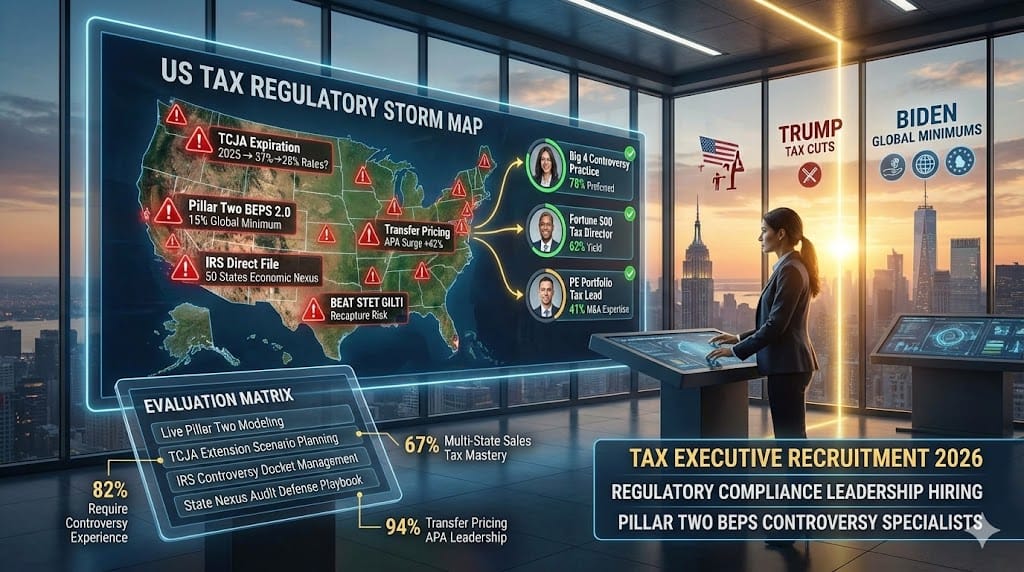
Recruiting Tax and Regulatory Compliance Executives in a Shifting US Landscape
13
Feb
Feb
As GLOBAL HEAD OF RESEARCH & LEADERSHIP ADVISORY at , a premier US-based executive search firm, I am presenting a critical analysis regarding the evolving executive talent landscape for tax and regulatory compliance leadership. The traditional perception of these functions as purely operational or ‘back-office’ is fundamentally outdated.
executive recruiting, Executive Search Challenges
Why Your Next VP of Financial Planning & Analysis (FP&A) Needs Data Science Skills

13
Feb
Feb
As Global Head of Research & Leadership Advisory at , I am consistently tracking the seismic shifts impacting executive talent requirements across the US corporate landscape. A critical observation from our recent analyses and numerous high-level engagements is the evolving mandate for Financial Planning & Analysis (FP&A) leadership.
executive recruiting, Executive Search Challenges, For Employers, PE Recruitment Challenges
The Role of the Finance Executive in Value Creation for PE Firms

13
Feb
Feb
The Strategic Architect: How the Finance Executive Drives Value Creation in Private Equity Firms In the high-stakes environment of US private equity, the finance executive’s mandate has undergone a profound evolution. No longer merely a steward of financial reporting or a keeper of records, the modern financial leader within a PE-backed enterprise is an indispensable strategic partner, intrinsically linked to.