


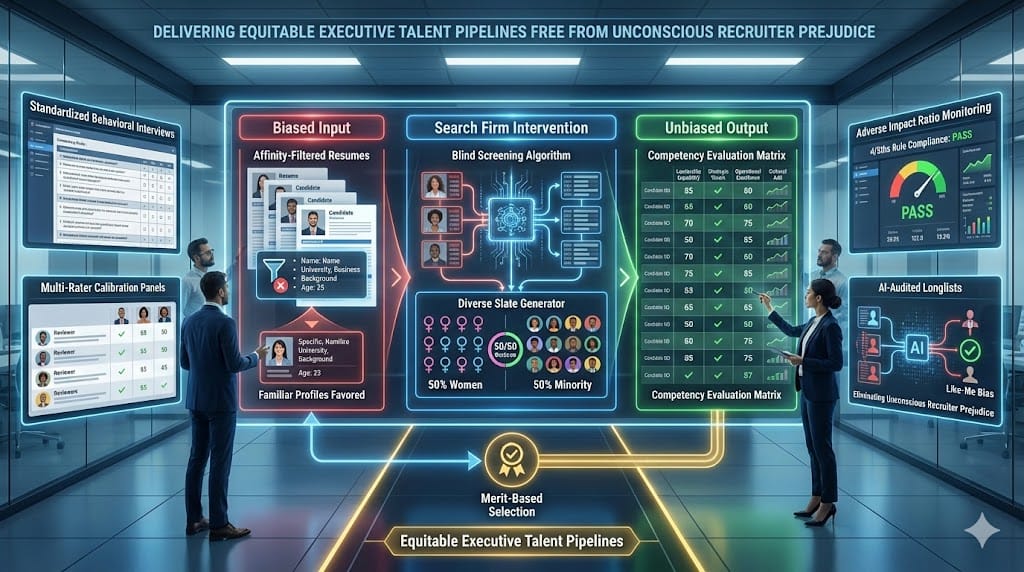
The Search Firm’s Imperative: Dismantling Unconscious Bias in Executive Talent Acquisition
As JRG Partners’ Global Head of Research & Leadership Advisory, I submit this critical analysis on the evolving role of premier executive search firms in fostering equitable talent strategies. In today’s intensely competitive US talent market, identifying and securing truly exceptional senior leadership demands a paradigm shift away from traditional, often biased, methodologies. A key challenge remains: What unconscious biases dominate executive recruiting? Our commitment at JRG Partners is to proactively challenge and dismantle these inherent predispositions embedded within conventional hiring paradigms, ensuring a more inclusive and effective talent acquisition process for our esteemed clientele.
Key Tenets of Our Anti-Bias Framework
- Leading search organizations, such as JRG Partners, are uniquely positioned as impartial arbiters to identify and mitigate implicit preferences in the recruitment lifecycle.
- Systemic process interventions, rather than mere awareness initiatives, are critical for achieving measurable bias reduction and promoting equitable outcomes in leadership appointments.
- Leveraging robust data analytics and objective assessment methodologies transforms subjective ‘gut feelings’ into evidence-based executive selection decisions.
- Proactive collaboration with our clients is essential to embed robust guardrails against bias and cultivate long-term cultural transformation within their organizations.
- Ultimately, the leadership advisory firm’s role transcends mere placement, evolving into the strategic development of a more inclusive talent ecosystem that directly drives superior organizational performance. This aligns directly with a firm’s fiduciary duty to maximize shareholder value.
Bias Identification in Traditional Executive Search
Our analytical approach at JRG Partners begins with a meticulous deconstruction of past recruitment activities. We deploy sophisticated tools to illuminate historical recruitment data, exposing demographic patterns and exclusionary trends that might have inadvertently narrowed talent pools.
- Analyzing historical leadership recruitment data for demographic patterns and exclusionary trends.
- Deconstructing the often-ambiguous concept of ‘culture fit’ to distinguish it from ‘culture add,’ thereby mitigating similarity bias and fostering genuine organizational enrichment.
- Identifying subtle language biases in job descriptions and executive candidate briefs that could inadvertently deter diverse applicants.
Diverse Slate Construction Protocols
JRG Partners employs rigorous protocols to ensure candidate slates reflect the true breadth of available leadership talent. We recognize that conventional networks often perpetuate homogeneity, and our methodology actively counters this.
- Expanding candidate sourcing strategies beyond conventional professional networks and direct referrals, actively seeking out underrepresented groups.
- Establishing clear, data-driven diversity targets for long-lists and short-lists, ensuring intentional equity from the outset of the senior executive search.
- Utilizing advanced AI-driven tools to identify highly qualified candidates from underrepresented groups and non-traditional backgrounds, broadening our outreach capacity significantly.
- Our deep market intelligence helps us address the question: How do search firms construct truly diverse candidate slates? by going beyond surface-level demographics to encompass cognitive diversity and varied career pathways.
Blind Screening and Anonymized Evaluation
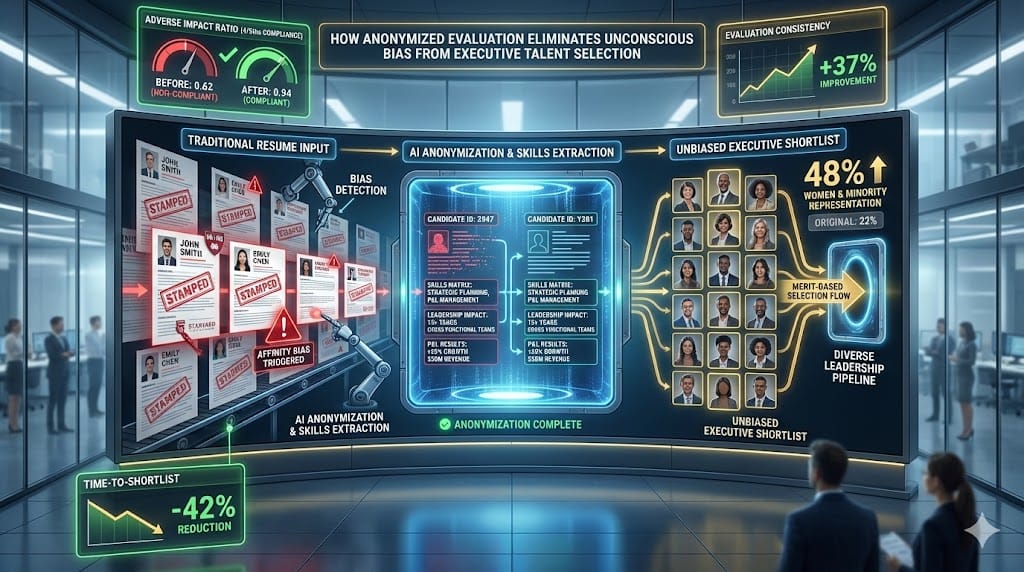
Anonymized evaluation is a cornerstone of our bias mitigation strategy. This step is particularly vital when considering the nuanced question: Which blind screening protocols work best for C-suite roles? JRG Partners’ protocols are designed to ensure initial assessments are based purely on merit and capability.
- Redacting personally identifiable information, such as names, gender, age, alma mater, or specific affiliations, from initial curriculum vitae and professional profiles.
- Focusing initial evaluations strictly on experience, demonstrated skills, and qualifications directly relevant to the executive role.
- Implementing proprietary technology solutions for automated anonymization to ensure unwavering consistency and eliminate human error in the redaction process.
Structured Interview Frameworks
To eliminate subjective judgments, JRG Partners mandates a highly structured interview process. This directly addresses the query: What structured interviews eliminate subjective judgments? Our framework ensures fairness and consistency for every candidate.
- Developing standardized, behavior-based and situational interview questions tied directly to the core competencies and strategic demands of the executive position.
- Ensuring all candidates are asked the exact same set of questions in the same predefined sequence to maintain equity.
- Providing comprehensive training for interview panels on active listening, consistent probing techniques, and critical awareness of their own inherent biases to foster objective assessment.
Objective Scoring Matrix Development
To ensure fairness and reduce subjectivity in evaluating top-tier candidates, we implement a robust numerical scoring system. This addresses the challenge: Which scoring matrices predict unbiased hiring outcomes?
- Creating a numerical scoring system founded upon predefined, job-relevant competencies and strategically weighted criteria.
- Requiring interviewers to provide specific examples and verifiable evidence for their scores, significantly reducing reliance on unquantifiable subjective impressions.
- Facilitating comparative candidate evaluation based on objective, quantifiable data rather than aggregate ‘likability’ or unvalidated personal rapport.
Long-List Expansion Beyond Alumni Networks
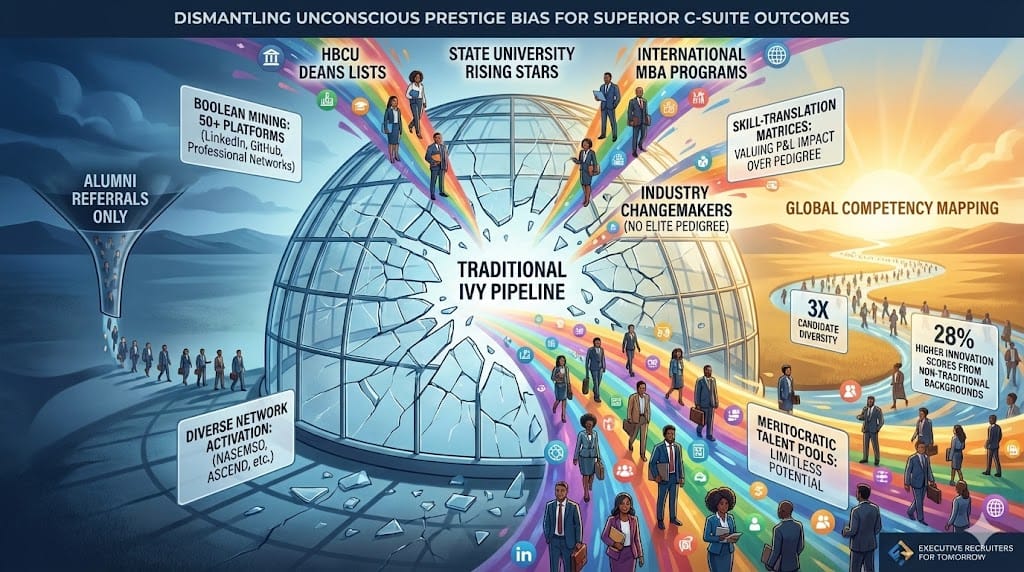
JRG Partners recognizes the limitations of relying on homogenous networks. We actively address: How do search firms expand beyond homogeneous networks? by casting a significantly wider net.
- Actively seeking executive candidates from a wider array of educational institutions, professional associations, and diverse industry sectors across the US.
- Targeting emerging talent pools and communities often overlooked by traditional search methodologies.
- Cultivating strategic relationships with diverse leadership organizations and advocacy groups to access untapped executive potential.
Client Guardrails Against Confirmation Bias
Our partnership extends to educating and equipping our clients to recognize and counteract their own biases. This ensures robust guardrails against bias reintroduction.
- Educating clients on prevalent cognitive biases, particularly the tendency to seek information that confirms pre-existing beliefs or assumptions.
- Implementing “devil’s advocate” challenges during client debriefs to scrutinize initial assumptions and perceptions of candidates.
- Providing objective data and alternative perspectives to balance client subjective preferences, ensuring a holistic and unbiased evaluation. This proactive engagement is key to addressing: What client training prevents bias reintroduction?
Measuring Bias Reduction Through Pipeline Analytics
At JRG Partners, we believe in measurable progress. Our sophisticated analytics track the impact of our anti-bias protocols rigorously.
- Tracking detailed diversity metrics (gender, ethnicity, professional background) at every stage of the recruitment funnel for each engagement.
- Identifying specific points where underrepresented groups might disproportionately drop off, allowing for targeted intervention and process refinement.
- Generating comprehensive reports on conversion rates, time-to-hire metrics, and overall representation to empirically demonstrate the positive impact of our interventions.
Metrics consistently underscore the business imperative of bias reduction:
- Organizations with diverse executive teams are 33% more likely to outperform their peers on profitability, underscoring the business imperative of bias reduction.
- Unconscious bias in hiring can lead to 2x more unqualified candidates being hired over qualified diverse candidates.
- Companies employing structured interview processes are 4x more likely to make a high-quality hire than those relying on unstructured methods.
- Blind screening has been shown to increase the representation of female candidates by up to 25% in initial hiring stages in certain industries.
- Only 15% of executive search firms consistently track and report diversity metrics beyond initial candidate submission. JRG Partners proudly surpasses this industry average through our transparent reporting.
Frequently Asked Questions
What exactly is unconscious bias, and why is it so prevalent in executive search?
Unconscious bias refers to the automatic, often unintentional, mental shortcuts our brains take based on our experiences and societal norms. In executive search, it’s prevalent because high-stakes decisions and limited time can lead to over-reliance on heuristics, affinity bias (preference for those similar to ourselves), and confirmation bias (seeking information that validates existing beliefs), impacting candidate assessment and selection.
How can a search firm ensure transparency and client buy-in for these anti-bias protocols?
Transparency is achieved through clear communication of our methodologies from the outset. JRG Partners engages clients through in-depth discussions, demonstrating the data-driven rationale and the proven business benefits of diverse leadership. Client buy-in is fostered by showcasing how these protocols lead to superior talent identification and alignment with modern corporate governance standards.
Are there any limitations or potential drawbacks to implementing blind screening processes?
While highly effective, some limitations include potential administrative overhead and the occasional need for specific background information (e.g., security clearances) at later stages. However, JRG Partners’ advanced technological integration minimizes these drawbacks, and the benefits of reduced bias far outweigh such considerations, particularly for critical C-suite appointments.
Beyond initial placement, what role does a search firm play in fostering long-term inclusivity?
Our role extends to providing post-placement advisory, including integration strategies for diverse leaders and consulting on organizational development to sustain an inclusive culture. We act as long-term strategic partners, helping clients build talent architectures that foster an environment where diverse leaders thrive and contribute effectively.
How do you measure the return on investment (ROI) of reducing bias in the hiring process?
The ROI is measured through improved organizational performance metrics, including enhanced profitability, innovation, employee engagement, and market share. Our pipeline analytics track diversity at all stages, demonstrating direct impact on equitable outcomes and correlating these with business advantages. Ultimately, our rigorous data collection and analysis enable us to effectively answer: How do firms measure actual bias reduction impact?, linking diverse leadership directly to enterprise value realization.
Ultimately, removing unconscious bias from the recruitment process requires more than just good intentions; it demands a structured, data-driven methodology that only an experienced partner can provide. By de-biasing every stage of the talent acquisition lifecycle—from initial sourcing to the final interview—organizations can ensure they are truly hiring the best person for the job while fostering a more inclusive corporate culture. JRG Partners specializes in this rigorous approach, offering executive search solutions and retained executive search partnerships that prioritize objectivity, equity, and long-term leadership success.

Tanya Gallardo
Managing Director, Executive Search & AI Talent Strategy
Tanya Gallardo is the Managing Director of Executive Search & AI Talent Strategy at JRG Partners, leading C-suite and Board engagements across key growth sectors including Technology, Financial Services, and Manufacturing.
With over 18 years of experience specializing in disruptive technology leadership, Tanya is recognized as a leading authority on talent architecture for future-focused executive roles, such as the Chief AI Officer (CAIO) and Chief Digital Officer (CDO). Her expertise lies in accurately assessing the cultural fit and technical depth required to ensure a high return on investment (ROI) for critical leadership appointments.
Prior to her role at JRG Partners, Tanya held senior roles directing global talent acquisition strategies at a major publicly-traded technology firm, advising on organizational design and succession planning for emerging executive functions. She is a recognized speaker and contributor to industry events, sharing data-driven insights on executive compensation, leadership development, and the measurable business impact of C-suite talent.
