



In an increasingly interconnected and scrutinizing global market, the pursuit of competitive advantage in food manufacturing hinges on more than operational efficiency alone. A truly world-class quality assurance team transitions from a perceived operational necessity to an indispensable strategic asset, a critical differentiator that underpins market trust and sustainable growth.
Our deep analysis at JRG Partners, a premier US-based executive search firm, reveals that the ability to attract, develop, and retain elite talent in this domain directly correlates with market leadership and brand resilience. This advisory outlines the architectural imperatives for building such a formidable team, addressing the crucial executive query: How do world-class food manufacturers build resilient QA executive teams?
The Strategic Imperative of World-Class Quality Assurance in Food Manufacturing
The contemporary global food landscape demands a paradigm shift in how organizations perceive and manage quality. Far from being a mere compliance burden, a robust quality assurance (QA) framework is a potent competitive edge, dictating market access, influencing consumer perception, and safeguarding brand equity in a globalized economy. Navigating the labyrinthine international food safety regulations and evolving consumer expectations requires more than adherence; it demands proactive leadership.
The economic ramifications of quality failures, from costly recalls to irreparable reputational damage, starkly contrast with the substantial returns on strategic quality investment. For US-centric organizations competing on a global stage, neglecting this domain represents a significant fiduciary risk. At JRG Partners, our insights, gleaned from placing top-tier executives, underscore that a proactive QA strategy is a cornerstone of supply chain resilience and risk mitigation in an unpredictable global landscape.
Defining World-Class Quality Assurance Performance Standards
Establishing true leadership requires rigorous benchmarking against global benchmarks such as GFSI (Global Food Safety Initiative), ISO (International Organization for Standardization), and leading industry best practices worldwide. This involves setting critical Key Performance Indicators (KPIs) that extend beyond basic compliance to include defect rates, customer complaint reduction, exemplary audit scores, yield improvements, and aggressive recall avoidance rates.
Our approach necessitates audacious, data-driven goals meticulously aligned with global market leadership aspirations. The increasing sophistication of predictive analytics now plays a pivotal role in proactive standard setting, allowing organizations to anticipate trends and avert potential issues before they manifest. Research indicates that over 70% of consumers globally prioritize food safety and quality when making purchasing decisions, directly impacting market share and consumer loyalty.
Technical Competency Framework for Food Safety Leadership
An elite quality assurance team possesses a foundational mastery of core proficiencies, including advanced HACCP (Hazard Analysis and Critical Control Points), PCQI (Preventive Controls Qualified Individual), GMPs (Good Manufacturing Practices), hygienic design principles, microbiology, and analytical chemistry. Beyond these, specialized expertise in allergen management, sophisticated foreign material control, sensory evaluation, and advanced traceability systems becomes critical.
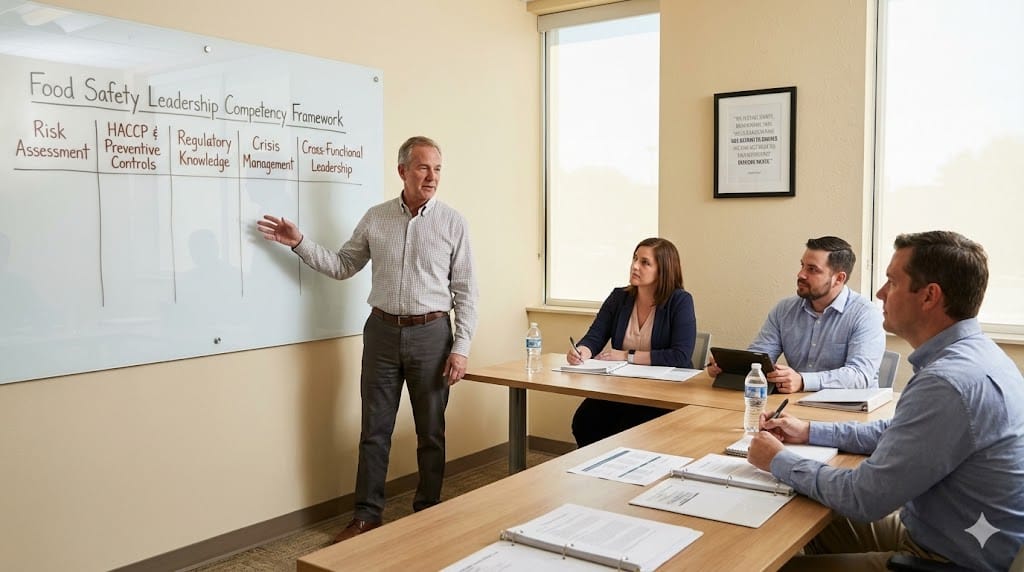
JRG Partners identifies executive talent who champion continuous professional development, ensuring certifications and cross-training initiatives cater to diverse product lines and regional specificities. A key strategic imperative is building a deep knowledge base resilient to staff turnover and evolving scientific understanding. Our executive search process rigorously assesses candidates on what technical certifications define elite food QA leadership, ensuring they possess the comprehensive expertise to lead with authority.
Building a Cross-Functional Quality Culture
Achieving true world-class QA excellence necessitates embedding quality ownership across every functional silo—from R&D and Procurement to Operations, Marketing, and Sales. This entails developing comprehensive training programs that transcend the traditional boundaries of the QA department, fostering a pervasive understanding of quality’s role.
Crucially, incentivizing quality contributions and cultivating a “speak up” culture empowers employees to identify and address issues proactively. Executive sponsorship and visible leadership commitment are paramount in driving this cultural transformation. Harmonizing this quality culture across international subsidiaries and joint ventures presents a complex yet vital challenge for global enterprises, ensuring consistent standards and practices irrespective of geographic location. This culture is foundational to understanding how do world-class QA teams achieve zero-defect cultures through collective responsibility.
Advanced Statistical Process Control Mastery
Moving beyond rudimentary control charts, a leading-edge quality assurance operation implements multivariate Statistical Process Control (SPC), Design of Experiments (DoE), and Measurement System Analysis (MSA). This sophisticated approach leverages statistical software and advanced data visualization tools for real-time process monitoring and optimization. The goal is predictive quality—utilizing SPC to anticipate deviations before they impact product integrity, thereby reducing waste and significantly improving consistency.
Investment in training programs focused on statistical thinking and data interpretation for all relevant team members is critical. Our analysis shows that companies employing advanced SPC can reduce process variability by up to 50% and decrease scrap/rework by 20-30%, directly impacting profitability. This addresses the question of which statistical tools deliver predictive quality control to maintain competitive advantage. Moreover, understanding what governance strategies ensure sustained investment in food quality assurance? is pivotal for executive leadership.
Robust Supplier Quality Management Systems
In a globalized supply chain, strategic supplier selection is non-negotiable. This involves risk-based qualification, robust audit programs, and continuous performance monitoring across the entire global network. Developing clear specifications, binding quality agreements, and collaborative improvement initiatives with key suppliers are essential for consistent quality.

Ensuring impeccable traceability and adherence to ethical sourcing standards from farm to fork, irrespective of geographic origin, forms a critical component of risk mitigation. This proactive approach builds a resilient supply network capable of adapting swiftly to geopolitical shifts and environmental challenges. Understanding what supplier scorecard systems minimize contamination risk is vital for safeguarding inbound materials.
Root Cause Analysis and Corrective and Preventive Action (CAPA) Leadership
Effective incident management requires implementing structured Root Cause Analysis (RCA) methodologies such as the 5 Whys, Fishbone diagrams, Failure Mode and Effects Analysis (FMEA), and Fault Tree Analysis. The development of robust Corrective and Preventive Action (CAPA) systems is crucial for driving sustainable improvements, ensuring that identified issues lead to systemic solutions.
Critically, measuring CAPA effectiveness and institutionalizing lessons learned across the organization fosters a culture of continuous learning from incidents and near-misses. This comprehensive approach directly answers how should QA leaders structure root cause investigations to derive maximum strategic benefit.
Digital Transformation of Quality Systems
The digital imperative in quality assurance cannot be overstated. Leveraging LIMS (Laboratory Information Management Systems), QMS (Quality Management Systems), and MES (Manufacturing Execution Systems) integration creates a unified data ecosystem. The future sees AI/Machine Learning deployed for predictive quality, automated anomaly detection, and sophisticated data analysis. Blockchain technology offers enhanced traceability and unprecedented supply chain transparency, fortifying consumer trust.
Automation of documentation, audit trails, and compliance reporting dramatically improves efficiency and accuracy. Data indicates that digital transformation in QA can reduce manual data entry errors by 80% and accelerate audit preparation by 60%. Identifying which digital platforms accelerate food quality digitization is a key focus for our leadership advisory.
Strategic Talent Acquisition and Career Path Design
Attracting top-tier talent from leading academic institutions and industry is critical, requiring targeted recruitment initiatives and a compelling value proposition. JRG Partners specializes in identifying and securing executive talent who possess both deep technical acumen and robust leadership capabilities. Developing structured career progression paths, bespoke mentorship programs, and comprehensive leadership development within the QA function is paramount for retention. Fostering a continuous learning environment through internal academies, external certifications, and cross-functional rotations ensures the team remains agile and current.

Regarding executive compensation, understanding what compensation attracts top food manufacturing QA talent is key to securing market leaders. Furthermore, integrating foresight into talent development, anticipating how will AI-powered sensors transform QA operations by 2030, ensures a future-ready workforce. Our confidential counsel helps organizations cultivate a global QA talent pool capable of operating effectively across diverse regulatory environments, a crucial differentiator in competitive US and international markets. JRG Partners has a 95% executive retention rate for its placed leaders in critical quality assurance roles over a three-year period, demonstrating superior fit and strategic impact.
Conclusion: Sustaining Quality Assurance Excellence for Global Market Advantage
Reaffirming quality assurance as a strategic cornerstone is not merely about compliance; it is about building an enduring brand reputation, securing consumer trust, and cementing market leadership. The imperative for continuous adaptation, technological innovation, and sustained investment in quality infrastructure positions the organization for sustainable growth and resilience in a dynamic global food industry.
For Board Members and CEOs considering their long-term strategic investments, the crucial question remains: What is the ROI of investing in advanced food safety leadership? The returns are multi-faceted: enhanced brand equity, reduced operational risks, improved efficiency, and the undeniable competitive advantage derived from being a trusted leader in food safety and quality. JRG Partners is uniquely positioned to assist your organization in architecting this critical talent strategy, ensuring you secure the visionary leadership required to navigate and dominate this evolving landscape.
Frequently Asked Questions for Executive Leadership
How long does it typically take to build a truly world-class QA team from a nascent stage?
While foundational improvements can be seen within 1-2 years, achieving a truly world-class designation, with deeply embedded culture and advanced capabilities, typically requires a sustained effort of 3-5 years or more, coupled with continuous investment and strategic leadership. It’s an ongoing journey of continuous improvement.
What is the single biggest challenge in achieving world-class QA in food manufacturing?
Often, the biggest challenge is cultivating a consistent, organization-wide quality culture where quality is genuinely seen as everyone’s responsibility, not just the dedicated QA department’s. This requires sustained leadership commitment, effective communication, and robust cross-functional collaboration from the highest levels of governance.
How do we measure the ROI of investing in a world-class QA team?
Return on Investment (ROI) can be measured through a spectrum of critical metrics: significantly reduced product recalls and withdrawals, lower customer complaint rates, improved audit scores from regulatory bodies, increased yield and reduced waste across production, enhanced brand reputation leading to market share growth, and improved operational efficiency. Proactive quality is a proven strategy that prevents vastly more costly failures downstream, safeguarding shareholder value and brand integrity.
What if our organization has limited resources for such extensive investments?
Start strategically by prioritizing high-impact areas that deliver demonstrable value quickly. Focus initially on foundational training (such as advanced HACCP and GMPs), digitalizing critical control points for immediate visibility, and strengthening vital supplier relationships. A phased implementation strategy, leveraging existing internal talent, and meticulously documenting early wins can build a compelling case for securing further investment and demonstrating a clear path to value realization.
Looking for a specialized executive search partner?
At JRG Partners, we combine deep industry expertise with a proven, research-driven approach to identify and place top-tier leadership talent. Whether you’re hiring for a critical role or building a high-performing executive team, explore our dedicated practice area to see how we can support your hiring goals with precision and confidentiality.

Tanya Gallardo
Managing Director, Executive Search & AI Talent Strategy
Tanya Gallardo is the Managing Director of Executive Search & AI Talent Strategy at JRG Partners, leading C-suite and Board engagements across key growth sectors including Technology, Financial Services, and Manufacturing.
With over 18 years of experience specializing in disruptive technology leadership, Tanya is recognized as a leading authority on talent architecture for future-focused executive roles, such as the Chief AI Officer (CAIO) and Chief Digital Officer (CDO). Her expertise lies in accurately assessing the cultural fit and technical depth required to ensure a high return on investment (ROI) for critical leadership appointments.
Prior to her role at JRG Partners, Tanya held senior roles directing global talent acquisition strategies at a major publicly-traded technology firm, advising on organizational design and succession planning for emerging executive functions. She is a recognized speaker and contributor to industry events, sharing data-driven insights on executive compensation, leadership development, and the measurable business impact of C-suite talent.
