


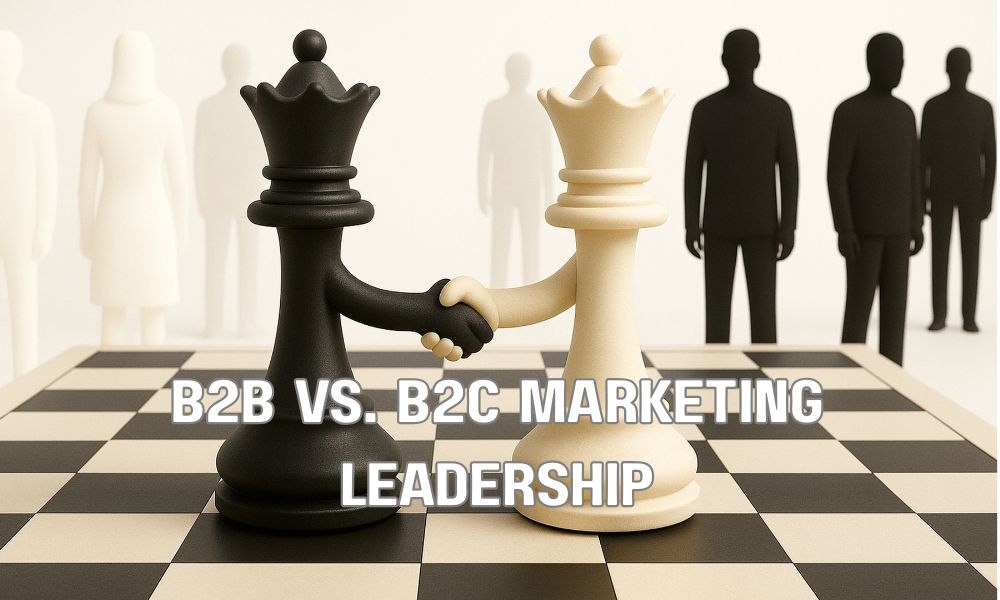
Manufacturing companies have traditionally operated in markets where marketing and sales are closely connected to engineering, procurement, distribution, and long sales cycles. But the modern manufacturing landscape is changing. Buyers increasingly research products online before speaking with a salesperson, manufacturers are investing in direct digital engagement, and even highly technical businesses are expected to build recognizable brands and communicate their value more effectively.
That creates an important executive hiring question: Should a manufacturing company hire a CMO with deep B2B marketing experience, or would a B2C-oriented marketing leader bring the capabilities needed for the next stage of growth?
The answer depends on the company’s customers, sales model, growth strategy, product complexity, and market position.
A B2B CMO may bring extensive experience in account-based marketing, channel development, technical positioning, lead generation, distributor relationships, and long enterprise sales cycles. A B2C-oriented CMO may bring different strengths, including brand building, consumer psychology, digital engagement, storytelling, e-commerce, customer experience, and demand generation at scale.
For manufacturing companies undergoing digital transformation, market expansion, or brand modernization, the ideal candidate may not fit neatly into either category.
The more important question is whether the CMO can understand the company’s buying ecosystem, translate complex products into compelling value propositions, generate demand, support sales, and build a marketing organization capable of driving sustainable growth.
Why Manufacturing Companies Need to Rethink the Traditional CMO Profile
For many manufacturing organizations, marketing historically played a supporting role to sales. Sales teams owned customer relationships, distributors controlled market access, and technical experts communicated product capabilities.
That model can still work in certain markets, but digital buying behavior has changed how industrial and manufacturing products are discovered and evaluated.
Potential customers may now research manufacturers through websites, technical content, search engines, webinars, videos, industry publications, social platforms, case studies, and online product resources before engaging with a sales representative.
As a result, marketing increasingly influences the buying journey long before a formal sales conversation occurs.
At the same time, manufacturing companies may be expanding into new geographies, launching new product categories, developing direct customer relationships, investing in automation and technology, or competing against newer companies with stronger digital brands.
This means the CMO may need to perform responsibilities that historically belonged to several different functions.
The executive may need to strengthen corporate positioning, modernize the brand, generate qualified demand, support sales, improve digital engagement, develop customer insights, and create a measurable marketing infrastructure.
JRG Partners’ manufacturing executive search practice similarly emphasizes the importance of strategic and transformational leadership as manufacturers respond to digital transformation, Industry 4.0, supply-chain pressures, workforce challenges, and changing competitive environments.
What Is the Difference Between a B2B and B2C Marketing Leader?
B2B and B2C marketing share many fundamental principles, but the buying environments can be significantly different.
A B2B marketing leader typically operates in an environment where purchasing decisions may involve multiple stakeholders, longer sales cycles, technical specifications, procurement requirements, contracts, channel partners, and significant financial commitments.
The CMO may need to understand account-based marketing, lead qualification, sales enablement, customer segmentation, distributor marketing, technical content, demand generation, and pipeline contribution.
A B2C marketing leader generally operates in a market where individual consumers have greater influence over purchasing decisions. Brand perception, emotional connection, customer experience, digital engagement, social influence, product positioning, and purchase frequency may become more prominent.
However, the distinction is not absolute.
Manufacturing companies increasingly use techniques associated with B2C marketing, including content marketing, social media, digital advertising, customer communities, personalization, video, and brand storytelling.
Likewise, sophisticated B2B marketers increasingly understand the importance of brand emotion, customer experience, digital engagement, and memorable positioning.
This convergence means companies should evaluate candidates based on capabilities rather than simply categorizing them as B2B or B2C executives.
When a Manufacturing Company Needs a B2B-Oriented CMO
A B2B-oriented CMO may be particularly relevant when the manufacturing company’s growth depends heavily on enterprise accounts, distributors, OEM relationships, industrial buyers, or highly technical products.
These organizations often require marketing strategies that support complex purchasing processes.
A B2B-oriented CMO may bring experience in:
- Account-based marketing.
- Enterprise demand generation.
- Sales and marketing alignment.
- Distributor and channel marketing.
- Lead generation and qualification.
- Technical content strategy.
- Long-cycle customer acquisition.
- Industry-specific positioning.
- Customer segmentation.
- Sales enablement.
This experience can be especially valuable when the company’s primary challenge is creating a predictable connection between marketing activity and the sales pipeline.
For example, a manufacturer selling highly engineered equipment to large industrial customers may not need a CMO whose primary strength is mass-market consumer advertising. It may instead need a leader who understands how engineers, procurement executives, plant managers, technical buyers, and senior executives evaluate suppliers.
In such an environment, the CMO must understand how to translate complex technical capabilities into commercially meaningful messages.
When a B2C-Oriented CMO Can Bring Strategic Value
A B2C-oriented marketing executive can become highly relevant when a manufacturing company sells products directly to consumers or operates in a category where brand preference significantly influences demand.
This can include manufacturers involved in consumer goods, home products, appliances, recreational products, food and beverage production, automotive products, personal products, or other consumer-facing categories.
A B2C-oriented CMO may bring strong capabilities in:
- Brand positioning.
- Consumer research.
- Customer experience.
- Digital marketing.
- Social media.
- Content and storytelling.
- E-commerce.
- Customer acquisition.
- Product launches.
- Brand loyalty and retention.
These capabilities can help a manufacturer move from being viewed primarily as a supplier to becoming a recognizable brand.
However, hiring a B2C leader simply because the company wants a more modern brand is not enough.
The executive must still understand manufacturing economics, product complexity, distribution structures, operational constraints, and the organization’s commercial model.
The best candidate may therefore be a B2C executive who has demonstrated an ability to adapt consumer marketing principles to complex products and business environments.
Does a Manufacturing CMO Need Deep Industry Experience?
Industry experience can be valuable, but it should not automatically outweigh transferable leadership capability.
A candidate who has spent twenty years in manufacturing may understand industry terminology, supply chains, distribution networks, technical products, and customer expectations exceptionally well.
However, long tenure in the industry does not necessarily demonstrate the ability to modernize a marketing organization.
Conversely, a marketing leader from another industry may bring sophisticated digital, brand, customer, or growth capabilities that a manufacturing organization currently lacks.
The key is to determine which capabilities are difficult to acquire and which can be learned.
A marketing executive can learn the specifics of a manufacturing category. It may be much harder to rapidly develop a track record of transforming a marketing organization, building a differentiated brand, creating sophisticated demand generation, or leading enterprise-level change.
The search should therefore distinguish between industry familiarity and leadership relevance.
The ideal candidate should be capable of learning the company’s technical and commercial environment while bringing the leadership capabilities required to achieve its strategic objectives.
Evaluate the CMO’s Ability to Translate Technical Products Into Market Value
One of the most important capabilities for a manufacturing CMO is the ability to simplify complexity without oversimplifying the product.
Manufacturers frequently compete on technical specifications, engineering capabilities, production quality, reliability, certifications, performance, or operational efficiency.
Those factors matter, but customers rarely purchase technical specifications in isolation.
They purchase outcomes.
A CMO must be able to translate technical capabilities into business or customer value.
For example, rather than communicating only that a manufacturing system provides a specific technical capability, the marketing organization should be able to explain how that capability affects productivity, cost, reliability, safety, quality, or total cost of ownership.
This requires close collaboration between marketing, product management, engineering, sales, and customer-facing teams.
During executive interviews, ask candidates to explain how they have marketed technically complex products in the past.
Their ability to communicate the product in clear commercial language can reveal much about their strategic marketing capability.
Assess the CMO’s Digital Transformation Experience

Digital transformation is increasingly influencing how manufacturing companies market and sell their products.
Manufacturers may invest in modern websites, marketing automation, CRM platforms, analytics, account-based marketing, customer portals, e-commerce, content platforms, social channels, and AI-supported marketing tools.
The CMO does not necessarily need to be a technology specialist.
However, the executive should understand how technology changes the customer journey and how marketing organizations can use data more effectively.
A strong candidate should be able to explain how they have:
- Modernized a marketing technology stack.
- Improved marketing measurement.
- Integrated CRM and marketing systems.
- Used customer data for segmentation.
- Built digital demand-generation programs.
- Improved website and digital experiences.
- Introduced new marketing analytics capabilities.
- Led teams through digital transformation.
Manufacturing companies increasingly need marketing leaders who can connect technology investment with commercial outcomes rather than adopting tools simply because they are new.
Measure the CMO’s Commercial and Financial Acumen
A manufacturing CMO should understand how marketing affects the broader economics of the business.
This is especially important in manufacturing because margins, production capacity, channel economics, pricing, customer concentration, and sales cycles can significantly influence growth strategies.
The CMO should be able to communicate with the CFO and other executives about marketing investment, expected outcomes, customer acquisition, pipeline contribution, brand investment, and return on marketing spend.
Companies should therefore ask candidates about the financial scope of previous roles.
Questions may include:
- What size marketing budget did you manage?
- How did you allocate investment across channels?
- Which metrics did you use to evaluate marketing performance?
- How did marketing influence revenue growth?
- How did you justify brand investment to finance leadership?
- How did you respond when marketing spending had to be reduced?
The objective is not to turn the CMO into a financial executive. It is to ensure that marketing leadership operates within the same commercial reality as the rest of the organization.
Build a CMO Candidate Scorecard Around the Company’s Strategy
A structured scorecard can help prevent the search from becoming overly influenced by personality, company prestige, or interview performance.
Manufacturing companies can evaluate candidates across several dimensions.
B2B Marketing Leadership
Assess experience with enterprise customers, account-based marketing, sales enablement, channel strategy, and long-cycle demand generation.
B2C and Brand Leadership
Assess consumer insight, brand positioning, customer experience, storytelling, digital engagement, and brand growth.
Manufacturing and Technical Understanding
Evaluate the candidate’s ability to understand technical products, industrial markets, engineering environments, and complex value propositions.
Digital Transformation
Assess experience with CRM, marketing automation, analytics, digital channels, e-commerce, customer data, and modern marketing technology.
Commercial Acumen
Determine whether the candidate understands revenue, profitability, customer economics, pipeline contribution, and marketing ROI.
Organizational Leadership
Evaluate the candidate’s ability to recruit talent, restructure teams, develop leaders, and establish accountability.
Executive Influence
Determine whether the CMO can work effectively with the CEO, CFO, COO, sales leadership, engineering, product management, and the board.
This approach makes it easier to compare candidates from different industries without automatically favoring one career background.
How to Decide What Type of CMO Your Manufacturing Company Needs
The final decision should come from the company’s strategic priorities.
A company with highly technical enterprise products and a complex distributor network may require a CMO with deep B2B and industrial marketing expertise.
A manufacturer selling directly to consumers may require stronger B2C brand and digital capabilities.
A company undergoing a major transformation may need a hybrid leader capable of combining B2B commercial discipline with B2C-style customer engagement.
The most useful framework is to ask four questions:
- Who are our most important customers?
- How do those customers discover, evaluate, and purchase our products?
- What marketing capabilities are missing from our organization today?
- What does the business need the CMO to accomplish over the next three to five years?
The answers provide a much more useful CMO profile than simply stating that the company needs a “B2B CMO” or a “B2C CMO.”
Final Considerations for Hiring a Manufacturing CMO
The B2B-versus-B2C distinction can be useful when defining a manufacturing CMO search, but it should not become an artificial boundary.
Manufacturing companies increasingly operate in markets where technical buying, enterprise sales, digital discovery, brand perception, customer experience, and data-driven marketing overlap.
The most effective CMO may therefore be an executive who understands both sides of the equation.
They should be able to communicate with engineers and procurement leaders while understanding customer psychology. They should be comfortable with account-based marketing while recognizing the value of brand building. They should understand traditional sales channels while embracing digital transformation.
Most importantly, they should be capable of turning marketing into a strategic growth function rather than treating it solely as a communications or lead-generation department.
For manufacturing companies, the right CMO profile ultimately depends on the organization’s customers, products, business model, growth objectives, and transformation agenda.
FAQs
Should a manufacturing company hire a B2B or B2C CMO?
The appropriate CMO profile depends on the company’s customers, sales model, product complexity, growth strategy, and marketing objectives. Companies serving enterprise and industrial buyers may prioritize B2B capabilities, while consumer-facing manufacturers may require stronger B2C brand and customer expertise. Organizations undergoing transformation may benefit from a CMO with experience across both environments.
What type of CMO does a manufacturing company need?
A manufacturing company needs a CMO whose capabilities match its strategic priorities. Important areas can include B2B demand generation, brand strategy, digital marketing, customer insights, technical product positioning, channel marketing, sales alignment, analytics, and organizational leadership.
Does a manufacturing CMO need B2B marketing experience?
Not always, but B2B experience can be highly valuable for manufacturers selling complex products through enterprise sales teams, distributors, OEM relationships, or long purchasing cycles. The importance of B2B experience depends on the company’s commercial model.
Can a B2C CMO successfully lead marketing for a manufacturing company?
A B2C CMO can be successful in manufacturing when the executive has transferable experience in brand building, customer engagement, digital transformation, product marketing, and organizational leadership. The candidate should also demonstrate an ability to understand technical products, industrial customers, and the company’s commercial environment.
What skills should a manufacturing CMO have?
Important skills can include strategic marketing, brand positioning, B2B demand generation, customer insights, digital transformation, technical product marketing, sales alignment, data analytics, commercial strategy, team leadership, and executive communication. The relative importance of each capability depends on the company’s business model.
How do you evaluate a CMO candidate for a manufacturing company?
Evaluate candidates against the company’s strategic objectives rather than relying solely on industry experience. Review their previous scope, business outcomes, customer complexity, marketing transformation experience, leadership responsibilities, commercial understanding, and ability to collaborate with sales, engineering, operations, finance, and executive leadership.
Should manufacturing companies recruit CMOs from outside the industry?
Recruiting outside manufacturing can expand the talent pool when the company needs capabilities that are difficult to find within its traditional industry network. Executives from industrial technology, CPG, automotive, healthcare, retail, food and beverage, and other adjacent sectors may have transferable marketing and transformation experience.
What is the difference between a B2B and B2C CMO in manufacturing?
A B2B-oriented CMO typically focuses more heavily on enterprise customers, account-based marketing, sales alignment, channel development, technical positioning, and long-cycle demand generation. A B2C-oriented CMO may bring greater emphasis on brand building, consumer insights, digital engagement, customer experience, and direct customer relationships. Some manufacturing companies require a combination of both.
If your organization is evaluating its next senior marketing hire, explore the Manufacturing CMO Executive Search Firm practice area at JRG Partners to learn more about executive search support for manufacturing marketing leadership.

Tanya Gallardo
Managing Director, Executive Search & AI Talent Strategy
Tanya Gallardo is the Managing Director of Executive Search & AI Talent Strategy at JRG Partners, leading C-suite and Board engagements across key growth sectors including Technology, Financial Services, and Manufacturing.
With over 18 years of experience specializing in disruptive technology leadership, Tanya is recognized as a leading authority on talent architecture for future-focused executive roles, such as the Chief AI Officer (CAIO) and Chief Digital Officer (CDO). Her expertise lies in accurately assessing the cultural fit and technical depth required to ensure a high return on investment (ROI) for critical leadership appointments.
Prior to her role at JRG Partners, Tanya held senior roles directing global talent acquisition strategies at a major publicly-traded technology firm, advising on organizational design and succession planning for emerging executive functions. She is a recognized speaker and contributor to industry events, sharing data-driven insights on executive compensation, leadership development, and the measurable business impact of C-suite talent.
