


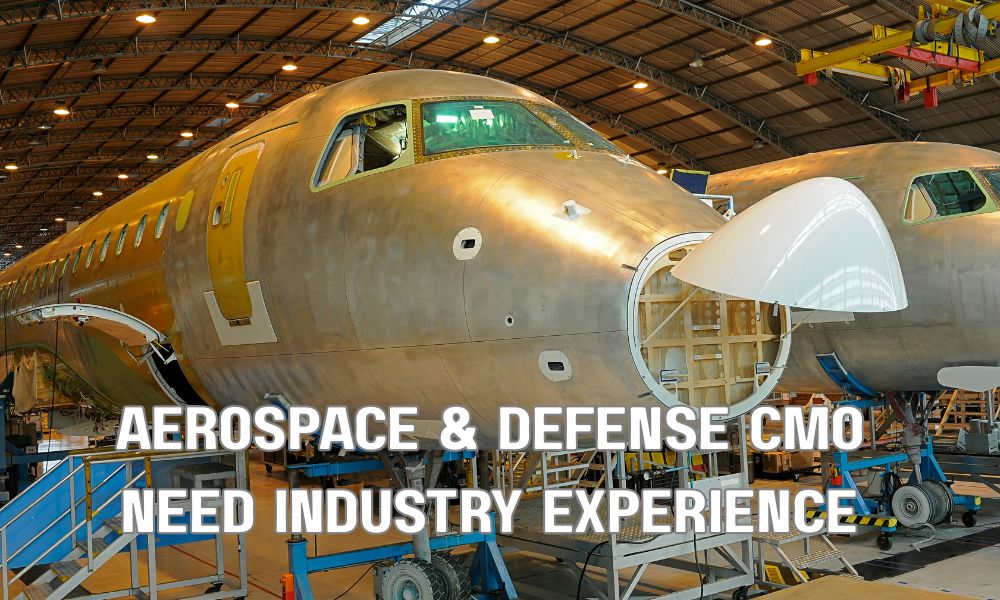
Hiring a Chief Marketing Officer for an aerospace and defense company is fundamentally different from hiring a marketing leader in a conventional consumer or technology market. Aerospace and defense organizations often operate across highly technical product categories, long sales cycles, complex procurement environments, regulated markets, government customers, commercial buyers, and mission-critical applications. The CMO must therefore understand how to position sophisticated capabilities while building credibility with stakeholders who may have highly specialized technical and operational expectations.
But does an aerospace and defense CMO necessarily need years of direct industry experience?
Not always. Direct aerospace, aviation, or defense experience can significantly reduce the learning curve, but it should not automatically outweigh strategic marketing leadership, commercial judgment, customer understanding, brand positioning, digital transformation capabilities, and the ability to work effectively with engineering, program management, sales, government-contracting, and executive teams.
The better question is whether the candidate has the combination of industry knowledge and transferable leadership capabilities required by the organization’s specific growth strategy.
For companies hiring a CMO in this highly specialized market, the evaluation should therefore go beyond the candidate’s previous industry labels. The objective is to determine whether the executive can understand technical complexity, communicate value to sophisticated buyers, strengthen market positioning, support business development, and build a marketing organization capable of contributing to long-term growth.
Why Marketing Leadership Is Different in Aerospace and Defense
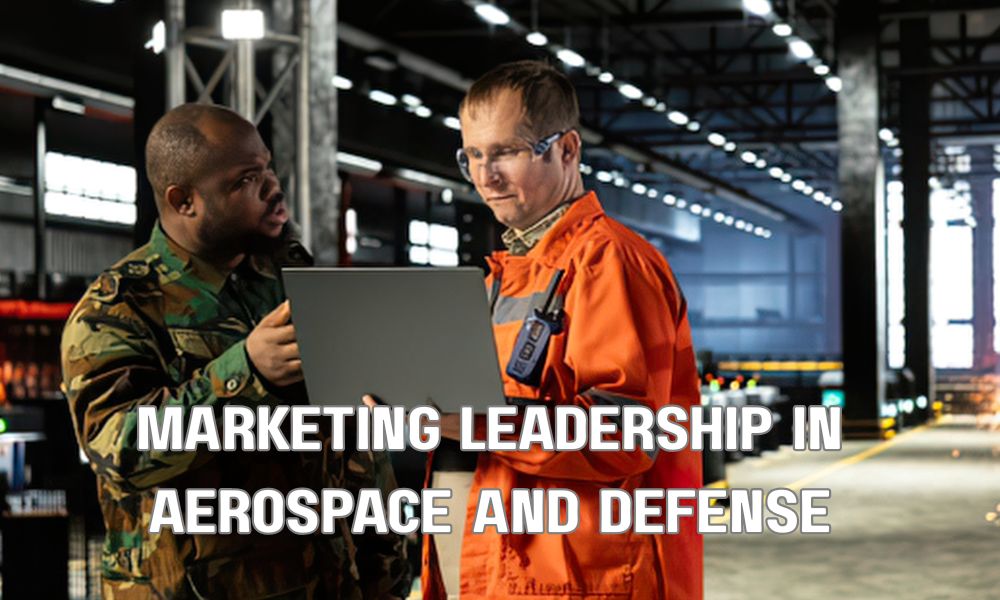
Aerospace and defense companies frequently sell products and services that require substantial technical understanding. Aircraft systems, defense technologies, avionics, propulsion, advanced manufacturing, cybersecurity, space systems, MRO services, and mission-critical technologies cannot always be marketed using the same approaches used for consumer products.
The marketing organization may need to communicate with engineers, procurement teams, government agencies, military organizations, commercial aviation companies, distributors, OEMs, investors, strategic partners, and senior executives. Each audience may evaluate the company’s value proposition differently.
This creates a distinctive challenge for the CMO. The executive must translate technical capabilities into commercially meaningful messages without oversimplifying the underlying technology.
At the same time, marketing cannot operate independently from sales, engineering, operations, program management, government contracting, or corporate strategy. The CMO may need to understand how technical differentiation influences positioning, how customer requirements affect messaging, and how long purchasing cycles influence demand-generation strategies.
Industry experience can make these relationships easier to navigate. However, strong leadership experience in another complex B2B, industrial, technology, healthcare, infrastructure, or regulated market can also provide relevant capabilities.
Does an Aerospace & Defense CMO Need Direct Industry Experience?
There is no universal requirement that a CMO must have spent their entire career in aerospace and defense. The importance of direct industry experience depends largely on the company’s business model, growth objectives, customer base, product complexity, and organizational maturity.
For example, a defense contractor selling sophisticated systems to government customers may place considerable importance on an executive’s familiarity with defense procurement, government contracting environments, and the expectations of institutional buyers.
An aerospace manufacturer entering new commercial markets may instead benefit from a CMO who has successfully repositioned complex industrial products, developed new market categories, and built international demand.
A rapidly growing aerospace technology company may value a marketing leader who has experience scaling a technology business, establishing a category, building a brand, and creating a modern marketing infrastructure—even if that executive comes from outside aerospace.
The key distinction is between industry familiarity and leadership capability. Industry knowledge can often be developed. Strategic leadership, commercial judgment, organizational leadership, and the ability to build effective marketing systems are generally harder to acquire quickly.
What Does Aerospace & Defense Industry Experience Actually Provide?

When evaluating an industry-experienced CMO, companies should identify exactly what that experience contributes rather than treating the industry label as a qualification by itself.
Understanding Complex Buying Processes
Aerospace and defense purchasing can involve multiple stakeholders, long decision cycles, extensive technical evaluation, procurement requirements, and significant customer risk considerations. A CMO who understands these dynamics may be able to build more realistic demand-generation and positioning strategies.
Technical Market Familiarity
Direct experience can help a marketing executive understand terminology, product architectures, competitive dynamics, customer pain points, and the relationship between engineering capabilities and market value.
Credibility With Internal Stakeholders
Engineering and technical teams may respond differently to a marketing leader who already understands their environment. An experienced aerospace marketer may be able to establish credibility faster when discussing technical products, program requirements, and customer expectations.
Knowledge of Industry-Specific Customers
A candidate who has previously marketed to aerospace OEMs, defense organizations, government customers, aviation companies, or specialized suppliers may already understand how these audiences evaluate vendors and partners.
These advantages can shorten the learning curve. However, they should still be tested during interviews. Simply having worked at an aerospace company does not demonstrate that a candidate successfully built a market strategy, repositioned a company, generated growth, or led a marketing transformation.
What Can a Non-Aerospace CMO Bring to the Organization?
Looking exclusively within aerospace and defense can create an unnecessarily narrow candidate pool. Some of the strongest marketing leaders may come from adjacent industries where they have solved similar strategic problems.
A CMO from industrial technology, enterprise software, advanced manufacturing, energy, cybersecurity, healthcare technology, infrastructure, or another complex B2B environment may bring highly transferable experience.
For example, a technology CMO who successfully translated complex technical products into compelling commercial propositions may have many of the capabilities required by an aerospace organization.
Likewise, a marketing executive from an industrial manufacturing company may understand channel management, technical product marketing, long sales cycles, distributor relationships, global positioning, and enterprise customer acquisition.
The question should therefore be: What problems has this executive already solved that resemble the problems our company needs the CMO to solve?
This approach allows the hiring organization to evaluate candidates based on evidence rather than industry labels alone.
How Should Companies Evaluate Technical Fluency?

A CMO does not necessarily need to be an aerospace engineer. Requiring an executive to possess the same technical depth as the company’s engineering leadership can unnecessarily eliminate commercially strong candidates.
Instead, companies should evaluate technical fluency.
Technical fluency means that the CMO can learn complex products, ask intelligent questions, understand the competitive significance of technical features, and translate engineering capabilities into customer value.
During interviews, executives can test this capability by presenting the candidate with a complicated product or technology and asking them to explain:
- Who the primary customer is.
- What problem the technology solves.
- Why the solution is differentiated.
- Which technical capabilities actually matter commercially.
- How the company should position the product.
- What objections a prospective customer might have.
- How marketing should work with engineering and sales to communicate the value proposition.
The candidate does not need to provide an engineering-level explanation. Instead, the company should evaluate how quickly the executive understands complexity and converts it into a commercially relevant narrative.
How Important Is Government and Defense Market Experience?
For organizations heavily dependent on government or defense customers, previous exposure to these markets can become substantially more important.
A defense-focused CMO may need to understand the difference between commercial demand generation and relationship-driven institutional markets. The marketing function may support corporate reputation, strategic communications, business development, thought leadership, customer engagement, trade events, proposal support, employer branding, and market intelligence rather than relying primarily on conventional digital acquisition.
However, the CMO does not necessarily need to personally perform government contracting functions. Those responsibilities may belong to dedicated contracts, legal, business development, or program-management teams.
Instead, the CMO should understand how marketing contributes to the broader commercial and strategic ecosystem.
When interviewing candidates, ask them to explain how they have worked with government customers, regulated buyers, institutional procurement organizations, or similarly complex stakeholders. Then determine whether their experience is genuinely relevant to the company’s market.
Evaluate the Candidate’s Ability to Market Highly Technical Products

One of the most important capabilities for an aerospace and defense CMO is the ability to turn technical differentiation into market differentiation.
A product may contain sophisticated engineering, but technical sophistication alone does not automatically create a compelling market position. Customers need to understand why the technology matters to them.
A strong CMO should be able to work with product, engineering, and subject-matter experts to answer several questions:
- What customer problem does the product solve?
- Why is the problem commercially important?
- What makes the company’s approach different?
- Which technical features create measurable customer value?
- What proof points support the company’s claims?
- How should the value proposition change for different audiences?
The best candidate may not be the executive who knows the most aerospace terminology. It may be the leader who can understand the terminology quickly and convert it into positioning that customers, partners, investors, and internal teams can understand.
Assess Strategic Marketing Leadership, Not Just Industry Tenure
A candidate with fifteen years of aerospace experience is not automatically a stronger CMO candidate than someone with eight years of experience in adjacent technical markets.
The organization should examine what the executive actually accomplished.
Important areas of evaluation include:
- Revenue growth influenced by marketing strategy.
- Successful repositioning or rebranding.
- New market or category development.
- Product launch experience.
- International expansion.
- Customer segmentation and market intelligence.
- Digital transformation.
- Demand-generation improvement.
- Marketing organization development.
- Integration of marketing with sales and business development.
- Executive and board-level communication.
Companies should also investigate the scale and complexity of the candidate’s previous responsibilities. Managing a small marketing department at an established aerospace supplier is different from transforming marketing for a rapidly scaling global aerospace technology company.
The candidate’s previous scope should therefore be compared with the organization’s future needs.
How to Build an Aerospace CMO Candidate Scorecard
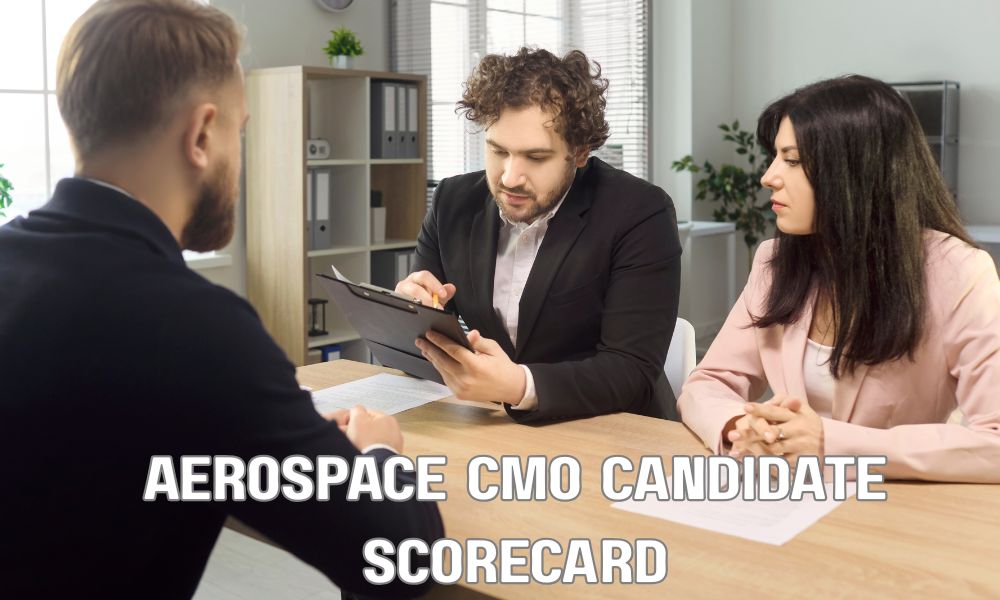
A structured scorecard can prevent hiring teams from overemphasizing one qualification—such as aerospace experience—while overlooking other capabilities.
A practical scorecard can evaluate candidates across several dimensions:
- Strategic Marketing Leadership: Can the executive create a marketing strategy aligned with corporate objectives?
- Industry Knowledge: Does the candidate understand aerospace, aviation, defense, or an adjacent technical market?
- Technical Fluency: Can the executive understand complex products and communicate their commercial value?
- Commercial Acumen: Can marketing activity be connected to pipeline, revenue, market expansion, and business growth?
- Customer Understanding: Does the candidate understand complex B2B, institutional, government, or enterprise buying behavior?
- Brand Leadership: Can the CMO strengthen reputation, differentiation, positioning, and corporate credibility?
- Digital Capability: Can the executive modernize marketing operations, analytics, content, automation, and digital engagement?
- Cross-Functional Leadership: Can the CMO collaborate effectively with engineering, sales, operations, finance, legal, and executive leadership?
- Team Building: Can the candidate recruit, develop, and organize a high-performing marketing function?
- Change Leadership: Can the executive lead transformation while maintaining alignment with the organization’s existing strengths?
This framework allows companies to distinguish between a candidate who simply has industry tenure and a candidate who has the leadership capabilities necessary for the specific CMO mandate.
When Should Aerospace Experience Carry More Weight?
Direct industry experience may become particularly valuable when the company operates in a highly specialized market and expects the CMO to contribute immediately.
For example, industry experience may deserve greater emphasis when the organization is:
- Entering a highly specialized defense market.
- Launching technically complex aerospace products.
- Working extensively with government or institutional customers.
- Competing against established aerospace brands.
- Undergoing a major repositioning within the industry.
- Expanding into new aerospace or defense segments.
- Operating with a highly technical executive team.
- Facing a compressed transition period where a long learning curve is undesirable.
In these circumstances, a CMO who already understands the market can potentially accelerate strategic alignment and reduce onboarding requirements.
However, the candidate should still demonstrate actual marketing leadership achievements. Industry familiarity should complement—not replace—CMO-level capability.
FAQs
Does an aerospace and defense CMO need direct industry experience?
Not necessarily. Direct aerospace or defense experience can shorten the learning curve, but transferable marketing leadership, technical fluency, commercial judgment, and experience with complex B2B markets can also be highly relevant.
What should aerospace companies look for when hiring a CMO?
Companies should evaluate strategic marketing leadership, technical fluency, commercial acumen, customer understanding, brand strategy, digital capabilities, cross-functional leadership, team development, and relevant aerospace or adjacent-industry experience.
Is aerospace experience more important than marketing leadership for a CMO?
The appropriate balance depends on the company’s objectives. Aerospace experience can be particularly valuable in highly specialized or regulated markets, while transformational marketing leadership may carry greater importance when the company needs repositioning, digital modernization, or market expansion.
Can a CMO from another industry succeed in aerospace and defense?
Yes. Executives from industrial technology, advanced manufacturing, cybersecurity, enterprise technology, healthcare technology, energy, and other complex B2B sectors may possess transferable experience in technical product marketing, long sales cycles, sophisticated buyers, and organizational transformation.
Does an aerospace CMO need an engineering background?
No. An engineering degree is not automatically necessary for a CMO. The more important consideration is whether the executive can understand complex technology, collaborate effectively with engineering teams, and translate technical capabilities into meaningful customer and market value.
How do you evaluate a CMO’s technical knowledge?
Give candidates a complex product or technology and ask them to identify the customer problem, competitive differentiation, target audience, value proposition, and potential objections. This can reveal how quickly they understand technical information and convert it into marketing strategy.
What experience is important for a defense-focused CMO?
Relevant experience may include government or institutional markets, defense customers, technical product marketing, corporate positioning, strategic communications, business development alignment, long sales cycles, and experience operating in highly regulated environments.
How should an aerospace company compare two CMO candidates?
Use a structured scorecard covering strategic marketing leadership, industry knowledge, technical fluency, commercial results, customer understanding, digital capability, cross-functional leadership, team development, and change management. This reduces the risk of overvaluing one credential.
What should an aerospace CMO accomplish in the first 90 days?
The first 90 days should typically focus on understanding the company’s strategy, customers, products, competitive position, marketing organization, sales process, data infrastructure, brand perception, and growth priorities before developing a focused marketing transformation roadmap.
Why is hiring a CMO for aerospace and defense different from hiring a general CMO?
Aerospace and defense companies often operate with highly technical products, complex buying processes, regulated environments, institutional customers, long sales cycles, and specialized stakeholder groups. The CMO must therefore combine sophisticated marketing leadership with the ability to operate effectively in a technically complex business environment.
Key Takeaway
Aerospace and defense industry experience can be an important advantage when hiring a CMO, but it should not become an automatic substitute for strong marketing leadership. The strongest evaluation considers what the company needs the CMO to accomplish, then assesses each candidate against those specific requirements.
For some organizations, direct aerospace or defense experience may be essential. For others, an exceptional marketing leader from an adjacent technical or regulated industry may bring valuable capabilities that are difficult to find within a narrow industry talent pool.
The goal is to identify an executive who can bridge technical complexity and commercial opportunity—someone who understands the customer, respects the engineering behind the product, communicates differentiated value, builds strong teams, and creates a marketing function that supports sustainable growth.
For organizations evaluating senior marketing leadership in this specialized market, explore the Aerospace, Aviation & Defense CMO Executive Search practice at JRG Partners.

Tanya Gallardo
Managing Director, Executive Search & AI Talent Strategy
Tanya Gallardo is the Managing Director of Executive Search & AI Talent Strategy at JRG Partners, leading C-suite and Board engagements across key growth sectors including Technology, Financial Services, and Manufacturing.
With over 18 years of experience specializing in disruptive technology leadership, Tanya is recognized as a leading authority on talent architecture for future-focused executive roles, such as the Chief AI Officer (CAIO) and Chief Digital Officer (CDO). Her expertise lies in accurately assessing the cultural fit and technical depth required to ensure a high return on investment (ROI) for critical leadership appointments.
Prior to her role at JRG Partners, Tanya held senior roles directing global talent acquisition strategies at a major publicly-traded technology firm, advising on organizational design and succession planning for emerging executive functions. She is a recognized speaker and contributor to industry events, sharing data-driven insights on executive compensation, leadership development, and the measurable business impact of C-suite talent.
