


The global mining and minerals sector is at the precipice of a historic supercycle. Driven by the aggressive transition toward renewable energy, the electrification of the global automotive fleet, and the escalating geopolitical race to secure critical mineral supply chains, the demand for copper, lithium, nickel, and rare earth elements has reached unprecedented levels. Simultaneously, traditional precious and base metal operations face declining ore grades, deeper and more complex geological deposits, and exponentially increasing regulatory scrutiny.
Capital is flowing heavily into greenfield exploration and massive brownfield expansions, but deploying capital is not the primary bottleneck—the true constraint is human capital. The mining industry is facing a severe, generational executive talent crisis. As veteran operators retire, companies are struggling to find battle-tested leaders capable of managing multi-billion-dollar capital expenditures (CapEx), ensuring uncompromising safety protocols in extreme environments, and maintaining the critical “social license to operate” with local communities and indigenous groups.
Hiring the right operations leadership is a make-or-break endeavor for any mining asset. A misaligned Chief Operating Officer (COO) or Mine General Manager can lead to catastrophic safety incidents, missed production guidance, blown capital budgets, and revoked environmental permits. This comprehensive guide outlines how mining boards, private equity sponsors, and CEOs can identify, evaluate, and recruit transformative operations executives capable of driving maximum asset value while navigating the immense complexities of modern resource extraction.
1. The Mining Talent Crisis: Why the Executive Landscape Has Shifted
For decades, mining executive progression followed a highly predictable, linear path: graduate as a mining engineer, transition to a shift boss, move to mine superintendent, and eventually ascend to General Manager or COO. However, this traditional pipeline has fractured. A prolonged period of underinvestment in the sector during previous commodity downturns led to a “missing generation” of mid-career professionals. Furthermore, modern mining operations are vastly more sophisticated than those of twenty years ago.
Today’s mining executives cannot simply be exceptional earth-movers. They must be hybrid leaders fluent in advanced fleet automation, data-driven geometallurgy, stringent Environmental, Social, and Governance (ESG) mandates, and complex international supply chains. Because these multifaceted leaders are exceptionally scarce, they are highly passive candidates, heavily compensated, and fiercely guarded by their current employers. Relying on traditional job postings or generalist recruitment agencies will inevitably fail to extract this caliber of leadership.
2. Critical Leadership Archetypes: Defining the Core Mandates
Before launching an executive search, the board or hiring committee must define the exact operational archetype required for their specific asset portfolio. The operational requirements for a multi-asset global producer differ drastically from those of a single-asset junior developer transitioning into its first production phase.
A. The Chief Operating Officer (The Enterprise Portfolio Orchestrator)
The Mining COO sits at the corporate level and manages a portfolio of diverse, geographically distributed assets. They are responsible for setting enterprise-wide safety cultures, optimizing capital allocation across competing mine sites, and driving standardized operational excellence.
- Core Strengths: Capital project governance, overarching ESG strategy, M&A operational integration, and managing enterprise-wide geotechnical and metallurgical risk profiles.
- Ideal Background: Extensive experience managing multiple site GMs, navigating complex international jurisdictions, and communicating directly with corporate boards and institutional investors.
B. The Mine General Manager (The Asset Commander)
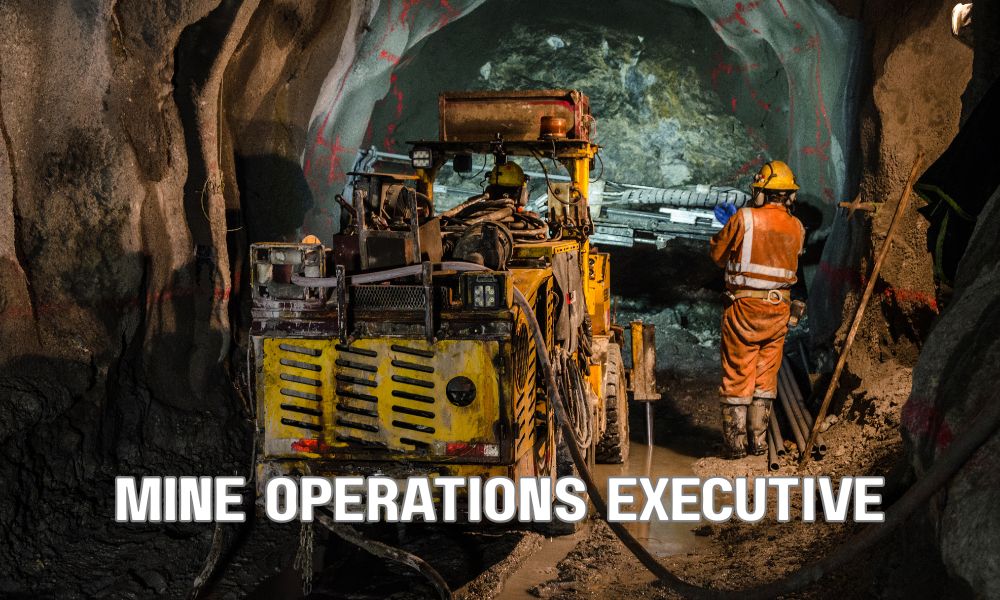
The Mine General Manager (GM) is the undisputed leader of a specific site. They act as the “CEO of the Mine,” holding ultimate P&L accountability for that specific asset. They manage the daily interplay between mine planning, drill and blast, load and haul, processing/milling, and equipment maintenance.
- Core Strengths: Relentless focus on Total Recordable Injury Frequency Rate (TRIFR), daily production tonnage tracking, union/labor relations, and localized community engagement.
- Ideal Background: Decades of boots-on-the-ground experience at tier-one operations. They often specialize deeply in either open-pit or underground (e.g., block caving, sub-level stoping) extraction methodologies.
C. VP of Technical Services & Engineering (The Planning Authority)
This executive bridges the gap between geology and daily operations. They oversee the Life of Mine (LOM) plan, short-term and long-term scheduling, reserves estimation, and metallurgical processing strategies.
- Core Strengths: Advanced geotechnical engineering, resource optimization, tailings management, and the implementation of autonomous mining technologies.
- Ideal Background: Highly credentialed (P.Eng or equivalent) with a background in mine engineering or geology, possessing the technical authority to dictate the structural safety and long-term viability of the extraction sequence.

3. Key Competencies to Demand in Mining Operations Leadership
Evaluating an executive candidate for a mining leadership role requires interrogating their operational grit, crisis management capabilities, and commercial judgment under immense pressure. Search committees must rigorously assess four critical competencies:
1. Absolute Commitment to Zero-Harm Safety Culture
In mining, safety is not a compliance metric; it is the fundamental moral and operational foundation of the business. A catastrophic safety failure not only costs lives but can result in the permanent revocation of operating licenses. Elite executives do not just track lagging indicators like lost-time injuries (LTIs); they proactively engineer safety into the mine plan, enforcing strict critical control management (CCM) and fostering a culture where every operator feels empowered to halt production if conditions are unsafe.
2. Capital Expenditure (CapEx) Stewardship and EPC Management
Building or expanding a mine requires hundreds of millions, or billions, of dollars. Whether executing a greenfield build or a brownfield expansion, the executive must possess supreme discipline in managing Engineering, Procurement, and Construction (EPC) or EPCM contractors. They must demonstrate a history of preventing scope creep, managing massive heavy machinery procurement, and delivering first-ore-to-mill on time and on budget.
3. Managing Geotechnical and Metallurgical Complexity
Mining is inherently unpredictable. Ore bodies frequently deviate from exploration models, presenting lower grades, complex mineralogy, or severe geotechnical instability (e.g., water inflows or seismic activity). The best operations leaders do not panic when the geology shifts; they possess the operational agility to rapidly adjust the mine plan, alter the processing circuit to optimize recovery rates, and protect the overall economics of the asset.
4. The Social License to Operate (ESG & Community Relations)
Modern mining assets cannot function without the consent of local communities, indigenous groups, and environmental regulators. A transformative mining executive spends a significant portion of their time outside the pit, acting as a diplomat. They must negotiate complex impact benefit agreements (IBAs), manage environmental stewardship (specifically water usage and tailings storage), and ensure the operation provides tangible, sustainable economic benefits to the host region.
4. The Mining Executive Scorecard: 5 Vetting Domains
To ensure objective assessment across the executive interview process, search committees should score every finalist across five distinct operational domains:
| Evaluation Domain | Critical Core Competencies | Sample Board Interview Question |
|---|---|---|
| 1. Safety & Crisis Management | Zero-harm leadership, critical control management, fatality prevention, emergency response execution. | “Describe a time when you experienced a severe geotechnical failure or safety incident. How did you manage the immediate crisis, interface with regulators, and fundamentally alter the site’s safety culture afterward?” |
| 2. Production & Cost Control | Unit cost optimization (e.g., cost per ton moved), fleet utilization, overall equipment effectiveness (OEE), bottleneck debottlenecking. | “Walk us through a specific operational turnaround where a site was consistently missing production guidance and bleeding cash. What levers did you pull to reduce the all-in sustaining cost (AISC)?” |
| 3. LOM Planning & Processing | Mine sequencing, grade control, metallurgical recovery optimization, autonomous tech integration. | “How have you navigated a scenario where the run-of-mine ore grade significantly underperformed the block model? How did you adjust the short-term mine plan and the mill circuit to preserve margins?” |
| 4. Capital Projects & Expansions | EPCM management, heavy fleet procurement, budget adherence, greenfield/brownfield construction. | “Detail your framework for managing a massive CapEx expansion project simultaneously alongside active, ongoing production without causing interference or unscheduled downtime.” |
| 5. ESG, Community & Labor | Indigenous relations, union negotiations, tailings governance, environmental permitting. | “How do you establish and maintain a social license to operate in a jurisdiction with high anti-mining sentiment and complex local community politics?” |
5. Executive Compensation, FIFO, and Relocation Dynamics
Securing a proven Mining COO or General Manager requires compensation packages that reflect the physical demands, geographic isolation, and immense financial responsibility of the role. Because top-tier leaders are incredibly scarce, they are highly compensated and heavily incentivized.
A competitive executive compensation package typically incorporates the following elements:
- Base Compensation: Base salaries for Mine General Managers typically range from $250,000 to $400,000+, while corporate COOs at mid-tier or major producers command base salaries between $350,000 and $600,000+, depending on the operational scale and jurisdiction risk.
- Short-Term Incentives (STI): Annual cash bonuses (typically 40% to 100% of base) that are strictly tied to a balanced scorecard: achieving zero fatalities/LTI targets, meeting production tonnage guidance, and hitting All-In Sustaining Cost (AISC) metrics.
- Long-Term Equity (LTI): Substantial stock options, RSUs, or performance rights designed to align the executive with the long-term share price appreciation and Life of Mine (LOM) strategic success.
- Roster and Relocation Considerations: Mining assets are rarely located near major metropolitan centers. Companies must clearly define the lifestyle structure. Is the role a residential placement requiring full family relocation to a remote mining town? Or is it a Fly-In, Fly-Out (FIFO) executive roster? FIFO roles require careful scheduling negotiations, while residential roles require extensive family support, housing allowances, and schooling provisions.
- Expatriate and Hardship Allowances: For executives deploying to complex international jurisdictions (e.g., parts of Africa, South America, or remote Northern Canada), offers must include robust hardship premiums, comprehensive security details, tax equalization, and international medical evacuation coverage.
Conclusion
As the global mining industry enters a period of intense capital deployment and critical strategic importance, the margin for operational error has vanished. Mining companies can possess world-class ore bodies and immense capital backing, but without visionary, battle-tested leadership, those assets will fail to yield their potential. The role of the Mining COO and Mine General Manager requires a uniquely resilient executive—one who commands profound geotechnical respect, operates with absolute commercial discipline, and fosters an uncompromising culture of safety and community stewardship.
Identifying, vetting, and extracting these rare leaders requires far more than generic recruiting tactics. It requires deep industry fluency, a global network of passive executive talent, and the ability to seamlessly manage complex international relocations. Forward-thinking mining boards, private equity sponsors, and CEOs rely on specialized expertise to secure this critical human capital. By partnering with a dedicated Mining & Minerals Executive Search Firm, your organization gains the strategic intelligence and unyielding execution required to seat the operational leaders who will safely and profitably drive the future of global resource extraction.
Frequently Asked Questions (FAQs)
1. What is the difference between a Mining COO and a Mine General Manager?
A Mine General Manager is the ultimate authority on a specific, single mine site, responsible for the daily execution, safety, and P&L of that localized operation. A Mining COO operates at the corporate executive level, managing a portfolio of multiple mine sites, setting enterprise-wide operational strategy, allocating capital across the portfolio, and interfacing directly with the Board of Directors and investors.
2. Can an operations executive from another heavy industry (like Oil & Gas or Manufacturing) transition into a Mine General Manager role?
While leaders from Oil & Gas or heavy civil construction bring excellent safety discipline and mega-project management experience, placing them as a Mine General Manager is highly risky. Understanding site-specific geotechnical rock mechanics, complex metallurgical processing circuits, and mine sequencing requires deep, specialized mining domain expertise. Non-mining executives are better suited for specific corporate VP roles (e.g., VP of Capital Projects) rather than frontline site GM roles.
3. How long does a retained executive search for a Mining COO typically take?
A rigorous, retained executive search for a top-tier Mining COO or GM generally requires 12 to 16 weeks from the execution of the contract to a signed offer letter. This timeline accounts for global market mapping, the confidential extraction of passive candidates (who are often located in remote international jurisdictions), intensive multi-stage technical vetting, and complex compensation and relocation negotiations.
4. Why is ESG and community relations now considered a core operational competency?
In modern mining, losing the “social license to operate” is just as catastrophic as a geotechnical failure. If local communities, indigenous groups, or environmental regulators block access roads, strike, or revoke water permits due to poor engagement, production halts immediately. The modern operations executive must be a skilled diplomat who integrates ESG strategy directly into the daily operational plan.
5. What is the impact of automation and AI on the profile of modern mining executives?
Mining operations are rapidly adopting autonomous haulage systems (AHS), automated drilling, and AI-driven predictive maintenance and sorting. The modern executive must be highly technologically literate, capable of bridging the cultural divide between traditional “dirt-moving” mining mentalities and modern data-driven, centralized remote operations centers.
6. How do “FIFO” (Fly-In, Fly-Out) rosters affect executive recruitment?
FIFO rosters are common for remote sites where building a permanent residential town is unfeasible. While they allow executives to maintain a primary residence in a major city, the gruelling travel and time away from family can cause burnout. Structuring highly competitive FIFO rosters (e.g., 8 days on/6 days off for senior leaders) and ensuring excellent site camp conditions are critical for attracting and retaining elite talent.
7. What are the biggest operational red flags to look for when interviewing a mining executive?
Key warning signs include: brushing past safety protocols or blaming frontline workers for LTI incidents rather than taking systemic accountability; a lack of fluency in managing unit costs (AISC); an inability to articulate how they managed a major unexpected geological deviation; and a combative or dismissive attitude toward environmental and community compliance.
8. Why should we use a specialized mining executive search firm instead of a generalist recruiter?
Generalist recruiters lack the technical vocabulary to effectively interview a candidate on block caving, flotation circuits, or tailings management. They also lack the specialized, global private networks required to extract passive leaders currently managing active mines in regions like Australia, South America, or Northern Canada. A specialized firm provides deep industry intelligence, technical vetting rigor, and global relocation expertise.

Tanya Gallardo
Managing Director, Executive Search & AI Talent Strategy
Tanya Gallardo is the Managing Director of Executive Search & AI Talent Strategy at JRG Partners, leading C-suite and Board engagements across key growth sectors including Technology, Financial Services, and Manufacturing.
With over 18 years of experience specializing in disruptive technology leadership, Tanya is recognized as a leading authority on talent architecture for future-focused executive roles, such as the Chief AI Officer (CAIO) and Chief Digital Officer (CDO). Her expertise lies in accurately assessing the cultural fit and technical depth required to ensure a high return on investment (ROI) for critical leadership appointments.
Prior to her role at JRG Partners, Tanya held senior roles directing global talent acquisition strategies at a major publicly-traded technology firm, advising on organizational design and succession planning for emerging executive functions. She is a recognized speaker and contributor to industry events, sharing data-driven insights on executive compensation, leadership development, and the measurable business impact of C-suite talent.
