



A Confidential Advisory from JRG Partners on Executive Talent Acquisition
As the Global Head of Research & Leadership Advisory at JRG Partners, a premier US-based executive search firm, I present this confidential analysis for your esteemed consideration. The appointment of a Chief Executive Officer represents arguably the single most critical strategic investment a board undertakes, fundamentally shaping an organization’s trajectory and shareholder value. Beyond the immediate operational expenditure, the comprehensive financial and strategic commitment required warrants meticulous foresight. A common query we address for our discerning clientele is: how much does it typically cost to hire a CEO? This document aims to delineate the intricate layers of this leadership acquisition, moving beyond a rudimentary base salary assessment to a holistic understanding of the total investment, encompassing direct remuneration, executive search fees, and frequently underestimated hidden expenses. Our focus remains exclusively on the nuances of the US market, its unique regulatory landscape, talent competition, and corporate governance norms, to offer a forward-thinking perspective on talent architecture.
Key Takeaways for Board Consideration:
- Hiring a CEO is a complex strategic investment, not merely an operational expense, with costs extending far beyond base salary.
- Total investment encompasses executive search fees, diverse compensation components (salary, bonus, equity), and often overlooked hidden costs like assessments, relocation, and legal fees.
- The choice of executive search model (retained vs. contingency) significantly impacts upfront costs and the quality of candidate pool.
- A failed CEO hire represents one of the most substantial financial and reputational risks a company can face, underscoring the importance of thorough due diligence.
- Company size, industry, and strategic objectives are critical determinants influencing the overall CEO hiring budget.
Deciphering the Comprehensive Investment in Executive Leadership
Defining the strategic value of a CEO is paramount to understanding the associated financial outlay. A chief executive’s leadership profoundly influences organizational growth, market position, and ultimately, shareholder value. This leadership acquisition is not a short-term transaction but a long-term commitment that impacts revenue streams and company culture for years. The initial outlay is merely the commencement of a total lifetime investment. Business research, including insights echoed by leading institutions, consistently suggests the total cost of bringing a new chief executive on board can range from 2x to 5x their annual base salary in the first year alone, reflecting the extensive layers of associated expenditures.
Navigating Executive Search Models and Their Financial Implications
The engagement model for identifying and attracting top executive talent profoundly shapes both the financial commitment and the caliber of candidates presented. Boards must critically assess these approaches.
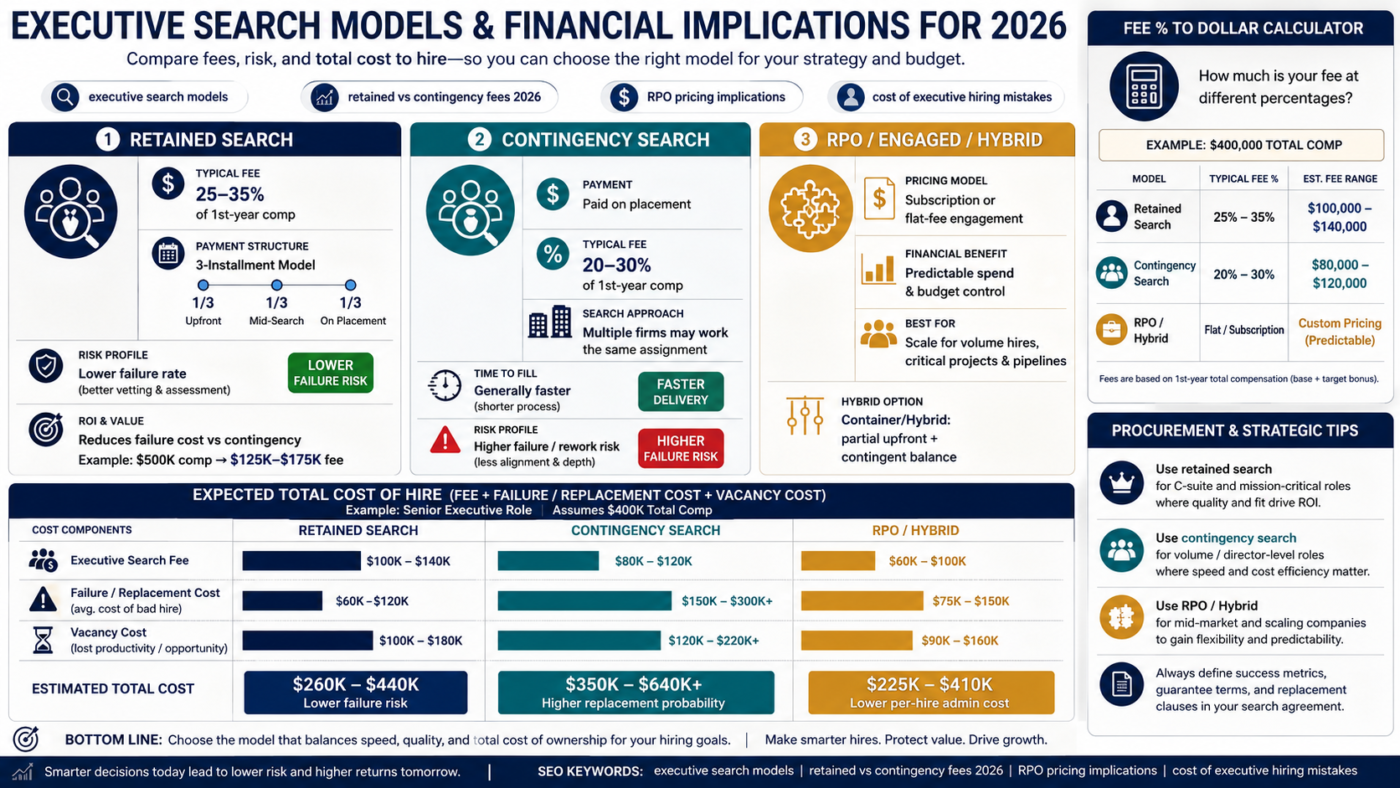
Retained Search: A Premium for Precision
- Description: An exclusive engagement where the executive talent partner is compensated regardless of the hire, facilitating deep market research and a dedicated pursuit of passive, highly sought-after candidates. This model allows for a comprehensive and discreet market scan.
- Typical Fee Structure: Involves an upfront retainer, followed by installment payments tied to search milestones, with a final payment upon successful placement. JRG Partners specializes in this model, leveraging our extensive network and rigorous vetting processes.
- Pros: Offers the most comprehensive search, unparalleled access to passive candidates, and dedicated resources from the partner firm. This approach ensures a thorough evaluation of cultural fit and strategic alignment.
- Cons: Generally entails a higher upfront cost and a more extended, albeit more robust, timeframe.
Contingency Search: Speed Versus Depth
- Description: This model involves payment only upon successful placement, and often allows for non-exclusive engagements with multiple firms.
- Typical Fee Structure: A percentage of the placed executive’s first-year compensation.
- Pros: No upfront cost, potentially faster turnaround for active job seekers.
- Cons: Less dedicated focus from the firm, often prioritizing speed and volume over the meticulous quality and strategic fit crucial for a chief executive role. Can overlook the most impactful passive talent.
Hybrid Approaches
Blending aspects of both models can be considered for highly specific scenarios, though for pivotal chief executive appointments, a dedicated retained search offers superior diligence and candidate depth.
In terms of financial expectations, retained search fees typically range from 25% to 35% of the CEO’s first-year compensation, while contingency fees can be slightly lower, often between 20% and 30%. JRG Partners’ commitment to identifying optimal leadership ensures a focus on value realization for our clients, justifying the investment in a meticulous, high-quality search process.
Dissecting Executive Search Firm Fee Structures
The fees charged by executive talent acquisition firms are a direct reflection of the specialized value they deliver in the competitive US market for senior leadership. Several factors influence these fees.
Factors Influencing Engagement Fees
- Firm reputation and proven track record in placing C-suite executives.
- The complexity of the search mandate, including niche industry requirements or challenging geographical scope.
- Global reach and ability to tap into diverse talent pools.
- Industry specialization and deep sector knowledge.
- Candidate scarcity for highly specialized leadership roles.
The Value Proposition of Specialist Firms
The core value proposition of engaging a specialist executive search firm like JRG Partners lies in our access to exclusive networks, rigorous vetting processes, and unparalleled market intelligence. We bring a forensic level of due diligence to each candidate, ensuring alignment with your strategic objectives and corporate culture. For C-suite roles in mid to large-cap US companies, top-tier executive search firms frequently charge 30-33% of the target CEO’s first-year cash compensation. This investment secures not just a candidate, but a strategically vetted leader capable of driving significant value.
The Multi-Faceted Architecture of CEO Compensation
A chief executive’s total remuneration package is a sophisticated architecture designed to attract, motivate, and retain top-tier talent while aligning their interests with shareholder value creation.
Base Salary: The Foundation
The fixed component, base salary, is market-driven and reflects the role’s complexity, industry standards, and the leader’s experience. It provides stability and serves as a benchmark for the role’s fundamental value.
Performance-Driven Incentives: Short and Long Term
-
- Annual Bonus (Short-Term Incentive – STI): This performance-based component is tied to the achievement of specific corporate and individual metrics, typically annual financial targets or strategic milestones.
- Long-Term Incentives (LTI) / Equity: Critical for aligning a CEO’s interests with sustained shareholder value.
- Stock Options: Grant the right to buy company shares at a future date at a set price, incentivizing stock price appreciation.
- Restricted Stock Units (RSUs): Shares granted upon meeting specific vesting conditions, promoting retention.
- Performance Share Units (PSUs): Shares granted based on achieving long-term performance targets, often over three to five years, directly tying compensation to strategic outcomes.
Equity compensation now often constitutes 50-70% of a public company CEO’s total direct compensation, dwarfing base salary and annual bonuses, signifying a paradigm shift towards long-term value creation.
Comprehensive Benefits and Perquisites
These non-cash components are crucial for a competitive package. They include robust health insurance, retirement plans, executive vehicles, housing allowances, club memberships, and carefully structured severance packages. These elements are designed to provide security and support, allowing the CEO to focus singularly on their fiduciary duties.
Unmasking the Overlooked Expenditures: Beyond Direct Remuneration
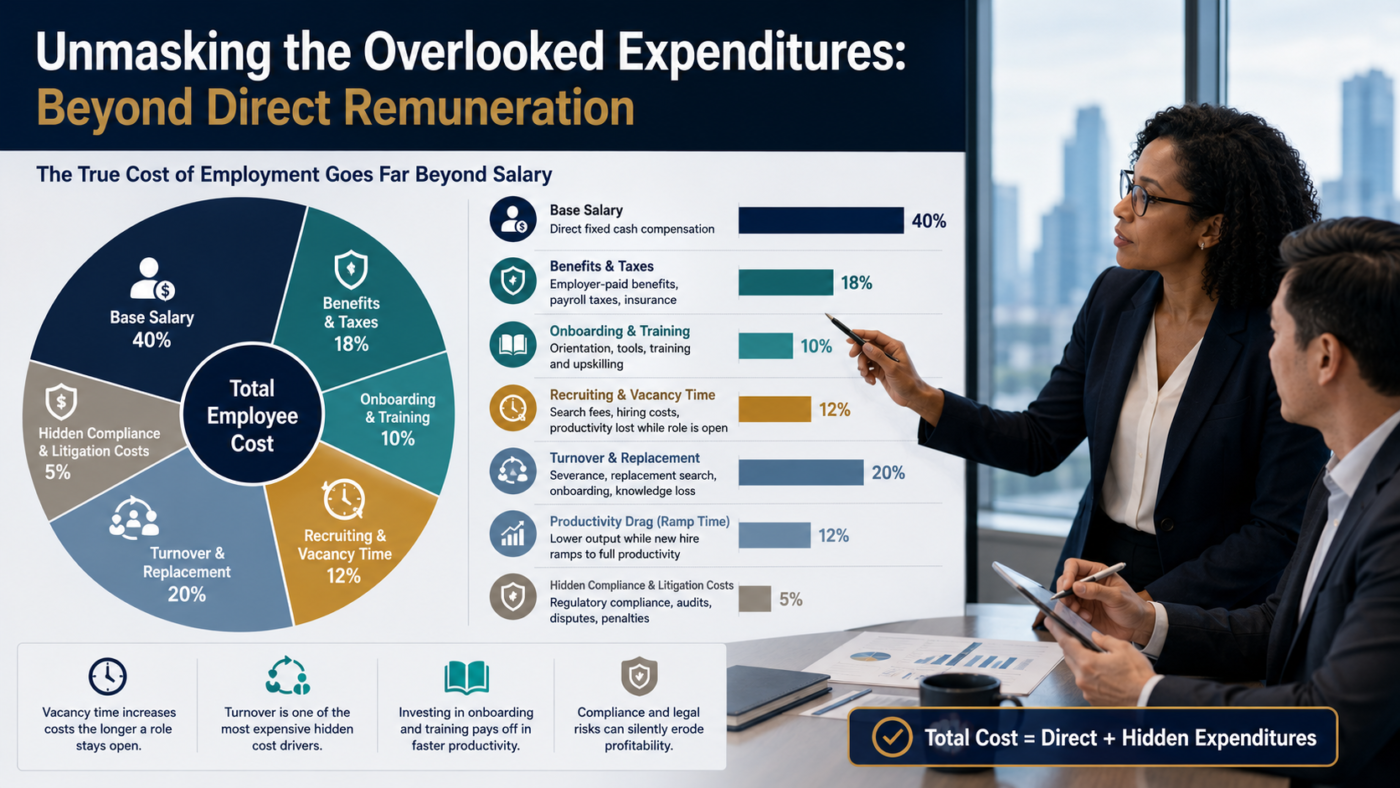
Beyond the readily apparent compensation and executive search firm fees, several hidden costs significantly contribute to the overall investment in a chief executive. These are often underestimated but crucial for successful integration and leadership longevity.
Assessments and Due Diligence
Rigorous psychometric and leadership assessments are vital for evaluating candidate fit, leadership style, and cultural alignment. Comprehensive background checks and due diligence verify credentials and professional history. JRG Partners’ processes incorporate these extensively to mitigate risk.
Relocation and Transition Support
For top-tier talent, relocation is often a necessity. These expenses include moving costs, temporary housing, spousal career support, and assistance with children’s school searches. These considerations are critical for a smooth personal transition, allowing the new leader to focus on organizational priorities swiftly.
Legal Frameworks and Agreements
Drafting complex employment agreements, equity grants, non-compete clauses, and intellectual property rights requires specialized legal counsel. These legal fees are a significant, non-negotiable component of the hiring process for senior leadership.
Onboarding and Integration
Effective onboarding and integration support, including executive coaching and strategic integration into the company’s culture and operations, is crucial. This proactive investment ensures the new chief executive quickly becomes productive and aligns with the organizational fabric. These “hidden” costs, often underestimated, can collectively add an additional 10-20% to the initial hiring budget.
Boards frequently inquire: What hidden costs should companies budget for when hiring a CEO? The answer encompasses all these critical elements that ensure not just a placement, but a successful, integrated leadership transition. It reflects the company’s commitment to the new leader’s success and effective value realization.
The Profound Ramifications of a Misaligned Leadership Appointment
A failed chief executive hire represents one of the most substantial financial and reputational risks a company can face. The cost extends far beyond a simple severance package.
Tangible Financial Erosion
This includes not only severance packages and the renewed recruitment costs for a replacement but also a potential decrease in stock price and direct financial losses from poor strategic decisions. Business intelligence consistently shows a failed chief executive hire at a large public company can cost shareholders an estimated 8-10 times the CEO’s annual salary, considering direct costs and lost market value.
Operational Dislocation and Morale Impact
A misaligned leader can cause a significant loss of strategic direction, project delays, and a decline in employee morale and productivity. This operational disruption erodes internal cohesion and external stakeholder confidence.
Reputational Imperilment
A poor leadership choice can lead to a loss of investor confidence, negative public perception, and significant difficulty in attracting future talent. The reputational damage can be long-lasting and severe.
Foregone Strategic Opportunities
Perhaps the most insidious cost is the opportunity cost: missed market opportunities, delayed innovation, and a resultant competitive disadvantage that can take years to recover from.
Contextualizing Investment: Enterprise Scale and Sector Dynamics
The total investment required for a chief executive hire is highly contingent upon the organizational magnitude and the industry landscape within the US market.
Impact of Organizational Magnitude
- Startups/SMBs: Often feature lower cash compensation but higher equity stakes, incentivizing growth and aligning with venture-backed models.
- Mid-Market Companies: Typically offer a balanced mix of cash and equity, reflecting increasing complexity and market presence.
- Large Enterprises/Public Companies: Command significant base salaries, substantial equity packages, and intricate benefits structures, commensurate with their vast scope and public scrutiny.
Industry-Specific Compensation Benchmarks
- High-Growth Sectors (Tech, Biotech): These sectors often feature aggressive compensation packages with a significant equity component, driven by intense competition for transformative talent.
- Mature Industries (Manufacturing, Utilities): Tend to have more stable compensation structures, often with lower equity upside, reflecting different growth profiles.
- Highly Regulated Industries (Financial Services, Pharma): Command a premium for specialized expertise, rigorous compliance knowledge, and risk management capabilities.
Geographic location, particularly within high-cost US metropolitan areas, also significantly impacts talent acquisition dynamics and compensation expectations. CEOs in the technology and financial services sectors often command 20-40% higher total compensation packages compared to those in traditional manufacturing or retail, even for companies of similar revenue size.
Establishing a Prudent Executive Talent Acquisition Budget
Building a realistic and robust budget for a chief executive appointment requires a comprehensive, strategic approach. Boards must move beyond surface-level figures.

A Holistic Financial Blueprint
This entails mapping out all direct and indirect expenses, from the initial executive search initiation to post-hire integration. A granular understanding of each cost component is crucial.
Strategic Resource Allocation
Prioritizing investment across executive search fees, the compensation structure, and crucial hidden costs is vital. This strategic allocation ensures that resources are deployed where they yield the greatest return on leadership investment.
Contingency and Risk Mitigation
Allocating funds for unforeseen expenses or extended search timelines is a prudent measure. A robust contingency plan mitigates financial surprises and allows for adaptability in a dynamic talent market. Expert recruiters advise allocating at least 5% of the target CEO’s first-year cash compensation specifically for onboarding, coaching, and integration support to maximize success.
Measuring Return on Leadership Investment
Ultimately, the board’s fiduciary duty necessitates considering the potential return on investment from a successful chief executive hire versus the profound costs of inaction or, worse, a poor choice. This long-term financial planning should integrate CEO compensation into multi-year financial forecasts, understanding that this is a critical capital allocation decision.
Therefore, How should boards estimate the total investment required to hire a CEO? The answer lies in adopting this comprehensive, future-focused framework, ensuring every component of the leadership acquisition is strategically addressed and adequately resourced for optimal value realization.
Frequently Asked Questions Regarding Executive Leadership Appointments
How long does a typical CEO search process take?
For a thorough, retained chief executive search in the US, JRG Partners typically advises a timeframe of 3 to 6 months from search initiation to candidate acceptance, sometimes longer for highly specialized or challenging mandates. This allows for comprehensive market mapping, rigorous vetting, and meticulous due diligence essential for such a critical role.
Is it always necessary to use an executive search firm to hire a CEO?
While not strictly “necessary,” engaging a specialist executive talent partner significantly mitigates risk and enhances the quality of the hire. Boards engaging firms like JRG Partners gain access to passive, top-tier talent, market intelligence, structured processes, and expert guidance on compensation and negotiations that are rarely achievable through internal efforts alone.
What are the key performance indicators (KPIs) often tied to CEO bonuses and equity?
CEO bonuses and equity grants are typically tied to a combination of financial KPIs (e.g., revenue growth, EBITDA, EPS, FCF, total shareholder return – TSR), strategic KPIs (e.g., successful M&A integration, market share expansion, new product launches), and often ESG (Environmental, Social, Governance) metrics or specific operational improvements, all tailored to the company’s strategic objectives.
What’s the difference between a golden parachute and a severance package?
A severance package is a standard payment provided to an executive upon involuntary termination without cause. A “golden parachute” is a specific type of severance agreement that offers substantial benefits (often including large cash payments, stock options, and other perks) to top executives in the event of a change of control (e.g., acquisition) of the company, often designed to align executive interests with shareholders during M&A activity without fear of job loss.
How can a company mitigate the risk of a bad CEO hire?
Mitigating the risk of a misaligned chief executive appointment involves several critical steps: engaging a reputable executive search firm with a proven track record, conducting exhaustive due diligence (including multi-stakeholder referencing), utilizing robust psychometric and leadership assessments, designing a compensation package that aligns long-term interests, and implementing a structured onboarding and integration program that includes executive coaching and clear performance milestones.

Tanya Gallardo
Managing Director, Executive Search & AI Talent Strategy
Tanya Gallardo is the Managing Director of Executive Search & AI Talent Strategy at JRG Partners, leading C-suite and Board engagements across key growth sectors including Technology, Financial Services, and Manufacturing.
With over 18 years of experience specializing in disruptive technology leadership, Tanya is recognized as a leading authority on talent architecture for future-focused executive roles, such as the Chief AI Officer (CAIO) and Chief Digital Officer (CDO). Her expertise lies in accurately assessing the cultural fit and technical depth required to ensure a high return on investment (ROI) for critical leadership appointments.
Prior to her role at JRG Partners, Tanya held senior roles directing global talent acquisition strategies at a major publicly-traded technology firm, advising on organizational design and succession planning for emerging executive functions. She is a recognized speaker and contributor to industry events, sharing data-driven insights on executive compensation, leadership development, and the measurable business impact of C-suite talent.
