


Key Takeaways for Board Consideration:
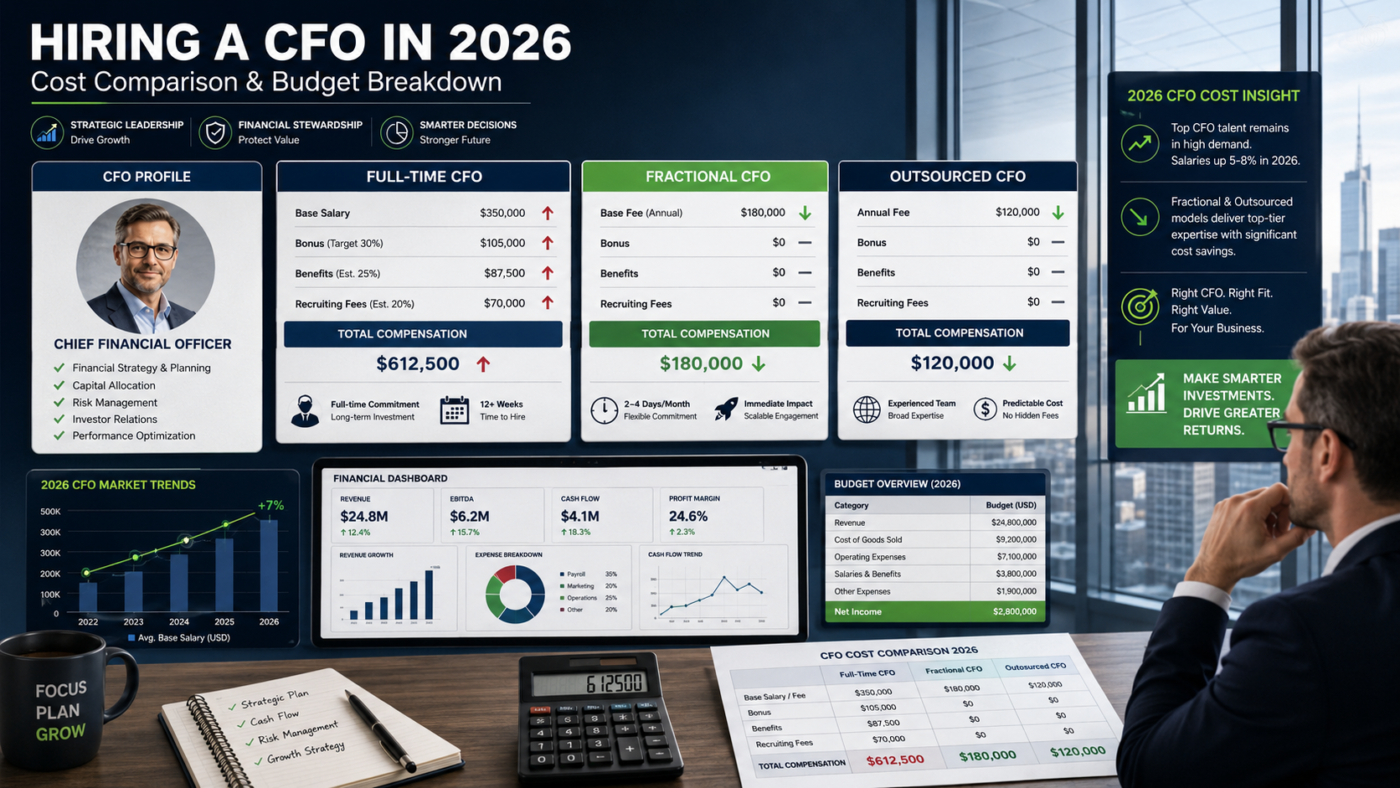
- Hiring a Chief Financial Officer (CFO) in 2026 represents a substantial financial commitment for US-based entities, typically ranging from $250,000 to well over $1,000,000 annually, influenced by numerous variables. This includes base salary, bonuses, equity, and a host of often-overlooked ancillary costs.
- The budget must encompass more than just base salary, including significant costs for executive search fees, performance bonuses, equity incentives, and critical hidden expenses like relocation and legal services, ensuring comprehensive executive talent acquisition.
- Fractional CFO models offer a viable and cost-effective alternative for businesses that require high-level financial expertise and strategic guidance without the overhead of a full-time executive, particularly for rapidly scaling or niche organizations.
- Company stage, size, industry vertical, geographical location within the US, and the specific strategic skill set demanded are primary drivers determining the overall compensation package for a top-tier finance leader.
- A comprehensive and realistic budget is essential for attracting and retaining top-tier financial leadership, ensuring long-term strategic and fiscal success, thereby safeguarding enterprise value creation.
Introduction: The Strategic Investment of a CFO in 2026
Esteemed Board Members,
This confidential analysis from JRG Partners’ Research & Leadership Advisory division aims to provide a granular understanding of the financial implications involved in securing a Chief Financial Officer for your organization in 2026. The evolving and expanded role of the CFO in an increasingly complex, data-driven, and globally interconnected US economy demands a comprehensive re-evaluation of the investment required. Beyond traditional financial oversight, today’s CFO is a strategic partner, a digital transformation catalyst, and a steward of sustainable growth. Understanding how much does it cost to hire a CFO in 2026? is paramount for sustainable business growth, strategic planning, and upholding fiduciary responsibility.
Projected market dynamics indicate an intensifying demand for highly skilled CFOs, particularly those adept in advanced analytics, AI integration, and ESG reporting. Our proprietary market intelligence at JRG Partners projects that global demand for senior finance executives is projected to increase by 8-12% annually through 2026, particularly for those with digital transformation and AI expertise, reflecting a significant paradigm shift in required capabilities.
What Drives CFO Hiring Costs in 2026
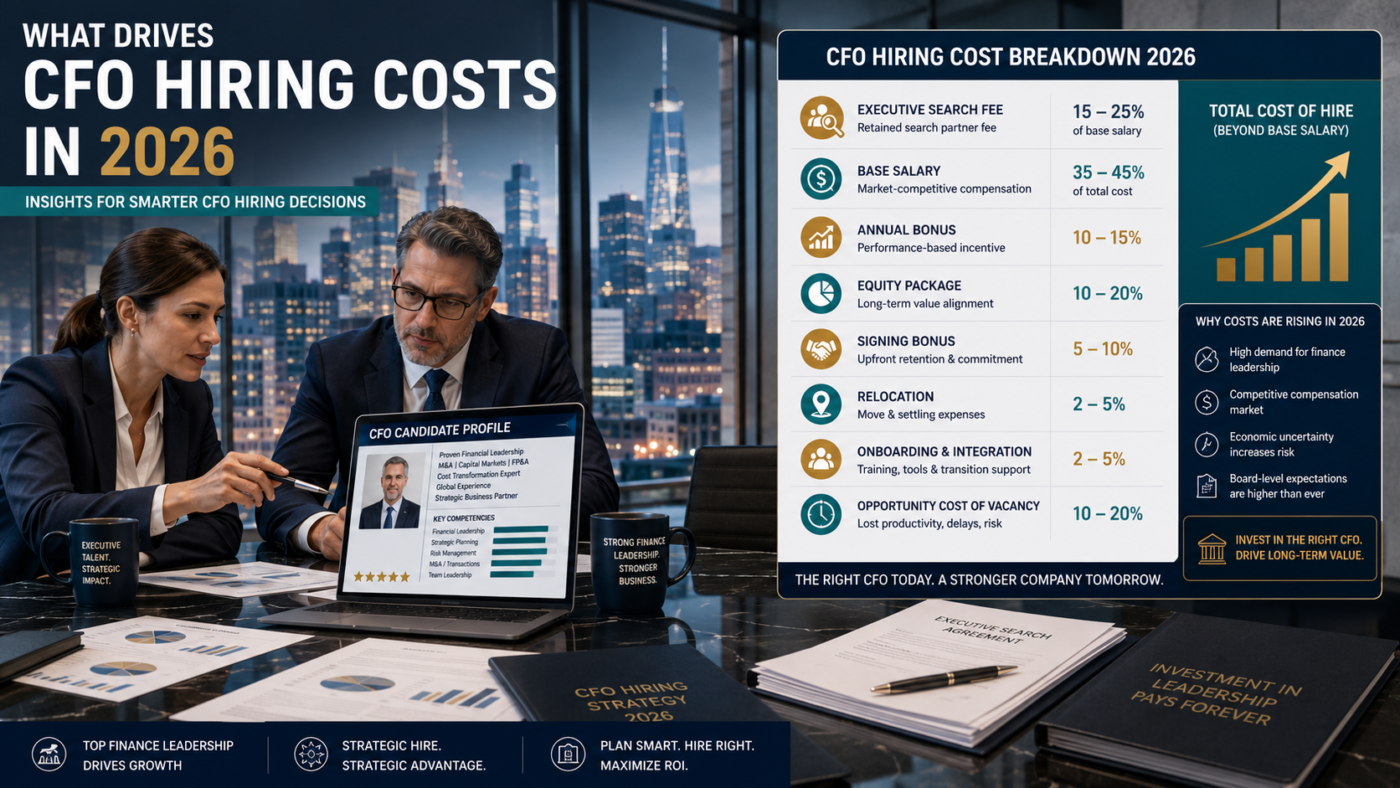
The total investment for securing a high-caliber CFO in the US is a multivariate function. Key drivers include:
- Market Demand & Talent Scarcity: The intensifying competition for highly experienced and strategically-minded finance leaders, particularly those with a proven track record in navigating complex market conditions and driving digital initiatives. This scarcity directly impacts compensation expectations.
- Economic Climate & Inflationary Pressures: Macroeconomic factors, including inflation, directly influence salary expectations and the purchasing power of compensation packages. Organizations must adjust to remain competitive.
- Required Skill Set Evolution: A premium is increasingly placed on CFOs with expertise in advanced analytics, AI integration, ESG reporting, robust cybersecurity protocols, and sophisticated global financial operations. These specialized competencies command higher compensation.
- Geographical Location: Significant cost variations exist between major US financial hubs (e.g., New York, San Francisco, Boston) and secondary or emerging markets. JRG Partners’ compensation benchmarks indicate that CFO compensation packages in tier-one global cities can be 25-40% higher than equivalent roles in emerging regional centers, reflecting higher cost-of-living and increased competition.
- Company Specifics: The revenue scale, operational complexity, growth trajectory, and whether the entity is public or private significantly influence the total compensation architecture. Public companies, for instance, often entail higher regulatory compliance responsibilities, impacting the requisite expertise and corresponding remuneration.
CFO Search Fees: Retained, Contingency, and Interim Models
Securing top-tier executive finance leadership often necessitates engaging specialized search partners. JRG Partners offers tailored approaches to ensure optimal talent acquisition. So, what are typical CFO search fees in 2026?
Retained Search Model:
- Description: An exclusive engagement, typically utilized for critical executive roles, involving a deep, proactive, and confidential search for passive candidates who are not actively seeking new employment. This is JRG Partners’ preferred model for pivotal leadership roles.
- Cost Structure: Involves an upfront retainer, often followed by progress payments, culminating in a final fee. This is typically 25-35% of the first year’s estimated total cash compensation. The average retained search fee for a CFO position in 2026 is expected to be 30-33% of the candidate’s first-year base salary plus bonus.
- Pros & Cons: Offers higher success rates, deeper market penetration, and access to top passive talent; however, it represents a higher upfront investment irrespective of placement, reflecting the dedicated resources deployed.
Contingency Search Model:
- Description: A non-exclusive search where the fee is only paid upon successful placement. This model is generally less suited for critical C-suite roles, as it may attract a narrower talent pool.
- Cost Structure: Typically 20-25% of the first year’s total cash compensation, paid only upon hiring.
- Pros & Cons: No upfront financial risk; however, it can lead to less dedicated service and a potentially narrower, often active, talent pool, which may not include the most strategically aligned leaders.
Interim CFO Services:
- Description: Engagement of a senior finance professional for a temporary period to bridge critical leadership gaps, manage specific strategic projects (e.g., M&A integration, IPO preparation), or support organizational transitions. JRG Partners maintains a robust network of highly qualified interim executives.
- Cost Structure: Daily or hourly rates, which can be significantly higher than a full-time equivalent on an annualized basis but offer unparalleled flexibility. Interim CFO daily rates can range from $1,800 to $4,500, potentially annualizing to $360,000 – $900,000 for full-time engagement.
- Pros & Cons: Immediate access to specialized expertise, flexible engagement terms, and no long-term employment overheads versus higher short-term costs and less long-term cultural integration.
Base Salary Benchmarks for Full-Time CFOs
For Board Members inquiring what salary range should companies expect for a CFO? JRG Partners’ compensation analytics indicate a broad spectrum driven by complexity and strategic impact across various organizational stages in the US market:
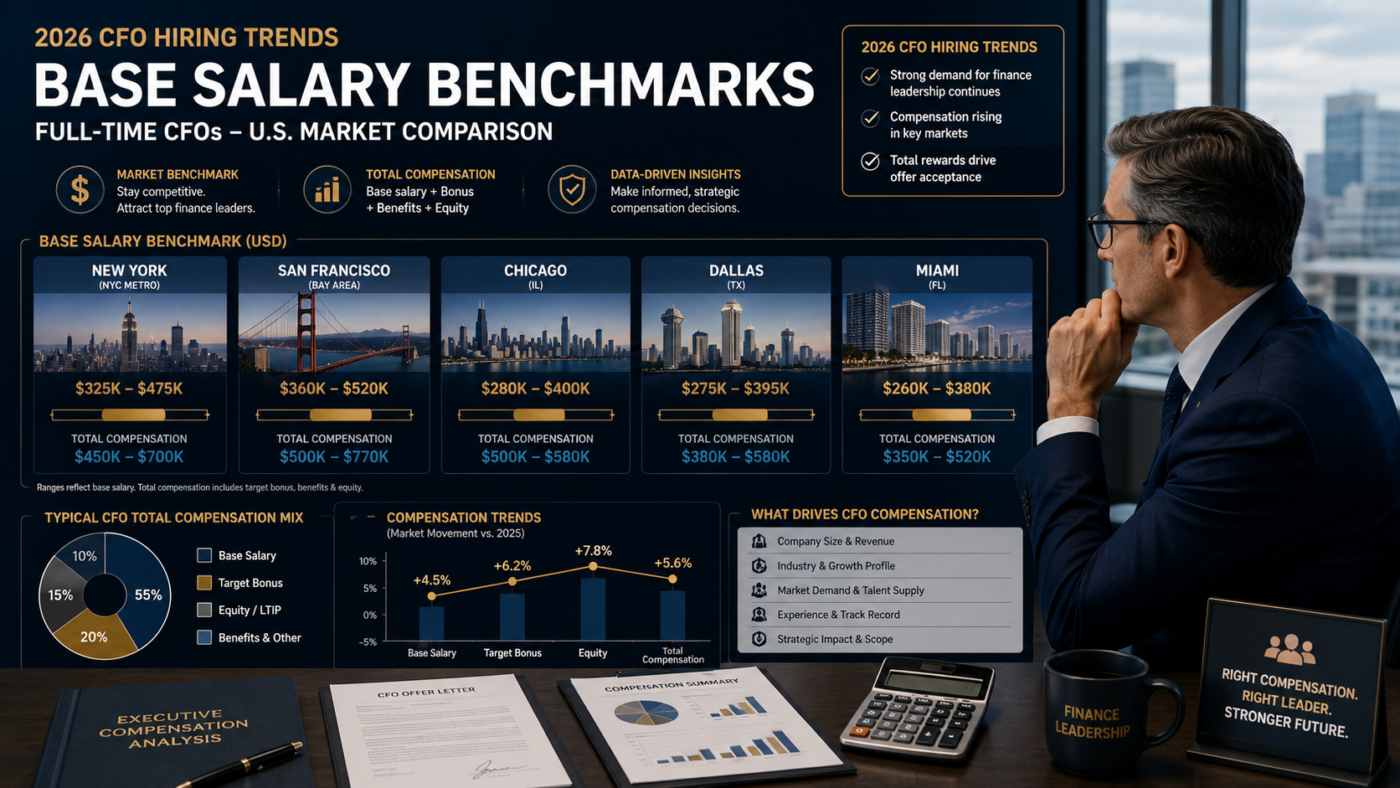
- Start-up/SME CFO (Early-Stage or Small to Medium Enterprise): Focus on foundational finance, fundraising, and initial scaling.
- Salary Range: $150,000 – $280,000.
- Growth Company CFO (Mid-Market or Rapidly Scaling): Emphasis on strategic growth, M&A activity, operational efficiency, and advanced financial modeling. These roles are critical for value realization.
- Salary Range: $280,000 – $550,000.
- Large Enterprise/Public Company CFO (Complex or Global Operations): Responsibilities include sophisticated investor relations, complex regulatory compliance, global treasury management, and significant M&A activity.
- Salary Range: $550,000 – $1,200,000+. The median base salary for a CFO at a publicly traded company with over $1 billion in revenue is projected to exceed $800,000 in 2026.
Influencing factors include: company revenue scale, employee count, industry vertical, investor profile, and the CFO’s depth of experience and demonstrated impact on fiduciary responsibility and strategic outcomes.
Bonus, Equity, and Long-Term Incentive Costs
Beyond base salary, the total executive compensation package for a CFO is significantly augmented by performance-based incentives. This directly addresses: How much do bonuses and equity add to CFO compensation?
Annual Performance Bonuses:
- Typical Structure: Tied to both individual performance KPIs (e.g., leadership, strategic contributions, operational enhancements) and company financial metrics (e.g., EBITDA targets, revenue growth, profit margins).
- Percentage: Commonly ranges from 25-60% of base salary, with top-tier executives potentially receiving 100% or more, particularly in high-growth or high-performance environments. Over 95% of CFOs are expected to receive an annual cash bonus in 2026, averaging 40-45% of their base salary.
Equity Compensation (Stock Options, Restricted Stock Units (RSUs), Performance Share Units (PSUs)):
- Purpose: Crucially aligns the CFO’s interests with shareholder value creation, serving as a powerful retention tool, particularly in high-growth or pre-IPO companies. This component is integral to a strong talent architecture.
- Valuation: Can be a substantial component of total compensation, often equaling or exceeding the base salary, especially for high-growth firms seeking to attract top-tier talent with limited immediate cash flow.
- Vesting Schedules: Typically 3-5 years, often with a one-year cliff, designed to encourage long-term commitment and strategic impact.
Long-Term Incentive Plans (LTIPs):
- Description: Multi-year programs (e.g., 3-5 years) designed to reward sustained performance against strategic targets, often delivered in cash or equity.
- Impact: Encourages long-term strategic planning, significant value generation, and retention of critical leadership.
Executive Perks and Benefits:
A competitive offer also includes a robust suite of executive perks: comprehensive health and dental insurance, generous 401k/retirement contributions, executive car allowance, relocation benefits, club memberships, and substantial professional development budgets. These components are essential for a holistic executive talent strategy.
Hidden Expenses: Legal, Relocation, Onboarding, and Assessment
When considering the full investment, it is critical to account for various hidden costs. What hidden costs are involved in CFO hiring?
- Legal Fees:
- Associated Costs: Drafting and rigorous review of employment contracts, offer letters, non-disclosure agreements, non-compete clauses, and complex executive benefit plans.
- Typical Range: $7,500 – $30,000, depending on complexity and US jurisdiction.
- Relocation Costs:
- Associated Costs: Packing and moving household goods, temporary housing, home sale/purchase assistance, spousal career assistance, and travel for family.
- Typical Range: $25,000 – $150,000+, highly dependent on distance (e.g., cross-country US move), family size, and housing market conditions. The average executive relocation package in 2026 is projected to cost $70,000 – $95,000 for cross-country moves.
- Executive Assessment Fees:
- Associated Costs: Third-party psychometric testing, leadership assessments, personality profiles, and comprehensive background checks. JRG Partners often leverages these tools to ensure optimal fit.
- Typical Range: $6,000 – $18,000 per candidate.
- Onboarding and Integration Support:
- Associated Costs: Executive coaching for the first 6-12 months, mentorship programs, travel for team integration, and professional development specific to the nuanced requirements of the role.
- Impact: Crucial for accelerating time to productivity and ensuring cultural fit; costs vary but are a vital investment in successful executive leadership integration.
- Severance Packages: Prudent budgeting includes consideration for potential future separation costs, typically 6-18 months of base salary plus benefits, depending on tenure and contract terms. This is a critical component of executive risk management.
Fractional vs. Full-Time CFO Cost Comparison
A strategic decision for many organizations revolves around the optimal engagement model for financial leadership. Is a fractional CFO more cost-effective than a full-time CFO?
| Model | Description | Cost Structure | Annualized Cost (US) | Pros | Cons |
|---|---|---|---|---|---|
| Fractional CFO | Engaging a highly experienced CFO on a part-time, project, or retainer basis; ideal for specific strategic needs, growth phases, or for companies not ready for a full-time executive. | Hourly rates ($200-$500+), project-based fees, or fixed monthly retainers. | Typically $80,000 – $300,000 (depending on hours committed and expertise level). Companies can gain access to senior-level CFO expertise through a fractional model for 35-70% of the total cost of a full-time CFO. | Flexibility, significant cost-effectiveness, access to diverse industry experience, no long-term employment overheads, immediate high-level expertise. | Less daily operational oversight, potential for less cultural integration if not managed proactively, limited bandwidth compared to full-time. |
| Full-Time CFO | A dedicated executive fully embedded in the company’s daily operations, strategic planning, and culture, providing continuous leadership and deep institutional knowledge. | Base salary, annual bonuses, equity/LTIPs, comprehensive benefits, and various hidden costs. | $250,000 – $1,200,000+ (all-in cost). | Deep integration, consistent leadership presence, complete ownership of the financial function, full-time commitment, strong cultural alignment. | Higher annualized cost, significant employment overheads, less flexibility, potentially longer lead time for hiring and onboarding. |
Key decision factors include current company stage and financial health, the complexity and scope of financial needs, budget constraints, and the desired level of executive presence and leadership. JRG Partners advises a thorough needs assessment to determine the optimal model for your specific organizational growth trajectory.
Cost Differences by Company Stage, Size, and Industry
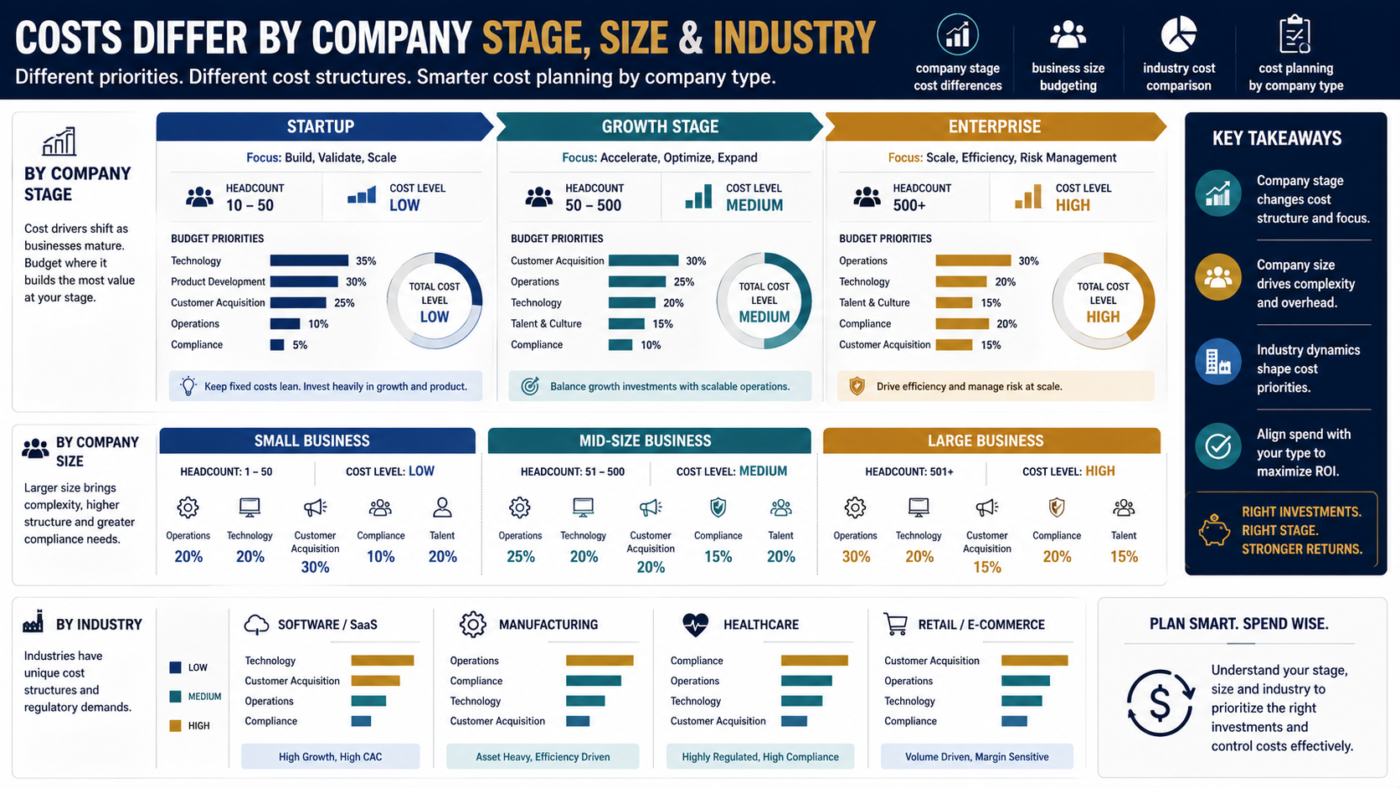
How do CFO hiring costs vary by company stage and revenue?
- Startups/Early-Stage Companies:
- Compensation Structure: Heavily weighted towards equity and stock options, with lower initial cash salaries. This aligns incentives with long-term enterprise value growth.
- Typical Total Cost: Often lower in immediate cash outlay, but with significant equity dilution.
- Growth-Stage Companies (Mid-Market):
- Compensation Structure: A balanced mix of competitive base salary, performance bonuses, and meaningful equity grants, especially if approaching an IPO or significant funding round.
- Typical Total Cost: Mid to high range, reflecting higher stakes and demand for specific expertise in scaling operations and market expansion.
- Mature Enterprises (Large Corporations):
- Compensation Structure: High base salaries, substantial annual and long-term cash bonuses, and performance-based equity or stock units.
- Typical Total Cost: Highest range, reflecting the complexity, regulatory demands (e.g., SEC compliance), and direct impact on market valuation and shareholder returns.
Industry Variations (US Market):
- Technology/Biotech: Often higher compensation due to rapid growth cycles, specialized capital market knowledge, and intense competition for talent in innovation-driven sectors.
- Financial Services: A premium is paid for deep regulatory expertise, sophisticated risk management capabilities, and acute market acumen.
- Manufacturing/Traditional Industries: Stable but competitive compensation, often emphasizing operational efficiency, supply chain optimization, and cost management. JRG Partners’ data indicates that CFO compensation in the technology and life sciences sectors consistently remains 18-25% higher than in traditional manufacturing or retail industries for comparable company sizes.
Building a Realistic CFO Hiring Budget
To successfully navigate this complex landscape, a systematic approach to budget formulation is essential. How should a company budget for the full cost of hiring a CFO?
- Define Comprehensive Needs: Clearly articulate the specific responsibilities, required experience, strategic objectives, and cultural fit for the CFO role. A precise role specification is the foundation.
- Conduct Thorough Market Benchmarking: Research current salary guides, compensation reports, and industry-specific data for similar roles in 2026. JRG Partners provides unparalleled access to real-time market intelligence for this purpose.
- Account for All Cost Components: Systematically include executive search fees, base salary, annual bonuses, equity/LTIPs, comprehensive benefits, and all potential hidden expenses.
- Align with Company Lifecycle: Structure the compensation package to fit your company’s stage of development, risk profile, and future growth potential, ensuring alignment with strategic imperatives.
- Prepare for Negotiation: Expect top candidates to negotiate for optimal terms across all components of their package. A well-prepared and flexible offer ensures competitive advantage.
- Engage Professional Advisors: Utilize executive search firms like JRG Partners, compensation consultants, and legal counsel for expert guidance, competitive insights, and to ensure full compliance with US employment law.
Conclusion: A Strategic Investment for Future Growth
Hiring a CFO in 2026 is a complex, multi-faceted investment requiring meticulous budget planning that extends far beyond just the base salary. Understanding and accounting for every cost component—from search fees and performance incentives to hidden expenses and the critical choice between fractional and full-time models—is crucial for robust financial foresight and prudent governance.
Ultimately, the cost of a top-tier CFO is a strategic investment that can yield significant returns through enhanced financial stewardship, optimized operations, accelerated strategic growth, and increased enterprise value. Approaching this decision with a holistic budgetary perspective is paramount for securing the right financial leader who will be instrumental in your organization’s future success. To conclude, understanding how should a company budget for the full cost of hiring a CFO? is not merely an accounting exercise, but a fundamental aspect of future-proofing your leadership team.
FAQs for Executive Leadership:
- What is the average total compensation for a CFO in a mid-sized growth company in 2026?For a mid-sized growth company (e.g., $100M-$500M revenue) in the US, the average total compensation for a CFO in 2026, including base salary, bonus, and equity, can range from $400,000 to $800,000, depending heavily on industry, location, and performance metrics.
- Is it more cost-effective to hire a fractional CFO or a full-time CFO for a Series A startup?For most Series A startups, a fractional CFO is often significantly more cost-effective. It provides access to senior-level expertise on a part-time basis, avoiding the full burden of salary, benefits, and overhead associated with a full-time executive, allowing capital to be conserved for growth initiatives. This typically applies until a company reaches substantial revenue or prepares for a major liquidity event.
- How much of a CFO’s total compensation should typically be allocated to equity?The equity component for a CFO varies widely by company stage. For early to growth-stage companies, equity can represent 50-200%+ of the base salary in long-term potential value, aiming to align the CFO with significant shareholder value creation. For large public companies, it might be 50-150% of base salary, structured through RSUs or PSUs over a vesting period.
- What are the key differences in CFO hiring costs between private equity-backed companies and bootstrapped companies?Private equity-backed companies often offer higher cash compensation (base + bonus) and structured equity with clear exit potential, attracting experienced CFOs for value acceleration, potentially increasing total compensation by 20-40% compared to equivalent bootstrapped firms. Bootstrapped companies typically offer lower cash but may provide more significant equity upside in a truly impactful role, emphasizing resourcefulness and long-term vision.
- When is the ideal time for a company to transition from outsourced accounting to hiring its first dedicated full-time CFO?The ideal time is typically when a company reaches significant revenue milestones (e.g., $15M-$50M+ annual revenue), is preparing for a major funding round or M&A activity, faces increasing operational complexity, requires sophisticated strategic financial planning beyond basic accounting, or needs a dedicated executive presence for investor relations and board reporting.
- What factors contribute most to the variability of CFO compensation ranges?The most significant factors include company size (revenue, employee count), industry (e.g., tech vs. manufacturing), geographic location (cost of living, talent competition), company stage (startup, growth, mature), specific skills required (e.g., M&A, IPO, digital transformation), and the CFO’s individual experience and track record.

Tanya Gallardo
Managing Director, Executive Search & AI Talent Strategy
Tanya Gallardo is the Managing Director of Executive Search & AI Talent Strategy at JRG Partners, leading C-suite and Board engagements across key growth sectors including Technology, Financial Services, and Manufacturing.
With over 18 years of experience specializing in disruptive technology leadership, Tanya is recognized as a leading authority on talent architecture for future-focused executive roles, such as the Chief AI Officer (CAIO) and Chief Digital Officer (CDO). Her expertise lies in accurately assessing the cultural fit and technical depth required to ensure a high return on investment (ROI) for critical leadership appointments.
Prior to her role at JRG Partners, Tanya held senior roles directing global talent acquisition strategies at a major publicly-traded technology firm, advising on organizational design and succession planning for emerging executive functions. She is a recognized speaker and contributor to industry events, sharing data-driven insights on executive compensation, leadership development, and the measurable business impact of C-suite talent.
