



The Strategic Imperative: Elevating Developer Experience to a Board-Level Mandate
In an increasingly digitized economy, where software defines competitive advantage and talent scarcity persists across the United States, the role of a dedicated Developer Experience (DX) leader has transcended mere operational optimization to become a critical component of enterprise strategy. This advisory outlines the profound strategic impact of developer experience executive talent on fostering innovation, enhancing operational efficiency, and securing the intellectual capital necessary for sustained market leadership.
As JRG Partners, a premier US-based executive search firm, we observe a paradigm shift in how leading organizations approach their technology ecosystems, recognizing that a superior DX is no longer a perk but a fiduciary duty to shareholders and a cornerstone of value realization. Our leadership advisory is designed to empower your organization to comprehend and leverage this pivotal executive function, ensuring your talent architecture is future-proofed against evolving market demands.
Key Strategic Imperatives for DX Leadership
- The VP DX executive function is pivotal for US enterprises aiming to boost engineer productivity, accelerate innovation cycles, and cultivate a robust tech ecosystem.
- Superior developer interaction directly translates to faster product development, elevated code quality, and enhanced developer retention, profoundly influencing the corporate bottom line.
- This executive leadership position orchestrates platform strategy, workflow optimization, and community engagement, serving as the authentic developer voice within the C-suite.
- Rigorous measurement of DX impact via metrics such as developer velocity, market entry speed, and satisfaction indices is crucial for demonstrating quantifiable return on investment.
- As AI and nascent technologies redefine development paradigms, the VP DX guides integration strategies, ensuring development workflows remain at the cutting edge of technological advancement.
Defining the VP DX Role in Modern Technology Architectures
The relentless complexity of contemporary software stacks and the fierce competition for top-tier engineering talent in the US market necessitate a dedicated, strategic focus on developer satisfaction and efficiency. This leadership role holds the core mandate of owning the entire end-to-end journey for both internal and external developers – from seamless onboarding to daily coding intricacies and robust deployment mechanisms.

This transcends mere tactical tooling provision, shifting towards a holistic methodology that minimizes cognitive load and maximizes developer flow states. Reducing friction in the development process directly correlates with accelerated feature delivery and innovation cycles. A recent industry survey indicated that 60% of developers report being burnt out or frustrated by their current development environment, underscoring the urgent need for proficient DX leadership in today’s demanding tech landscape.
Evolution of the Role
The transformation of software development from siloed tasks to intricate, interconnected systems demands a specialized executive focus. This evolution mandates leadership capable of navigating complexity while preserving developer morale and output.
Core Mandate and Strategic Impact
This leader’s mandate encompasses the entire developer lifecycle. Their strategic oversight ensures that every interaction an engineer has with the platform, tools, and processes is optimized for efficacy. What core responsibilities define VP Developer Experience success? It encompasses everything from toolchain rationalization to fostering an inclusive and productive coding environment.
Platform Strategy and Developer Ecosystem Stewardship
Effective DX leadership is intrinsically linked to the efficacy of an organization’s internal platforms and its engagement with external developer communities. This role leads the development and continuous refinement of internal platforms, guaranteeing they are intuitive, dependable, and potent for engineering teams. Simultaneously, it involves crafting sophisticated strategies for engaging, supporting, and expanding communities around proprietary APIs, SDKs, and open-source contributions.
This executive establishes architectural guidelines, promulgates best practices, and fosters a unified vision for all developer-facing infrastructure, advocating for features that genuinely serve developer needs and reduce time-to-value. Companies with a well-defined platform strategy led by DX leadership experience a 2x faster adoption rate of their APIs and internal tools, a testament to the direct impact on product traction and ecosystem growth.
Internal Platform Leadership
Guiding the strategic development of internal systems ensures that the foundational components of your engineering operations are robust, user-friendly, and scalable, minimizing internal friction points for your highly skilled engineers. This focus on internal platform leadership is a hallmark of high-performing DX organizations.
External Ecosystem Cultivation
Beyond internal excellence, the VP DX drives the strategy for public-facing developer assets. How does DX leadership accelerate platform adoption rates? By ensuring superior documentation, accessible SDKs, and responsive community support, making external integration seamless and attractive.

This proactive approach cultivates an engaged developer community, expanding your reach and influence.
Developer Advocacy and Community Building
The VP DX serves as the executive conduit for developer feedback, expertly translating technical pain points into strategic imperatives for the organization. This position is instrumental in building vibrant developer communities through orchestrating initiatives for forums, technical events, educational content, and comprehensive documentation that fosters knowledge sharing and cross-team collaboration. Strategic communication, articulating product updates, deprecations, and future roadmaps with transparency and in a developer-centric manner, builds trust and minimizes disruption.
Furthermore, guiding contributions to and consumption from the open-source ecosystem enhances corporate credibility and serves as a powerful magnet for top-tier engineering talent within the US market. A significant 75% of developers express a preference for engaging with companies that actively listen to and incorporate community feedback into their product development processes, highlighting the imperative of authentic advocacy. Optimizing developer experience for business growth fundamentally relies on this proactive engagement.
Championing the Developer Voice
This critical function ensures that the practical realities and challenges faced by engineers are not only heard but acted upon at the highest levels of executive leadership, aligning technical vision with ground-level needs. What developer advocacy strategies build thriving communities? Effective advocacy blends empathy with strategic influence, establishing a direct channel for constructive feedback and collaborative problem-solving.
Building Vibrant Communities
Fostering an ecosystem where developers feel supported, informed, and valued is paramount. This includes curating resources, facilitating peer-to-peer learning, and recognizing contributions, thereby strengthening the developer-company bond.
Tools, APIs, and Workflow Optimization Impact
A core responsibility of this executive role is the meticulous streamlining of the entire development toolchain. This includes overseeing the careful selection, seamless integration, and continuous optimization of Integrated Development Environments (IDEs), robust CI/CD pipelines, advanced testing frameworks, and sophisticated monitoring solutions. The VP DX also defines exacting standards for API design, documentation, discoverability, and usability, guaranteeing frictionless integration and widespread adoption. Identifying and implementing solutions to automate mundane, repetitive tasks is crucial, liberating developers to concentrate on higher-value, intellectually stimulating work.

By designing workflows that minimize context switching, decision fatigue, and unnecessary complexities, this leadership significantly reduces cognitive load, enhancing overall developer efficiency. Inefficient developer tools and suboptimal workflows can increase development costs by up to 20% due to lost productivity and increased debugging time, emphasizing the direct financial benefit of DX investment. Which tools signal enterprise-grade developer experience maturity? This includes integrated suites that offer seamless version control, automated testing, and comprehensive observability, all contributing to a reduction in operational friction.
Streamlining the Toolchain
Careful curation and integration of development tools are essential for maximizing output and reducing frustration. This ensures engineers have access to high-performance, intuitive solutions that enhance, rather than hinder, their work.
API Excellence
Defining and enforcing rigorous standards for APIs ensures they are not just functional but truly delightful to work with, promoting widespread adoption and minimizing integration challenges.
Cross-Functional Alignment with Engineering Leadership
The VP DX operates in close partnership with the CTO and VP of Engineering, ensuring that developer experience initiatives are seamlessly integrated with broader technical strategy, critical architectural decisions, and long-term talent development plans. This role fosters crucial synergy with product management, ensuring that developer needs are deeply embedded within product roadmaps, particularly for developer-facing products and features. It also necessitates a delicate balance with security and operations teams, harmonizing the imperative for developer velocity with stringent security protocols and robust operational resilience.
Furthermore, the VP DX significantly contributes to employer branding by showcasing a superior developer experience, making the organization an exceptionally attractive destination for top engineering talent in the US market. Organizations demonstrating high DX maturity report 30% greater collaboration and fewer cross-functional blockers between engineering and product teams, a testament to the unifying power of this role. How should VP DX collaborate with CTO and CPO peers? This collaboration involves shared strategic planning, resource allocation, and a unified vision for product and platform development, prioritizing both internal and external user satisfaction.
Partnership with CTO/VP Engineering
This symbiotic relationship ensures that developer initiatives are not isolated but are core to the overarching technical vision, leading to integrated strategies that benefit the entire engineering organization.
Synergy with Product Management
By embedding developer insights into product development, the VP DX ensures that solutions are not only user-centric but also buildable and maintainable, accelerating time-to-market.
Metrics Proving DX ROI on Velocity and Retention
Quantifying the impact of Developer Experience investments is paramount for demonstrating fiduciary responsibility and securing continued executive support. Key Performance Indicators (KPIs) include tracking critical DORA metrics such as Deployment Frequency, Lead Time for Changes, and Mean Time to Resolution (MTTR), which directly reflect engineering velocity and system stability.

Developer Satisfaction Surveys, including internal Net Promoter Score (NPS) for internal tools and platforms, coupled with qualitative feedback loops, provide invaluable insights into sentiment. Onboarding efficiency, measured by the time it takes for new developers to achieve full productivity, highlights the effectiveness of foundational DX elements.
Crucially, monitoring developer retention rates provides a direct correlation between DX improvements and reduced attrition, showcasing the tangible financial impact of a satisfied and engaged engineering workforce. Companies strategically investing in DX initiatives have reported up to a 15% improvement in developer retention rates year-over-year, illustrating the potent link between experience and talent longevity. Which metrics best measure developer productivity gains? A comprehensive suite includes DORA metrics, code quality indicators, and internal platform adoption rates, all triangulating toward demonstrable efficiency improvements.
Key Performance Indicators (KPIs)
Precise, data-driven metrics offer an objective lens into the effectiveness of DX strategies, transforming qualitative improvements into measurable business outcomes.
Developer Satisfaction Surveys
Beyond quantitative metrics, understanding the subjective experience of developers through structured feedback is vital for identifying pain points and cultivating a positive engineering culture.
AI Integration and Emerging Technology Roadmaps
The VP DX holds a critical role in leveraging artificial intelligence for enhancing the developer experience. This involves identifying and integrating AI-powered tools such as advanced code assistants, intelligent debuggers, and automated documentation generators to augment developer capabilities, not replace them. Furthermore, this leader guides the judicious adoption and seamless integration of new technological paradigms—be it Web3, serverless architectures, or quantum computing—into existing developer workflows, ensuring competitive relevance.
Proactively identifying future skill gaps and developing targeted training programs is essential to keep the US developer workforce at the technological forefront. Addressing the ethical implications and governance surrounding AI in software development practices is also a crucial component of this foresight. An overwhelming 80% of developers anticipate AI to significantly reshape their daily workflows within the next three years, underscoring the critical need for DX leadership in this transformative period. How will AI reshape developer workflows by 2030? It will lead to more intelligent tooling, accelerated code generation, and a shift towards higher-level problem-solving for human engineers, requiring strategic guidance from DX leadership.
Leveraging AI for DX
Integrating intelligent automation and assistance tools empowers developers to be more productive, innovative, and focused on core problem-solving, enhancing overall output and satisfaction.
Navigating Emerging Technologies
Strategic adoption of cutting-edge technologies ensures the organization remains competitive, while careful integration minimizes disruption and maximizes developer embrace.
Building and Scaling High-Performance DX Teams
Establishing the optimal organizational structure for DX is paramount, encompassing roles such as dedicated DX engineers, skilled technical writers, community managers, and specialized tooling architects. JRG Partners has unparalleled success in identifying and securing transformative C-suite and VP-level technology leadership, including these specialized DX roles, demonstrating our robust talent architecture framework.
Attracting professionals with a unique blend of deep technical expertise, profound empathy, and exceptional communication acumen is fundamental for DX success. Fostering an internal culture that unequivocally prioritizes the developer’s well-being, productivity, and professional growth creates a virtuous cycle of innovation and retention. Equipping the DX team itself with the necessary advanced tools and streamlined methodologies ensures they operate with peak efficiency and effectiveness.
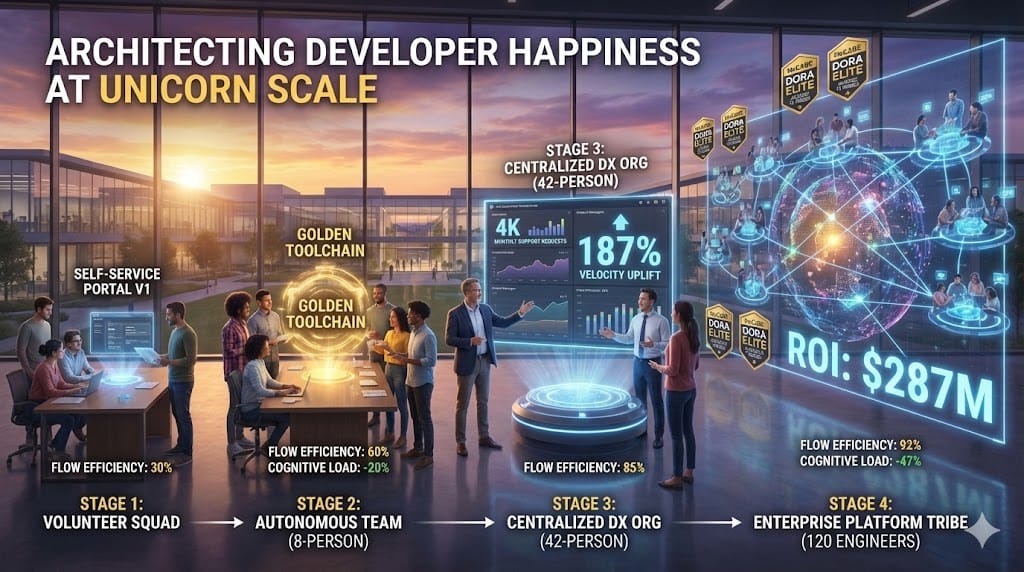
High-performing DX teams are shown to contribute to a 25% faster time to resolution for critical engineering issues by proactive identification and mitigation of bottlenecks. What talent profiles excel in VP DX leadership roles? Ideal candidates possess a blend of senior engineering background, product management acumen, and a deep, empathetic understanding of developer psychology and workflows.
JRG Partners’ deep expertise in executive search within the US technology sector consistently delivers leaders who not only understand these nuances but are equipped to drive this critical function with strategic foresight and operational excellence. Our rigorous talent architecture framework ensures that the individuals we identify are not just skilled, but perfectly aligned with your corporate governance and strategic growth objectives, particularly in areas like talent acquisition and retention and the formation of high-performance DX teams.
Frequently Asked Questions (FAQs)
Q: What’s the core difference between a VP of Engineering and a VP of DX?
A: While a VP of Engineering typically focuses on product delivery, architectural soundness, and managing engineering teams to build the product, a VP of DX focuses intensely on optimizing the experience of the developers building that product (and often external developers utilizing it). This includes addressing their workflows, tooling, and overall professional satisfaction, creating an environment where high-quality work can flourish.
Q: How do you practically measure the success and ROI of DX initiatives?
A: Success is rigorously quantified through improved developer velocity metrics (e.g., deployment frequency, lead time for changes), demonstrably reduced onboarding time for new hires, higher developer satisfaction scores (often via internal Net Promoter Score for tools and platforms), lower developer attrition rates, and concrete qualitative feedback illustrating significant reductions in workflow friction and cognitive load.
Q: Is the VP DX role primarily relevant for companies with external APIs or developer platforms?
A: Not exclusively. While undeniably critical for fostering robust external ecosystems and API adoption, the role is equally vital for large engineering organizations to profoundly optimize internal developer productivity, significantly boost employee satisfaction, and accelerate time-to-market for proprietary products and services. Its value extends across all software-driven enterprises in the US.
Q: What are the most crucial skills for a successful VP DX?
A: Essential skills encompass deep technical empathy, incisive strategic thinking, robust communication and advocacy capabilities, a comprehensive understanding of the entire software development lifecycle, expertise in community building, and a proven track record of leadership in engineering or product management. This blend ensures both technical credibility and the ability to influence at an executive level.
Conclusion: Investing in Developer Experience as a Strategic Imperative
The rise of the VP of Developer Experience marks a pivotal moment in corporate governance and strategic talent management within the US technology landscape. This role is no longer a luxury but an absolute necessity for organizations striving for agility, innovation, and developer retention in a fiercely competitive market. By investing strategically in DX leadership, companies are not just optimizing internal processes; they are making a profound commitment to their most valuable asset – their engineering talent.
This commitment directly translates to superior product delivery, enhanced market competitiveness, and ultimately, a healthier bottom line. Future-proofing enterprise innovation through DX leadership is a strategic imperative that requires immediate and concerted attention from the Board. JRG Partners remains at your service to navigate this evolving executive talent landscape, ensuring your organization secures the visionary leadership required for sustained success. As technical architectures evolve rapidly, leaving gaps between technology spending and strategic business outcomes is a liability. To bridge this divide, progressive organizations must explore the new relationship between CFO and CIO driving digital ROI. Aligning fiscal planning with digital infrastructure modernization allows boards to accelerate transformation velocity, eliminate redundant software costs, and ensure maximum corporate effectiveness.

Tanya Gallardo
Managing Director, Executive Search & AI Talent Strategy
Tanya Gallardo is the Managing Director of Executive Search & AI Talent Strategy at JRG Partners, leading C-suite and Board engagements across key growth sectors including Technology, Financial Services, and Manufacturing.
With over 18 years of experience specializing in disruptive technology leadership, Tanya is recognized as a leading authority on talent architecture for future-focused executive roles, such as the Chief AI Officer (CAIO) and Chief Digital Officer (CDO). Her expertise lies in accurately assessing the cultural fit and technical depth required to ensure a high return on investment (ROI) for critical leadership appointments.
Prior to her role at JRG Partners, Tanya held senior roles directing global talent acquisition strategies at a major publicly-traded technology firm, advising on organizational design and succession planning for emerging executive functions. She is a recognized speaker and contributor to industry events, sharing data-driven insights on executive compensation, leadership development, and the measurable business impact of C-suite talent.
