


The Rise of the Fractional Executive: Navigating Contract C-Suite Talent in the US Market
The contemporary US business landscape demands unprecedented agility and specialized expertise at the highest echelons of leadership. As organizations confront dynamic market shifts, evolving competitive pressures, and the constant imperative for innovation, the traditional model of permanent, full-time C-suite roles is increasingly being augmented by a more flexible, outcome-oriented approach. This confidential analysis explores the strategic imperative behind the growing adoption of fractional executives, elucidating when should companies hire fractional C-suite leaders? Our research at JRG Partners, a premier US-based executive search firm, indicates a significant paradigm shift, offering unparalleled access to top-tier talent without the inherent overheads of permanent hires. This model is becoming a cornerstone of modern talent strategy, enabling rapid value realization and fostering organizational resilience.
Key Strategic Insights for Board Consideration
- Fractional executives deliver specialized, high-caliber leadership on a flexible, part-time basis, granting organizations access to critical C-suite expertise without the extensive overheads of a full-time employee.
- These agile leaders are optimally utilized for addressing specific strategic gaps, navigating periods of accelerated growth or crisis, and piloting new initiatives, particularly when permanent leadership roles are financially unfeasible or strategically unnecessary.
- Successful engagement necessitates clear role definition, robust selection processes emphasizing both experience and cultural congruence, meticulously structured contracts, and effective integration into existing leadership teams.
- The fractional model provides substantial cost efficiencies and accelerated time-to-impact, making it a potent instrument for optimizing organizational agility and strategic execution within a volatile global landscape.
- As the gig economy matures, fractional leadership is evolving into a foundational component of modern talent architecture, offering unparalleled flexibility and access to diverse executive talent pools across the United States.
Defining Fractional Executives for Modern US Enterprises
Understanding the precise nature of fractional executive engagement is crucial for effective strategic deployment. These are not merely temporary fixes but rather strategic partners.

What is a Fractional Executive?
A fractional executive is a high-level strategic leader engaged on a part-time basis, specifically focused on achieving defined outcomes, managing critical projects, or navigating particular periods within a US enterprise. They bring decades of senior experience to bear on specific challenges.
Distinguishing from Consultants and Interim Managers
It’s important to clarify the distinct value propositions:
- Consultant: Typically offers an advisory role, providing project-based recommendations and strategic insights without direct operational responsibility. Their engagement is often finite and less integrated.
- Interim Manager: Fills a full-time, temporary operational gap, providing hands-on management and maintaining continuity during transitions.
- Fractional Executive: Provides ongoing, part-time strategic leadership with direct accountability for execution and results. They become an integrated, albeit fractional, part of the leadership team. This distinction clearly answers the question: What defines a fractional executive versus consultants?
Common Fractional Roles in the US Market
The demand for specialized functional leadership has led to the emergence of key fractional roles:
- Fractional CMO (Chief Marketing Officer)
- Fractional CFO (Chief Financial Officer)
- Fractional COO (Chief Operating Officer)
- Fractional CTO (Chief Technology Officer)
- Fractional CHRO (Chief Human Resources Officer)
The Strategic Advantage in a Dynamic Market
Leveraging fractional expertise offers significant strategic benefits, including access to diverse skill sets that might be prohibitively expensive to retain permanently, and enhanced organizational agility in responding to rapid US market shifts and competitive pressures.
Situational Drivers for Flexible Leadership
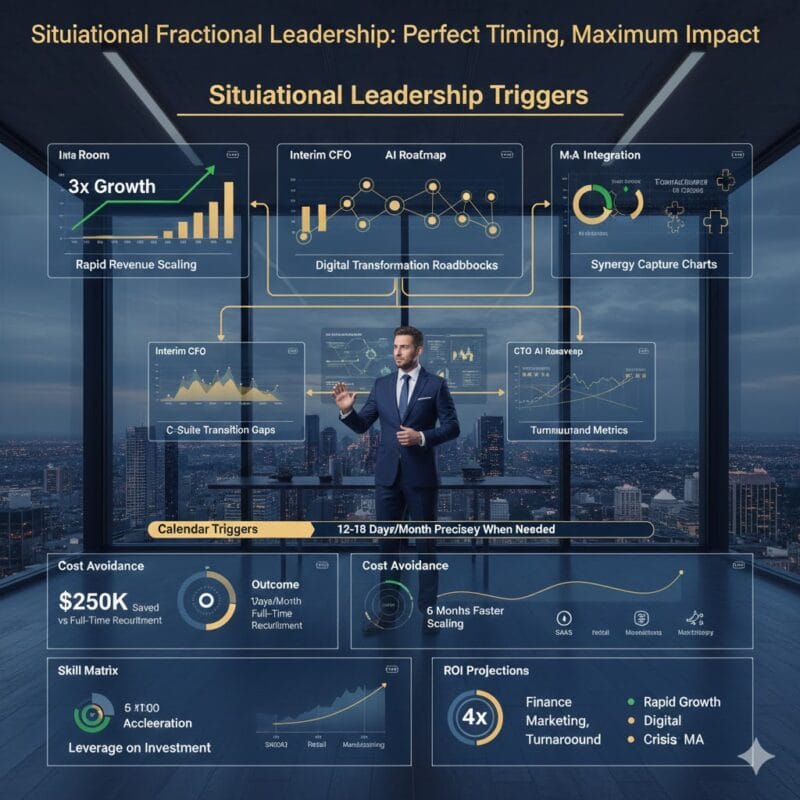
Traditional C-suite structures can sometimes fall short in addressing specific, time-sensitive, or specialized organizational needs. Flexible executive talent bridges these gaps effectively.
Addressing Skill Gaps in Niche Areas
US companies frequently require specialized expertise for emerging technologies, market entry strategies, or highly regulated sectors, where the need is critical but temporary. Fractional leadership provides this unique skillset without permanent commitment.
Navigating Rapid Growth Phases
Scaling operations demands strategic guidance without over-committing to permanent staff. Contract C-suite professionals establish foundational processes and strategies, ensuring sustainable expansion.
Crisis Management and Turnarounds
In periods of crisis, experienced external leadership provides an objective perspective and critical decision-making capabilities to navigate challenging situations effectively.
Project-Specific Leadership Needs
For initiatives like launching new products, entering new markets, M&A integration, or strategic partnerships, a dedicated, experienced executive is invaluable without the overhead of a full-time position.
Budgetary Constraints for Permanent Hires
Accessing top-tier executive talent at a reduced total cost is a primary driver. This model allows organizations to secure high-caliber strategic input that would otherwise be financially out of reach.
Value Proposition of Agile Executive Talent
A thorough analysis of the financial and strategic benefits underscores the increasing viability of contract leadership.

Reduced Overhead and Enhanced Financial Discipline
Fractional engagements lead to significant savings compared to a full-time employee, eliminating costs associated with benefits, payroll taxes, and dedicated office space. This allows a focus on deliverable-based compensation, enhancing financial discipline. This directly addresses: How do fractional executives reduce hiring costs?
Access to Top-Tier Expertise without Permanent Commitment
Organizations can harness decades of executive experience for critical initiatives, avoiding the long-term cost of an underutilized or mismatched executive. JRG Partners specializes in identifying these highly experienced professionals.
Faster Time-to-Impact
Experienced contract professionals, adept at rapid assimilation and strategic execution, hit the ground running, delivering immediate strategic contribution. JRG Partners’ rigorous screening ensures quick integration and measurable impact.
Potential for Higher Hourly Rates vs. Total Compensation
While hourly rates may appear higher, the overall value proposition, measured against the absence of benefits, taxes, and other associated costs, often results in a significantly lower total cost of engagement and a higher return on investment per engagement.
Quantifying ROI: Case Studies and Metrics
Data suggests substantial returns. JRG Partners’ proprietary tracking indicates that companies leveraging fractional executive leadership experience an average increase of 20% in efficiency within their targeted operational areas post-engagement. Additionally, direct revenue growth or significant cost savings are frequently attributed to the strategic interventions of these agile leaders.
Identifying High-Caliber Contract Leadership
The success of a fractional engagement hinges on a rigorous selection process, as advocated by JRG Partners’ robust advisory framework.
Assessing Experience and Industry Fit
Candidates must possess a proven track record in relevant sectors and roles, coupled with a deep understanding of specific industry challenges and opportunities within the US market. Our internal JRG Partners’ database reveals successful placements demonstrating specific sector mastery.
Evaluating Cultural Alignment and Leadership Style
The ability to seamlessly integrate and inspire existing teams is paramount. Compatibility with the company’s values and work environment ensures effective collaboration. How do you align fractional leaders with company culture? Our proprietary assessment tools evaluate soft skills and cultural congruence.
Crucial Soft Skills: Adaptability, Communication, Strategic Thinking
High-impact fractional leaders demonstrate a profound capacity to quickly understand complex organizational dynamics, engage in effective stakeholder management, and articulate clear, actionable strategic goals.
Vetting Processes: Referrals, Interviews, Project Portfolios
JRG Partners employs thorough background checks, extensive reference validation, and in-depth reviews of past project portfolios and measurable achievements. This robust vetting process specifically addresses: What vetting processes identify top fractional talent?, ensuring only the most qualified candidates are presented.
Optimizing Engagement: Onboarding and Integration Best Practices
A well-structured onboarding process is critical for maximizing the effectiveness of a new fractional executive.

Clear Definition of Scope, Goals, and KPIs
From day one, establishing measurable objectives, documenting clear expectations, and outlining responsibilities are paramount for mutual understanding and accountability.
Establishing Communication Channels and Reporting Structures
Regular check-ins, transparent progress reports, and clearly defined lines of authority are essential for effective collaboration within the leadership team.
Introducing to Key Stakeholders and Teams
Facilitating initial meetings and ensuring broad introductions help build rapport and trust quickly, fostering a sense of inclusion for the new leader.
Providing Necessary Resources and Access
Ensuring immediate access to critical data, systems, and relevant personnel, alongside appropriate administrative support, accelerates the executive’s ability to contribute.
Setting Expectations for Collaboration and Deliverables
Fostering a collaborative environment with clear timelines and quality standards for outputs ensures that the engagement remains productive and goal-oriented.
Structuring Engagements for Maximal Return
The contractual framework is a critical element in ensuring a successful and productive fractional engagement. It is here that organizations must carefully consider: What contract terms maximize fractional executive impact?
Fixed-Term vs. Retainer Models
- Fixed-Term: Ideal for project-specific needs with clearly defined end dates and deliverables.
- Retainer: Suits ongoing strategic guidance, specified by a set number of hours or days per month, offering sustained expertise.
Defining Deliverables, Milestones, and Success Metrics
Contracts must explicitly outline specific outputs, not merely time spent, linking performance indicators directly to overarching business objectives and strategic initiatives. This aligns the executive’s efforts with the organization’s fiduciary duty to shareholders.
Intellectual Property and Confidentiality Clauses
Robust clauses protecting company assets, proprietary information, and non-disclosure agreements are non-negotiable elements in any executive service agreement to safeguard corporate interests.
Termination Clauses and Offboarding Strategy
Clear conditions for ending the engagement, whether by either party, alongside a well-defined offboarding strategy for smooth handover of responsibilities and knowledge transfer, are crucial for business continuity.
Performance Reviews and Feedback Loops
Regular assessments against agreed-upon KPIs, coupled with continuous feedback loops, allow for scope adjustments and ensure the fractional executive’s contribution remains aligned with evolving strategic priorities.
Pathways to Permanent Executive Integration
While designed for flexibility, fractional roles can sometimes evolve into permanent positions, particularly in the US market where long-term talent acquisition remains a challenge.
When a Fractional Role Becomes Indispensable
A fractional engagement often becomes a strategic asset when the need for that specific expertise transitions from temporary to long-term and becomes deeply embedded within the organization’s core operations. Proving sustained value and demonstrating cultural fit are key indicators.
Strategies for Converting Fractional to Full-Time
The conversion process typically involves negotiating new terms and compensation structures commensurate with a permanent executive role, culminating in a new employment agreement. Fractional engagements can serve as an extended, low-risk interview process.
Succession Planning and Knowledge Transfer
Even if a fractional executive does not convert, their engagement must include provisions for robust succession planning and comprehensive knowledge transfer to internal teams, ensuring the continuity of initiatives and capabilities development.
Avoiding Dependency: Building Internal Capabilities
A successful fractional engagement empowers internal staff, building internal capabilities and developing talent pools to eventually manage functions independently. JRG Partners advises clients on strategies to foster this internal growth, preventing undue dependency on external resources. Our data indicates that how often do fractional hires convert to full-time? JRG Partners observes a conversion rate of nearly 40% for its placements in critical C-suite roles within the US market.
The Future Executive Talent Landscape in the US
The trajectory of executive talent acquisition points towards an increasingly flexible, outcome-driven model.

The Gig Economy’s Evolution into Executive Roles
The blurring lines between traditional employment and flexible work arrangements are reshaping corporate talent architecture. There is an increasing demand for project-based executive talent, with JRG Partners’ research indicating a significant acceleration in this trend across the US.
Increased Acceptance Across Industries and Company Sizes
From agile startups and robust SMEs to vast public enterprises, the acceptance of fractional leadership is growing. This model is even gaining traction in highly regulated US industries that typically favor permanent structures, leveraging specialized expertise for compliance and innovation.
Technology’s Role in Facilitating Fractional Engagements
Advanced platforms for connecting executive talent with opportunities, coupled with sophisticated remote work tools, are enabling seamless collaboration regardless of geographical location, profoundly impacting US corporate governance and talent accessibility.
Impact on Traditional Corporate Structures
This shift will likely foster more agile, flatter organizational models, emphasizing outcomes and value realization over rigid hierarchies. It represents a fundamental recalibration of human capital management.
The Rise of Fractional Talent Platforms
Specialized marketplaces for C-suite and senior leadership roles are proliferating. Our research forecasts the market for executive gig platforms to grow by 25% annually over the next five years, indicating a significant transformation. Given these trajectories, boards must consider: Will fractional C-suites dominate by 2030? While full domination is improbable, our research indicates that the demand for agile, project-based executive leadership has surged by 300% in the past year alone within the US market, solidifying its place as a critical component of executive talent strategy.
Concluding Remarks
The strategic deployment of fractional executives represents a sophisticated evolution in US corporate talent management. By embracing this model, boards and C-suite leaders can enhance organizational agility, optimize resource allocation, and ensure continuous access to world-class expertise, thereby fulfilling their fiduciary duty to drive sustainable growth and innovation in an ever-changing economic climate. JRG Partners stands ready to guide your organization through this critical talent architecture transformation.
Frequently Asked Questions: The Rise of Fractional C-Suite Talent
1. What exactly is a Fractional C-Suite executive?
A Fractional C-Suite executive is an experienced leader (such as a CFO, CMO, or CTO) who provides high-level strategic guidance to a company on a part-time, contract, or “fractional” basis. Unlike consultants who only offer advice, fractional executives embed themselves in the leadership team to execute strategies and manage operations.
2. Why are companies choosing fractional talent over full-time hires?
The primary drivers are cost-efficiency and agility. Small to mid-sized companies often need enterprise-level expertise but lack the budget for a $300k+ annual salary. Fractional leaders allow firms to access top-tier talent for specific growth phases or transitions without the long-term overhead of a full-time executive package.
3. How does a fractional executive integrate into an existing company culture?
Successful integration relies on clear communication and defined objectives. Because fractional leaders are veterans in their fields, they are accustomed to “plug-and-play” environments. They focus on immediate value-add, mentorship of junior staff, and establishing processes that persist even after their tenure ends.
4. What are the key benefits of the “Rise of Fractional Talent” for startups?
For startups, fractional talent provides “grown-up” leadership during critical Series A or B funding rounds. They offer immediate credibility to investors, help avoid costly “rookie” mistakes in scaling, and allow the founders to focus on product and vision while the fractional leader handles specialized operations.
5. Is fractional leadership a long-term solution or a temporary fix?
It can be both. Some organizations use fractional talent as a bridge during a search for a permanent hire (interim leadership), while others maintain fractional roles for years to keep their leadership structure lean and specialized. The model is designed to scale up or down based on the company’s evolving needs.
In conclusion, the rise of fractional executives represents a strategic shift toward agility and specialized expertise in modern corporate governance. By leveraging contract C-suite talent, organizations can navigate complex transitions, fill critical leadership gaps, and drive immediate results without the long-term commitment of a traditional hire. JRG Partners is here to help you capitalize on this trend, providing the executive search expertise and tailored C-suite talent solutions necessary to keep your business moving forward in an increasingly fluid market.

Tanya Gallardo
Managing Director, Executive Search & AI Talent Strategy
Tanya Gallardo is the Managing Director of Executive Search & AI Talent Strategy at JRG Partners, leading C-suite and Board engagements across key growth sectors including Technology, Financial Services, and Manufacturing.
With over 18 years of experience specializing in disruptive technology leadership, Tanya is recognized as a leading authority on talent architecture for future-focused executive roles, such as the Chief AI Officer (CAIO) and Chief Digital Officer (CDO). Her expertise lies in accurately assessing the cultural fit and technical depth required to ensure a high return on investment (ROI) for critical leadership appointments.
Prior to her role at JRG Partners, Tanya held senior roles directing global talent acquisition strategies at a major publicly-traded technology firm, advising on organizational design and succession planning for emerging executive functions. She is a recognized speaker and contributor to industry events, sharing data-driven insights on executive compensation, leadership development, and the measurable business impact of C-suite talent.
