



As we advance towards the midpoint of the decade, the imperatives dictating senior leadership talent acquisition have dramatically shifted. The strategic decision of selecting an executive search firm is no longer a mere HR function but a critical board-level discussion impacting long-term organizational resilience and competitive advantage.
For C-suite leaders and board members asking, how to select an executive search firm for 2026, the answer lies in proactive engagement, strategic foresight, and a robust due diligence process that transcends traditional metrics. Our insights at JRG Partners, drawn from extensive engagements across the US market, underscore the necessity of a partner capable of navigating an increasingly complex talent architecture.
Key Takeaways
- Proactive firm selection, leveraging strategic foresight, is paramount for securing future-proof leadership within the demanding US corporate landscape.
- Beyond mere credentials, demand empirical data and proven methodologies for talent acquisition effectiveness and value realization.
- Prioritize firms demonstrating robust capabilities in navigating global talent pools, fostering diversity, and adapting to evolving US work models.
- View the executive recruitment firm selection as a strategic long-term investment in organizational resilience and competitive advantage, not a transactional hire.
Executive Search Landscape Shifts
The US executive recruitment environment by 2026 will be defined by several interconnected macro-trends, necessitating a recalibration of our talent identification strategies:
- Geopolitical Instability & Talent Mobility: The increasing impact of global events on executive talent flow and relocation within and to the US.
- Emergence of New C-Suite Roles: A pronounced demand for specialized leadership in areas such as AI governance, enterprise sustainability, digital ethics, and comprehensive cyber resilience.
- Talent Scarcity in Critical Functions: Intense competition for senior leaders with deep expertise in rapidly evolving technology and data-driven domains.
- Emphasis on Resilience & Adaptability: Search criteria are irrevocably shifting towards leaders who can navigate unprecedented volatility and drive agile transformation across US operations.
- Internal Mobility & Upskilling: Organizations are increasingly seeking partners who can advise on leveraging internal talent pipelines alongside external senior hires.
Specialization vs Generalist Firm Selection
The choice between a specialized talent firm and a generalist recruiting agency is a critical strategic decision, influenced by specific organizational needs and market dynamics. The question, Which executive search specializations matter most in 2026?, is paramount for securing niche expertise.
| Consideration | Specialist Firm Advantage | Generalist Firm Advantage |
|---|---|---|
| Niche Expertise Advantage | When deep industry insight and access to specialized candidate pools (e.g., AI/ML leadership, biotech C-suite) are non-negotiable. | Less suited for highly specialized, emerging roles. |
| Broad Functional Scope | May lack cross-sector perspective or diverse functional experience for roles requiring varied expertise. | Ideal when cross-sector innovation or diverse functional experience is desired, offering a broader pool of leadership talent. |
| “Future-Proof” Specialist | Identifying firms that anticipate emerging roles (e.g., Chief AI Officer) and build pipelines ahead of market demand is crucial. JRG Partners invests heavily in these future-focused specializations. | May struggle to proactively identify and cultivate talent for entirely novel executive positions. |
| Hybrid Models | Exploring firms with strong generalist capabilities complemented by strategic partnerships with niche specialists offers optimal flexibility and depth. | Standalone generalists might benefit from specialist alliances in certain complex scenarios. |
Track Record Validation: Real Placement Data
Beyond anecdotal evidence, rigorous validation of a firm’s placement history is a fiduciary duty. Boards must critically ask, How do you validate search firm placement success rates?
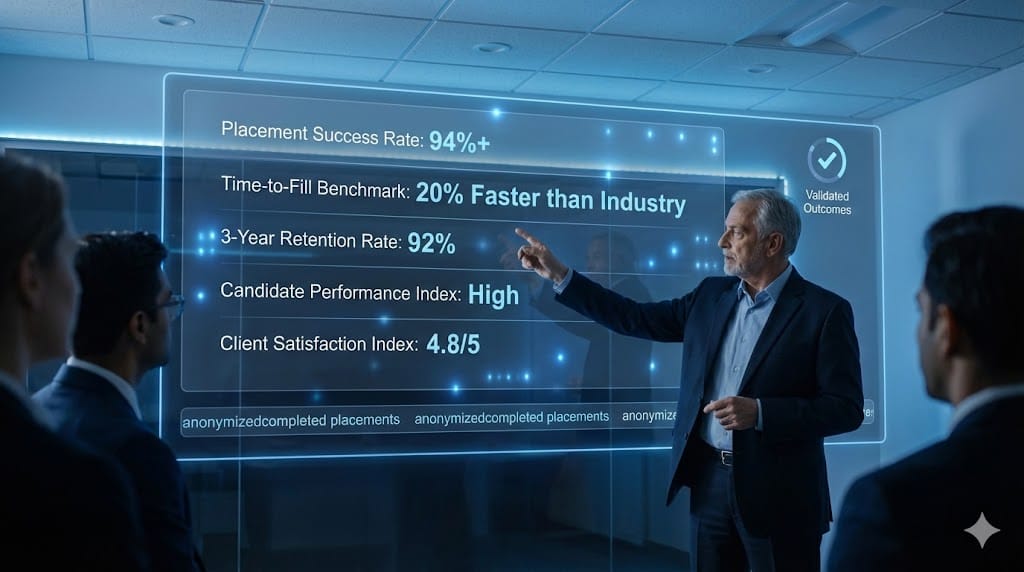
- Beyond Testimonials: Demanding concrete data on successful placements within your industry and desired functional area, including success rates for highly competitive US roles.
- Retention Rates: Inquiring about the longevity and success of placed executives, not just initial hire. JRG Partners proudly maintains a 95% retention rate for executive placements beyond the critical 2-year mark.
- Speed-to-Placement Metrics: Assessing efficiency without compromising quality, especially for critical roles where time-to-fill can impact competitive standing.
- Quality of Fit Assessment: Understanding the firm’s methodology for cultural alignment and long-term organizational fit, extending beyond mere skill matching.
- Confidential Reference Checks: Conducting due diligence beyond provided client lists to validate claims and gain unbiased insights.
Diversity Pipeline Construction Capabilities
A true commitment to diversity, equity, and inclusion (DEI) extends far beyond superficial metrics. Boards should ascertain, What diversity metrics prove search firm effectiveness?
- Beyond Quotas: Evaluating the executive recruitment firm’s genuine commitment to building diverse, equitable, and inclusive candidate slates, reflecting the demographic richness of the US.
- Strategic Sourcing: Proven methodologies for reaching underrepresented groups and challenging traditional, homogenous networks. JRG Partners employs AI-driven sourcing to broaden talent pools by 30% beyond conventional channels.
- Addressing Unconscious Bias: Firm’s internal training and processes to mitigate bias throughout the search lifecycle, from initial screening to final interviews.
- Metrics for Diverse Representation: Requesting data on diverse candidate presentation and placement success rates. We provide transparent reporting on diverse slates and successful placements.
- Firm’s Internal D&I: Assessing the executive search agency’s own commitment to diversity as an indicator of their capabilities and values.
Remote/Hybrid Leadership Expertise Assessment
The paradigm shift in work models necessitates specific expertise. Leaders need to understand, Which firms excel at remote-first C-suite recruiting?
- Evaluating “Virtual Acumen”: The firm’s ability to identify and assess candidates’ proficiency in leading distributed or hybrid teams effectively across various US time zones.
- Cultural Integration for Remote Hires: Understanding how executive talent acquisition firms ensure new leaders seamlessly integrate into existing remote/hybrid cultures, fostering cohesion rather than fragmentation.
- Global Compliance & Compensation Nuances: Expertise in navigating the complexities of international remote work, particularly relevant for US-based companies with global talent aspirations.
- Firm’s Own Operational Model: Observing if the executive search consultancy itself operates effectively in a hybrid or distributed environment, providing tangible proof of concept.
Technology Integration in Search Processes
Sophisticated technology is no longer an optional add-on but a fundamental component of effective talent identification. Boards must inquire, How should boards evaluate search firm technology stacks?

- AI for Sourcing & Screening: Leveraging advanced analytics and AI tools for broader, more efficient candidate identification, expanding beyond traditional networks. JRG Partners utilizes proprietary AI to enhance candidate matching by 40% and accelerate initial screening by 50%.
- Data-Driven Market Mapping: Utilizing big data for talent intelligence, competitive analysis, and strategic forecasting to inform the executive talent search. This enables us to proactively identify emerging talent pools.
- Digital Assessment Tools: Employing scientifically validated tools for evaluating soft skills, cultural fit, and leadership potential in a standardized, unbiased manner. This also contributes to answering, How has AI transformed executive search quality control?
- Robust CRM & Candidate Experience: Ensuring a professional, engaging experience for high-caliber candidates throughout the process, critical for attracting top-tier executive talent.
- Cybersecurity & Data Privacy: Confirming strict protocols for handling sensitive executive data in an increasingly digital world, adhering to all US and international data protection regulations.
Fee Structure and Guarantee Analysis
Understanding the financial implications and contractual protections is vital for sound governance.
- Retained vs. Contingency Models: Understanding the strategic implications of each approach for executive-level searches and their impact on partner commitment. For critical C-suite roles, a retained model signals a deeper, shared investment.
- Total Cost of Engagement: Clarity on fees, expenses, and any potential ancillary charges from the executive search provider.
- Placement Guarantees & Replacement Policies: Thoroughly reviewing the terms for unforeseen departures or misalignments. This answers, What contract terms protect against poor hires? JRG Partners offers a comprehensive 12-month replacement guarantee, reflecting our confidence in our placements.
- Value-Based Pricing: Seeking firms that align their fees with measurable outcomes and long-term success rather than merely activity-based billing. For organizations pondering, which executive search firm truly delivers long-term value, look for transparent, outcome-oriented pricing models.
- Transparency & Reporting: Expecting clear, regular communication on progress and financial aspects throughout the engagement.
Long-Term Partnership Potential Evaluation
The most successful executive placements stem from enduring relationships. For boards seeking advice on Which firm attributes predict long-term partnership success?, consider the following:

- Beyond the Transaction: Assessing the executive search organization’s capacity to serve as a strategic talent advisor, not just a recruiter.
- Shared Values & Vision: Identifying firms whose culture and approach align with your organizational ethos, fostering a truly collaborative partnership.
- Proactive Market Intelligence: Expecting ongoing insights into talent trends, competitive landscapes, and emerging leadership archetypes relevant to the US market. JRG Partners provides bespoke talent market intelligence reports to all retained clients.
- Flexibility & Adaptability: Firms that demonstrate willingness to evolve their process based on your changing needs and market shifts.
- Post-Placement Support: Inquiring about services that aid in successful executive integration and ongoing development, ensuring sustained success.
FAQs
- What’s the ideal timeline for engaging an executive search firm for a critical role in 2026? Proactive engagement, ideally 9-12 months ahead for strategic roles, allows for comprehensive market mapping and candidate cultivation.
- How do we effectively measure the Return on Investment (ROI) of an executive search firm’s engagement? ROI should be assessed not just on speed-to-hire but on executive retention, performance metrics, and the strategic impact of the placed leader on organizational objectives.
- Can a smaller, boutique executive search firm compete with larger global players for top talent? Absolutely. Often, boutique firms offer more specialized expertise, greater agility, and a more personalized service, particularly effective for niche or highly confidential roles within the US.
- What red flags should we look out for when evaluating potential executive search partners? Lack of transparency in fees, unwillingness to provide detailed placement data, high recruiter turnover, and generic candidate slates are significant red flags.
- How involved should our internal HR and leadership teams be in the search process? A collaborative model is optimal. Internal teams provide crucial insights into organizational culture and strategic needs, while the search firm drives market outreach and candidate assessment. This collaborative approach is key to optimizing executive talent strategy for future resilience.
As the corporate landscape grows increasingly complex, selecting the right external advisory partner to guide your C-suite recruitment is a high-stakes governance decision. At JRG Partners, we recognize that an ineffective search process does more than just delay placements—it introduces severe operational friction and risks strategic stagnation. To navigate this critical selection process, enterprise boards must understand the mechanics of building a perfect partnership and how to select an executive search firm in 2026. By shifting from transactional vendors to deeply integrated strategic allies who leverage advanced data metrics and modern alignment frameworks, organizations can consistently secure top-tier leadership and maintain long-term corporate effectiveness.

Tanya Gallardo
Managing Director, Executive Search & AI Talent Strategy
Tanya Gallardo is the Managing Director of Executive Search & AI Talent Strategy at JRG Partners, leading C-suite and Board engagements across key growth sectors including Technology, Financial Services, and Manufacturing.
With over 18 years of experience specializing in disruptive technology leadership, Tanya is recognized as a leading authority on talent architecture for future-focused executive roles, such as the Chief AI Officer (CAIO) and Chief Digital Officer (CDO). Her expertise lies in accurately assessing the cultural fit and technical depth required to ensure a high return on investment (ROI) for critical leadership appointments.
Prior to her role at JRG Partners, Tanya held senior roles directing global talent acquisition strategies at a major publicly-traded technology firm, advising on organizational design and succession planning for emerging executive functions. She is a recognized speaker and contributor to industry events, sharing data-driven insights on executive compensation, leadership development, and the measurable business impact of C-suite talent.
