



At JRG Partners, a leading US-based executive search firm, we understand that executive talent represents the apex of an organization’s strategic investment. The profound impact of a suboptimal executive placement—often termed “hiring regret”—extends far beyond immediate financial considerations, profoundly eroding shareholder value, strategic momentum, and organizational morale.
This memo outlines a critical framework for strategic due diligence, an indispensable component of modern leadership advisory designed to safeguard your enterprise against these pervasive risks.
Key Takeaways for Board and C-Suite Oversight
- Executive hiring regret imposes a significant drain on organizational resources, jeopardizing strategic momentum and team morale. Proactive, comprehensive due diligence is therefore not merely prudent, but an absolute fiduciary duty.
- A multi-faceted, deep-dive due diligence process, extending far beyond superficial checks, is crucial for accurately assessing an executive’s true capabilities, leadership efficacy, and intrinsic cultural fit.
- Successful mitigation involves a holistic approach, scrutinizing past performance, cultural alignment, and identifying potential termination risks across previous tenures.
- Integrating advanced verification protocols and robust stakeholder validation protects strategic investments and is paramount for ensuring leadership alignment with long-term objectives.
- Due diligence is not a singular event; a structured post-hire reality check framework is essential for validating initial assessments and ensuring successful integration and sustained impact.
The Strategic Imperative of Advanced Executive Due Diligence
The cascading impact of an executive mis-hire reverberates throughout a company’s entire talent architecture, directly affecting strategy execution, financial performance, and organizational culture. Beyond the direct financial costs, which studies indicate can range from 2x to 7x their annual salary depending on the role and industry, the indirect consequences are profound: erosion of market position, critical project delays, loss of institutional knowledge, and irreparable reputational damage.
Traditional, superficial talent acquisition processes are fundamentally inadequate for executive-level appointments, which carry unique, systemic risks. At JRG Partners, our rigorous 12-step executive vetting process is meticulously designed to uncover these latent risks, ensuring robust talent integration.
Anatomy of Executive Hiring Failure Patterns
Deconstructing the common red flags often overlooked in high-stakes appointments is crucial. These can include inconsistencies in career progression, exaggerated achievements, unverified team leadership claims, and a demonstrable lack of strategic adaptability. We contend that cognitive biases—such as the “halo effect,” confirmation bias, and affinity bias—can significantly cloud judgment during the executive recruitment process.
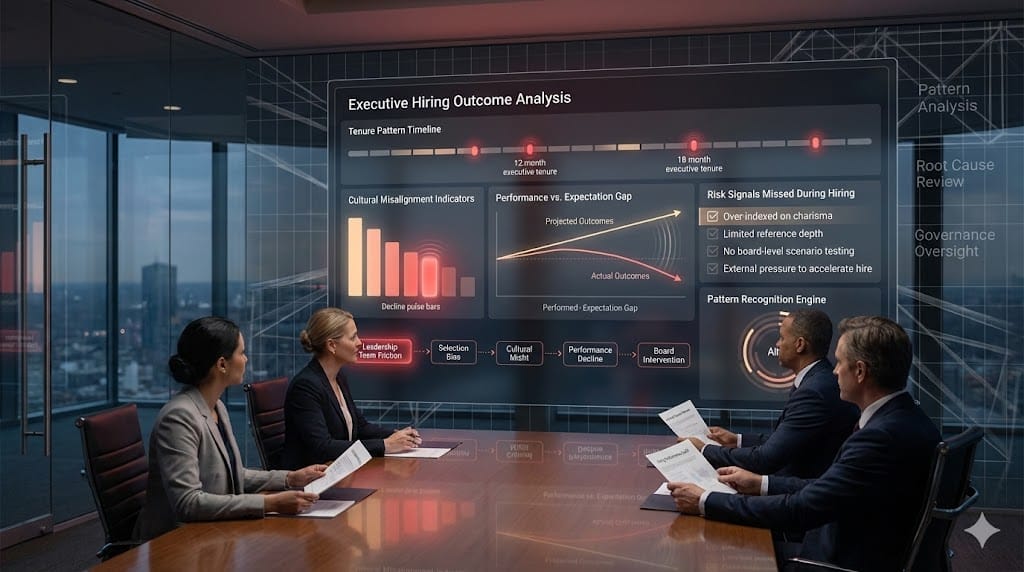
Differentiating between perceived competency or charisma and demonstrable, consistent performance within diverse organizational contexts is paramount. We actively seek to understand Which patterns predict executive failure within first 18 months? and to identify underlying issues that lead to failure, such as misaligned leadership styles, an inability to translate vision into execution, ethical lapses, or poor stakeholder management.
Deep-Dive Credential Verification Protocols
Our methodology for credential validation extends to methodical verification of all academic qualifications, professional certifications, and stated credentials directly with primary issuing institutions. This includes rigorous scrutiny of career progression for unexplained gaps, unusual demotions, or rapid, unmerited promotions. We validate company names, exact dates of employment, and reported titles directly with HR or credible third-party sources. We then cross-reference stated responsibilities and achievements with industry benchmarks and typical organizational structures for those roles.
Furthermore, leveraging specialized firms for advanced background checks covering criminal records, financial solvency, regulatory compliance, and potential litigation history is a standard practice. Looking ahead, we anticipate that the question of Will AI background verification become standard by 2030? will be answered with a resounding affirmative, though human insight will always remain critical for nuanced executive assessments.
Reference Interviews That Reveal Hidden Truths
Strategically moving beyond provided references is a hallmark of superior due diligence. We seek to connect with former direct reports, peers, and supervisors (with candidate consent, where legally and ethically appropriate) to gain a 360-degree perspective. Employing structured, behavioral interviewing techniques designed to uncover specific examples of leadership style, conflict resolution, decision-making, and organizational impact is central to this. We probe deeply for specific instances of success, significant failures, and the learning derived from challenges.
Critically, What specific reference questions expose executive performance gaps? lies at the heart of our methodology. We also leverage professional networks and publicly available information to identify and validate “indirect” references, which often offer broader, unvarnished perspectives. Our experts are adept at interpreting evasive answers, overly glowing recommendations without specific examples, or notable silences as potential areas for further investigation.
360° Stakeholder Validation Across Tenures
Systematically gathering comprehensive insights from a wide array of former colleagues, board members, investors, key clients, and strategic partners provides an invaluable, multi-dimensional view. This process assesses the consistency of the candidate’s performance, leadership behavior, and ethical conduct across different organizational cultures, industry cycles, and leadership structures. It also identifies patterns in collaboration, influence, team development, and external relationship management.

Understanding how the candidate navigated significant organizational changes, crises, political landscapes, and market disruptions in various past roles is paramount. Ultimately, What 360 validation reveals cultural mismatch risks? is a question central to our approach, ensuring that we contribute to ensuring leadership alignment with long-term objectives that are foundational to your long-term success.
Performance Data Extraction from Prior Roles
Actively seeking quantifiable metrics and verifiable achievements directly attributable to the candidate—such as revenue growth, market share expansion, cost reduction, successful product launches, or M&A integration—is fundamental. We disaggregate individual contributions from broader team or organizational successes to understand true impact. Our approach includes contextualizing performance data within the specific market conditions, company stage, available resources, and competitive landscape of previous roles.
How do you verify claimed business outcomes against company records? is a critical line of inquiry for us. We also prioritize analyzing leadership outcomes such as talent retention rates, successful succession planning, and the development of high-performing teams, ensuring we discern How do you extract real performance data from vague executive narratives?.
Cultural Fit Assessment Beyond Surface Signals
Clearly defining the organization’s core values, desired leadership behaviors, strategic culture, and long-term vision forms the bedrock of this assessment. We utilize sophisticated behavioral interview questions and psychometric assessments to probe past experiences related to adaptability, innovation, risk appetite, collaboration, and resilience. Assessing the candidate’s alignment with the company’s decision-making processes, communication styles, ethical frameworks, and desired employee experience is critical.
Proactively identifying potential areas of friction or misalignment can significantly hinder integration, engagement, and long-term impact on the team and wider organization. Research indicates that over 50% of executive failures are attributable to poor cultural fit, leading to high turnover and diminished team performance.
Termination Risk Pattern Recognition
Thoroughly analyzing reasons for all past departures is a non-negotiable step: distinguishing between voluntary resignations, strategic realignments, and involuntary terminations. Identifying patterns of short tenures, frequent job changes without clear upward trajectory, or lateral moves with diminished responsibility provides crucial insights. We investigate any history of legal disputes, ethical complaints, regulatory investigations, or significant organizational controversies.

A key aspect is understanding the candidate’s narrative around past dismissals or difficult transitions and rigorously cross-referencing it with external accounts. This allows us to accurately answer Which termination patterns signal hiring red flags? and advise accordingly.
Post-Hire 90-Day Reality Check Framework
Our partnership extends beyond placement. Establishing clear, measurable, and mutually agreed-upon strategic objectives and key results (OKRs) for the executive’s first 30, 60, and 90 days is essential. Implementing a rigorous schedule of regular, structured check-ins with the new executive, their direct reports, peers, and relevant stakeholders is standard. Monitoring early performance indicators—such as strategic alignment with organizational goals, successful team integration, quality of decision-making, and initial cultural impact—is vital.
Gathering proactive and reactive feedback from critical internal and external stakeholders helps to validate initial assessments and identify potential integration challenges. Establishing a formal review process at the 30, 60, and 90-day marks provides constructive feedback, allows for objective adjustments, and ensures the executive is on track for long-term success. This answers the critical question: What post-offer due diligence prevents regret hires?
Legal and Ethical Safeguards in Executive Due Diligence
Ensuring strict compliance with all relevant data privacy regulations (e.g., GDPR, CCPA) and US employment laws across all jurisdictions involved is paramount. Obtaining explicit written consent from the candidate for all background checks, reference outreach, and data processing activities is a fundamental ethical and legal safeguard.
Maintaining strict confidentiality throughout the entire executive vetting process protects both the organization and the candidate. Adhering to non-discriminatory practices, focusing solely on job-related qualifications, past performance, and professional conduct, reinforces the integrity of the process.
Building a Robust Internal Due Diligence Competency
Investing in continuous training for HR professionals, executive recruiters, and hiring managers on advanced due diligence techniques, legal compliance, and critical assessment skills is a strategic imperative. Developing standardized protocols, comprehensive checklists, and templated reporting for all executive vetting processes ensures consistency and rigor. Strategically leveraging external expertise—such as JRG Partners’ deep industry knowledge and extensive network for specialized checks, forensic analysis, and geopolitical risk assessments—is prudent where internal capabilities are limited.
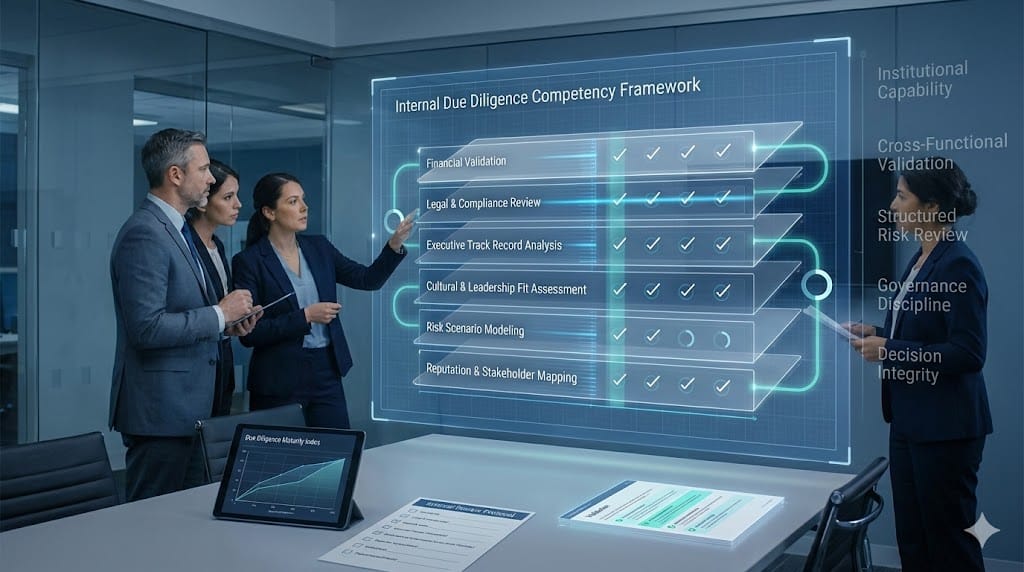
Cultivating an organizational culture that prioritizes thoroughness, critical questioning, and long-term risk mitigation in all executive hiring decisions is key to sustainable success. JRG Partners prides itself on a 98% executive retention rate for placements exceeding three years, a testament to our commitment to comprehensive due diligence and sustainable leadership.
Frequently Asked Questions for Executive Boards
Q1: How far back should executive due diligence typically extend?
A: Generally, a comprehensive due diligence process should cover the past 10-15 years of an executive’s career, or the entirety of their executive-level roles, focusing on significant leadership positions and strategic impacts.
Q2: Is it ethical to contact references not provided by the candidate?
A: While common in executive search, it is best practice and often legally required to obtain explicit permission from the candidate before contacting individuals outside their provided reference list. Proceeding without consent can strain trust and pose legal risks.
Q3: What is the most common mistake companies make in executive due diligence?
A: The most frequent error is an over-reliance on a candidate’s resume and provided references, coupled with an underestimation of cultural fit’s importance. This often stems from rushing the process due to perceived urgency or the desire to fill a critical role quickly.
Q4: Can technology and AI genuinely automate parts of executive due diligence?
A: Yes, AI and advanced data analytics can significantly assist in initial screenings, public record checks, social media analysis, and identifying potential red flags from vast datasets. However, human judgment, qualitative assessment, and nuanced interview skills remain indispensable for executive-level vetting.
Q5: How can a smaller organization conduct effective executive due diligence without extensive resources?
A: Smaller organizations can prioritize critical verification points, strategically leverage their existing professional networks and industry contacts, and consider focused outsourcing for key specialized checks (e.g., criminal background, financial forensics) rather than attempting a full, in-house deep dive on every aspect.
Conclusion: Elevating Talent Governance for Future Success
The strategic imperative of robust executive due diligence cannot be overstated. In an increasingly complex talent landscape, the costs of a mis-hire—both tangible and intangible—are simply too high for any forward-thinking organization to bear. By embracing a deep-dive, multi-faceted approach, informed by the expertise of firms like JRG Partners, Boards and C-Suites can significantly enhance their talent governance, ensuring not only the selection of highly capable leaders but also their successful integration and long-term impact. This proactive stance is the most effective defense in preventing executive mis-hires and cementing a resilient, high-performing leadership team ready to navigate future challenges and opportunities while maximizing long-term corporate effectiveness.

Tanya Gallardo
Managing Director, Executive Search & AI Talent Strategy
Tanya Gallardo is the Managing Director of Executive Search & AI Talent Strategy at JRG Partners, leading C-suite and Board engagements across key growth sectors including Technology, Financial Services, and Manufacturing.
With over 18 years of experience specializing in disruptive technology leadership, Tanya is recognized as a leading authority on talent architecture for future-focused executive roles, such as the Chief AI Officer (CAIO) and Chief Digital Officer (CDO). Her expertise lies in accurately assessing the cultural fit and technical depth required to ensure a high return on investment (ROI) for critical leadership appointments.
Prior to her role at JRG Partners, Tanya held senior roles directing global talent acquisition strategies at a major publicly-traded technology firm, advising on organizational design and succession planning for emerging executive functions. She is a recognized speaker and contributor to industry events, sharing data-driven insights on executive compensation, leadership development, and the measurable business impact of C-suite talent.
