


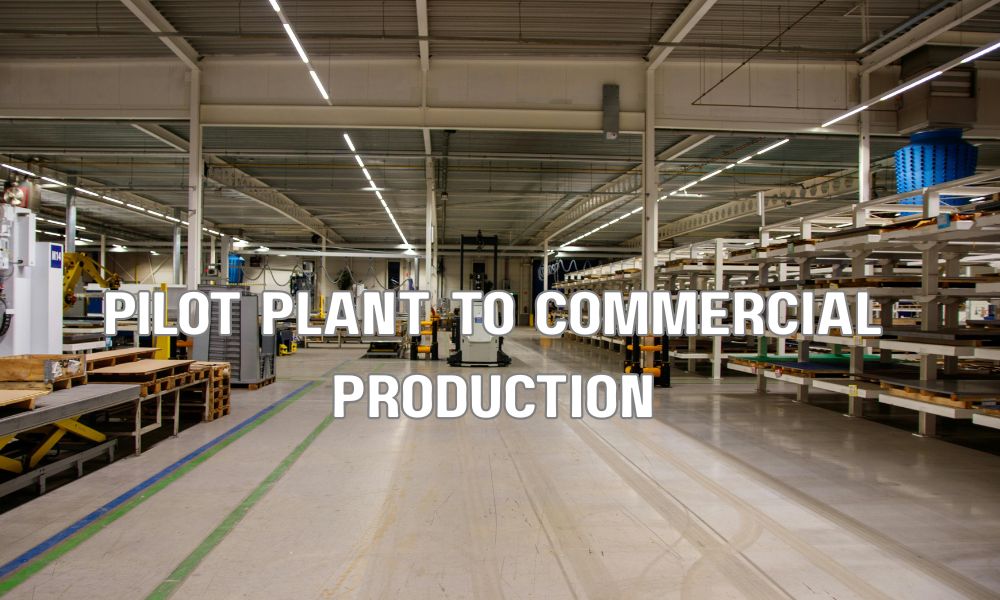
The FoodTech industry has entered a critical, uncompromising phase of maturity. Over the past decade, venture capital has poured billions of dollars into alternative proteins, precision fermentation, cultivated meat, and advanced vertical farming. These investments funded brilliant scientific breakthroughs, allowing startups to successfully prove their concepts in the laboratory and validate their technologies at the pilot scale. However, the ecosystem has now reached a massive structural bottleneck: the transition from pilot-scale validation to full-scale, profitable commercial production.
This transition is notoriously referred to as the “Valley of Death” in industrial biotechnology and food science. The physics, biology, and economics of producing fifty liters of a novel protein in a benchtop bioreactor are fundamentally different from producing five hundred thousand liters in a commercial facility. Navigating this chasm requires hundreds of millions of dollars in capital expenditure (CapEx), flawless supply chain logistics, and rigorous regulatory navigation. Most importantly, it requires a completely different archetype of executive leadership.
The visionary founders and academic scientists who drove the early-stage R&D are rarely the executives equipped to design massive manufacturing facilities, negotiate complex offtake agreements, and drive unit economics to parity with traditional agriculture. For venture capital sponsors, boards of directors, and founders, recognizing this inflection point and augmenting the C-suite is the difference between revolutionizing the global food system and becoming a costly academic experiment. To secure leaders who possess the rare blend of biological fluency and heavy industrial manufacturing grit, top organizations frequently partner with specialized FoodTech recruiters who possess the deep industry networks required to extract passive talent from legacy food and biotech conglomerates.
The Scaling Chasm: Why Pilot Success Doesn’t Guarantee Commercial Viability
Before launching an executive search, the board must understand exactly why scaling FoodTech is so operationally treacherous. When moving from a pilot plant to commercial manufacturing, the organization shifts from a pure science focus to an industrial engineering focus.
At the pilot scale, the primary goal is biological validation: proving that a microbe can produce a specific protein or that cultivated cells will differentiate into muscle tissue. Costs are high, but volumes are low. At commercial scale, the primary goal is unit economics. The executive leadership team must solve immense engineering challenges, such as heat transfer, oxygen diffusion, and shear stress in massive bioreactors, which can instantly kill a cell line that thrived in a smaller tank. Furthermore, downstream processing (DSP)—the extraction and purification of the final food ingredient—often becomes the most expensive and complex bottleneck.
An executive who has only ever managed pilot plants will dramatically underestimate the CapEx requirements, the facility construction timelines, and the complex supply chain required to secure raw feedstock (like agricultural sugars) by the ton. The organization needs battle-tested operators who understand heavy industrial manufacturing and traditional CPG (Consumer Packaged Goods) distribution.
Defining Key Leadership Roles for the Scale-Up Phase
To successfully navigate the commercialization phase, FoodTech companies must hire or elevate specific executive archetypes. The mandates for these roles differ drastically from early-stage startup functions.
1. Chief Operating Officer (COO) / VP of Manufacturing
The COO or Head of Manufacturing is the most critical hire during the scale-up phase. They are the architect of the physical supply chain and the manufacturing footprint. Their mandate is to transition the company from making small batches of an expensive prototype to continuously manufacturing tons of an affordable commodity.
- Core Strengths: Capital project governance, Engineering, Procurement, and Construction (EPC) management, facility design, downstream processing optimization, and traditional food safety standards (HACCP/FSMA).
- Ideal Background: Decades of experience in large-scale food and beverage manufacturing, industrial fermentation, or biopharma CMC (Chemistry, Manufacturing, and Controls). They must know how to build and operate a factory.
2. Chief Technology Officer (CTO) / VP of Process Engineering
In the scale-up phase, the CTO transitions from focusing purely on molecular biology to focusing on process engineering and scale-up thermodynamics. They must ensure that the biological process remains stable as the tank size increases exponentially.
- Core Strengths: Bioprocess engineering, scale-up modeling, techno-economic analysis (TEA), and bridging the gap between R&D scientists and manufacturing floor engineers.
- Ideal Background: Advanced degrees in biochemical or chemical engineering, with a proven history of scaling novel bioprocesses from pilot to commercial scale without losing titer or yield.
3. Chief Commercial Officer (CCO) / VP of Business Development
A massive commercial facility is a liability if the company cannot sell the product. The CCO is responsible for securing long-term offtake agreements, navigating B2B ingredient sales to global CPG companies, and positioning the product for consumer acceptance.
- Core Strengths: B2B ingredient sales, CPG joint ventures, pricing matrix development, and navigating complex global food supply chains.
- Ideal Background: Extensive commercial experience at major legacy food conglomerates (e.g., Cargill, ADM, Nestlé) or specialized ingredient suppliers, possessing a massive Rolodex of CPG procurement executives.
Critical Competencies to Demand in FoodTech Executives
Evaluating an executive candidate for a commercial FoodTech role requires moving past scientific passion and rigorously interrogating their industrial and commercial pragmatism. Search committees must test candidates across three critical competencies:
1. Techno-Economic Analysis (TEA) and Unit Economics
In FoodTech, unit economics are ruthless. Alternative proteins and cultivated fats must eventually achieve price parity with heavily subsidized traditional agriculture. An elite executive utilizes rigorous Techno-Economic Analysis (TEA) to model the exact cost of production at scale. They must be able to identify which specific input (e.g., media costs, energy consumption, or downstream purification) is destroying the margin and ruthlessly engineer a solution to drive the cost of goods sold (COGS) down.
2. CapEx Management and EPC Execution
Building a commercial-scale fermentation or cultivated meat facility costs tens to hundreds of millions of dollars. The executive must possess supreme discipline in managing Engineering, Procurement, and Construction (EPC) contractors. They must demonstrate a history of preventing scope creep, managing massive supply chain delays for specialized stainless steel bioreactors, and delivering infrastructure on time to preserve the company’s capital runway.
3. Regulatory Navigation (FDA, USDA, EFSA)
Novel foods face extreme regulatory scrutiny. In the United States, cultivated meat requires dual approval from both the FDA and the USDA, while precision fermentation products must typically achieve GRAS (Generally Recognized as Safe) status. A transformative operations or commercial leader must possess deep regulatory foresight, ensuring that the manufacturing process is designed from day one to comply with stringent global food safety audits.

The FoodTech Executive Scorecard: 5 Vetting Domains
To ensure objective assessment across the executive interview process, search committees should score every finalist across five distinct operational domains utilizing a structured rubric:
| Evaluation Domain | Critical Core Competencies | Sample Board Interview Question |
|---|---|---|
| 1. Scale-Up Engineering | Bioprocess optimization, heat/mass transfer scaling, downstream processing (DSP) architecture. | “Describe a time you transitioned a biological process from a 1,000L pilot tank to a 50,000L+ commercial tank. How did you anticipate and mitigate shear stress and oxygen transfer failures?” |
| 2. CapEx & Infrastructure Build | Greenfield/brownfield facility design, EPC contractor management, equipment procurement. | “Walk us through a major capital project you managed. How did you navigate supply chain bottlenecks for custom bioreactors while keeping the facility construction on budget?” |
| 3. Unit Economics & TEA | COGS reduction, raw material sourcing, continuous manufacturing transition, energy optimization. | “How do you utilize Techno-Economic Analysis to align the R&D team’s focus with the actual margin-killers in the commercial manufacturing process?” |
| 4. Regulatory & Food Safety | GRAS self-affirmation, FDA/USDA compliance, HACCP implementation, quality assurance scaling. | “Detail your experience designing a manufacturing facility that successfully passed rigorous FDA or equivalent global food safety inspections for a novel food product.” |
| 5. Commercial Partnerships | Offtake agreement negotiation, B2B ingredient sales, joint venture structuring with legacy CPGs. | “How do you negotiate a long-term offtake agreement with a major CPG company when your commercial facility is still 18 months away from being fully operational?” |
Common Pitfalls in FoodTech Executive Hiring
Even highly sophisticated venture boards make critical unforced errors when recruiting FoodTech leadership. Avoiding these common gaps is essential for preventing costly scale-up failures.
Overvaluing Pure Academics Over Industrial Engineers
A frequent error is promoting a brilliant academic scientist to lead commercial manufacturing. The scientist who discovered the novel protein strain is rarely the right person to design the HVAC and piping for a massive industrial plant. Commercial scale-up requires gritty, experienced chemical and bioprocess engineers who understand fluid dynamics, preventative maintenance, and union labor management. The board must have the foresight to build a bridge between the academic founders and industrial operators.
Ignoring the Importance of Downstream Processing (DSP)
Many FoodTech startups focus 90% of their attention on the fermentation or cultivation process and treat extraction and purification as an afterthought. In reality, Downstream Processing (DSP) often accounts for more than 50% of the total commercial manufacturing cost. When hiring a CTO or VP of Manufacturing, search committees must ensure the candidate has profound expertise in large-scale centrifugation, filtration, and drying technologies, not just upstream bioreactor management.
Underestimating Traditional Food Industry Expertise
FoodTech companies often view themselves as Silicon Valley tech startups. However, they are ultimately producing food. Hiring an executive team consisting entirely of software engineers and biopharma scientists will lead to blind spots regarding sensory profiles, shelf-life stability, consumer packaging, and legacy food supply chains. A balanced C-suite must integrate seasoned veterans from the traditional food and beverage industry.

Concise FAQ
1. When should a FoodTech startup hire a commercial Chief Operating Officer?
A commercial COO should be hired before the final blueprints for the commercial facility are approved. If a company waits until the facility is built to hire the operator, they will inevitably discover severe design flaws that prevent efficient large-scale manufacturing. The COO must govern the EPC process from day one.
2. Can an executive from traditional biopharma manufacturing transition into FoodTech?
Yes, but with caveats. Biopharma manufacturing (like producing monoclonal antibodies) requires extreme purity, but operates with high margins and small volumes. FoodTech requires massive volumes and operates on razor-thin margins. A biopharma executive must demonstrate the ability to shift their mindset from “absolute purity at any cost” to “food-grade safety with aggressive COGS optimization.”
3. What role does Contract Manufacturing (CDMO) play in scaling?
Many FoodTech companies use CDMOs to bridge the gap between pilot scale and building their own massive facility. The executive leadership team must be highly skilled at CDMO tech transfers, ensuring that the biological process parameters are flawlessly communicated to the external partner to prevent failed batches and wasted capital.
4. How should compensation be structured for a scale-up executive?
Compensation must align heavily with long-term value creation and operational milestones. In addition to a competitive base salary, executives should receive substantial equity (options or RSUs) that vests based on critical scale-up achievements: successfully commissioning the commercial plant, achieving target unit economics, or securing major B2B offtake agreements.
5. Why is retaining an executive search firm critical at the commercialization stage?
The talent pool of executives who have successfully scaled precision fermentation or alternative proteins is incredibly small. Most of these leaders are heavily compensated and actively building facilities for competitors. Specialized search firms possess the proprietary networks, industry credibility, and technical vetting capabilities required to identify and extract this passive talent.
Conclusion
The global FoodTech sector holds the promise of securing the future of the global food supply chain, but that promise can only be realized through flawless industrial execution. The transition from a successful pilot facility to a profitable, commercial-scale manufacturing plant is the ultimate test of a company’s viability. It requires a leadership team capable of mastering complex bioprocess engineering, navigating immense capital expenditures, and driving unit economics to parity with legacy agriculture.
Identifying, evaluating, and securing this rare caliber of executive talent requires rigorous vetting and a nuanced understanding of both biological science and heavy industrial manufacturing. By utilizing structured competency scorecards, testing candidates on real-world scale-up failures, and ensuring a balance of innovative agility and traditional food industry pragmatism, FoodTech boards can dramatically de-risk their path to commercialization. Partnering with specialized executive search professionals ensures access to the elite leaders who possess the operational grit required to execute massive capital projects, inspire investor confidence, and bring revolutionary food technologies to the global market.

Tanya Gallardo
Managing Director, Executive Search & AI Talent Strategy
Tanya Gallardo is the Managing Director of Executive Search & AI Talent Strategy at JRG Partners, leading C-suite and Board engagements across key growth sectors including Technology, Financial Services, and Manufacturing.
With over 18 years of experience specializing in disruptive technology leadership, Tanya is recognized as a leading authority on talent architecture for future-focused executive roles, such as the Chief AI Officer (CAIO) and Chief Digital Officer (CDO). Her expertise lies in accurately assessing the cultural fit and technical depth required to ensure a high return on investment (ROI) for critical leadership appointments.
Prior to her role at JRG Partners, Tanya held senior roles directing global talent acquisition strategies at a major publicly-traded technology firm, advising on organizational design and succession planning for emerging executive functions. She is a recognized speaker and contributor to industry events, sharing data-driven insights on executive compensation, leadership development, and the measurable business impact of C-suite talent.
