


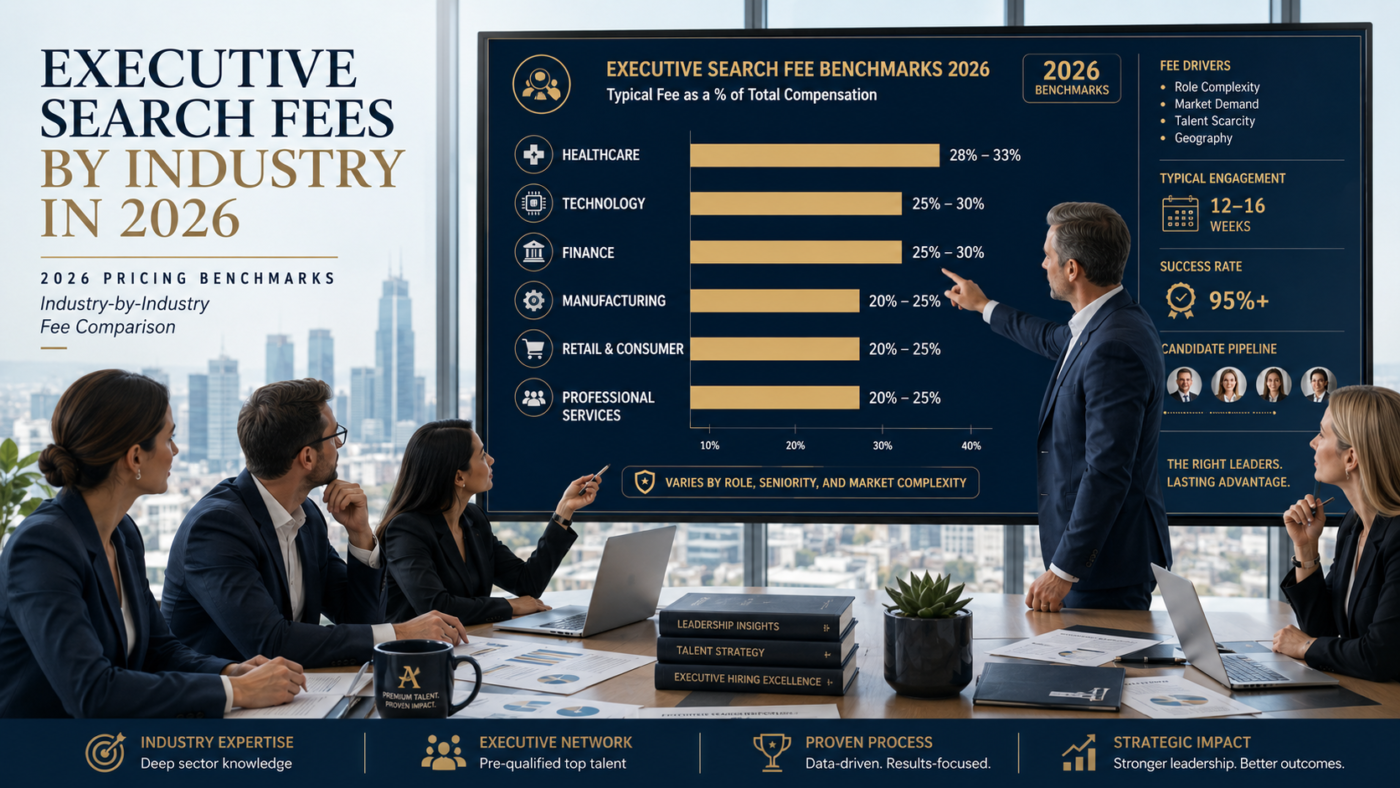
Key Strategic Insights: U.S. Executive Talent Landscape 2026
- Shifting Talent Acquisition Landscape: Executive placement remuneration in the U.S. is intensely fluid, shaped by sector-specific talent scarcity, evolving leadership role complexities, and a deepening focus on strategic value realization over mere transactional cost.
- Value-Centric Remuneration Dominates: While a percentage of first-year compensation remains a prevalent model, sophisticated firms like JRG Partners increasingly incorporate value-based components, especially for critical C-suite and board appointments, reflecting the profound strategic impact and market scarcity of such leadership.
- Technology’s Dual Impact on Talent Sourcing: Advanced analytics and artificial intelligence concurrently drive operational efficiencies – potentially lowering baseline costs for some components of a search – while also enabling more precise, high-value targeting. This precision justifies premium fees for accessing truly top-tier executive talent.
- Domestic Market Nuances Critical: Within the United States, significant fee variations exist. Economic dynamism, regulatory environments, and localized talent pools across major metropolitan hubs versus secondary markets create distinct pricing dynamics.
- Strategic Negotiation Paramount: A comprehensive grasp of diverse executive recruitment models, ancillary charges, and internal resource allocation is essential for U.S. executives to effectively negotiate and compare talent solutions, ensuring optimal return on investment for pivotal leadership hires.
As the U.S. economy continues its dynamic trajectory, the investment in executive talent remains a critical fiduciary duty for boards and senior leadership. Understanding the intricate mechanics of executive search pricing is no longer merely an operational concern but a strategic imperative. This memo outlines the forecasted 2026 benchmarks for executive recruitment services across the U.S. market, providing clarity on evolving fee structures and value drivers. One critical query often posed by discerning leaders is: What are the typical fee ranges (percent of first-year compensation and flat minimums) for retained, contingency, and engaged executive searches in 2026? This analysis aims to provide a definitive answer, grounded in market realities and JRG Partners’ proprietary research.
U.S. Executive Search Fee Models: Retained, Contingency, and Engaged Approaches
Retained Executive Search
- Definition: An exclusive partnership, characterized by an upfront commitment fee, typically reserved for critical senior-level or highly specialized leadership roles. JRG Partners specializes in this model, ensuring dedicated, discreet, and comprehensive market engagement.
- Pros & Cons: This model offers a demonstrably higher success rate, dedicated resources, and in-depth market mapping, but entails a higher overall investment and a more deliberate timeline commensurate with the strategic importance of the role.
- Typical Fee Structure: Commonly structured as one-third payment upon engagement, one-third after a specific milestone (e.g., presentation of a qualified shortlist), and the final third upon candidate placement. The professional fee is generally a percentage of the first-year compensation package (base salary plus anticipated bonus).
- STAT: 70% of C-suite and board searches in the U.S. in 2025 are conducted on a retained basis, underscoring its efficacy for paramount leadership appointments.
Contingency Executive Search
- Definition: A success-based arrangement where payment is rendered solely upon successful placement; often a non-exclusive mandate.
- Pros & Cons: This model presents no upfront financial risk and can yield quicker results for less senior positions or roles with broader talent pools. However, it generally involves less dedicated firm effort and may lead to a more transactional, rather than strategic, candidate sourcing approach.
- Typical Fee Structure: A percentage of the placed candidate’s first-year compensation, payable upon the candidate’s start date.
- STAT: Contingency executive search firms account for approximately 45% of placements for roles below the Vice President level in U.S. mid-market companies.
Engaged Executive Search: A Hybrid Approach
- Definition: This blended model incorporates a smaller upfront engagement fee, followed by a contingency payment upon successful placement. It balances commitment with reduced initial capital outlay.
- Pros & Cons: It offers a middle ground, providing a degree of commitment and dedicated resources from the search firm while mitigating the higher upfront costs of a fully retained model. This approach is well-suited for challenging mid-level to senior U.S. positions where some upfront investment is warranted but not at the full retained level.
- Typical Fee Structure: A flat upfront engagement fee (e.g., $5,000-$20,000) followed by a reduced contingency percentage (e.g., 20-25%) of the first-year compensation.
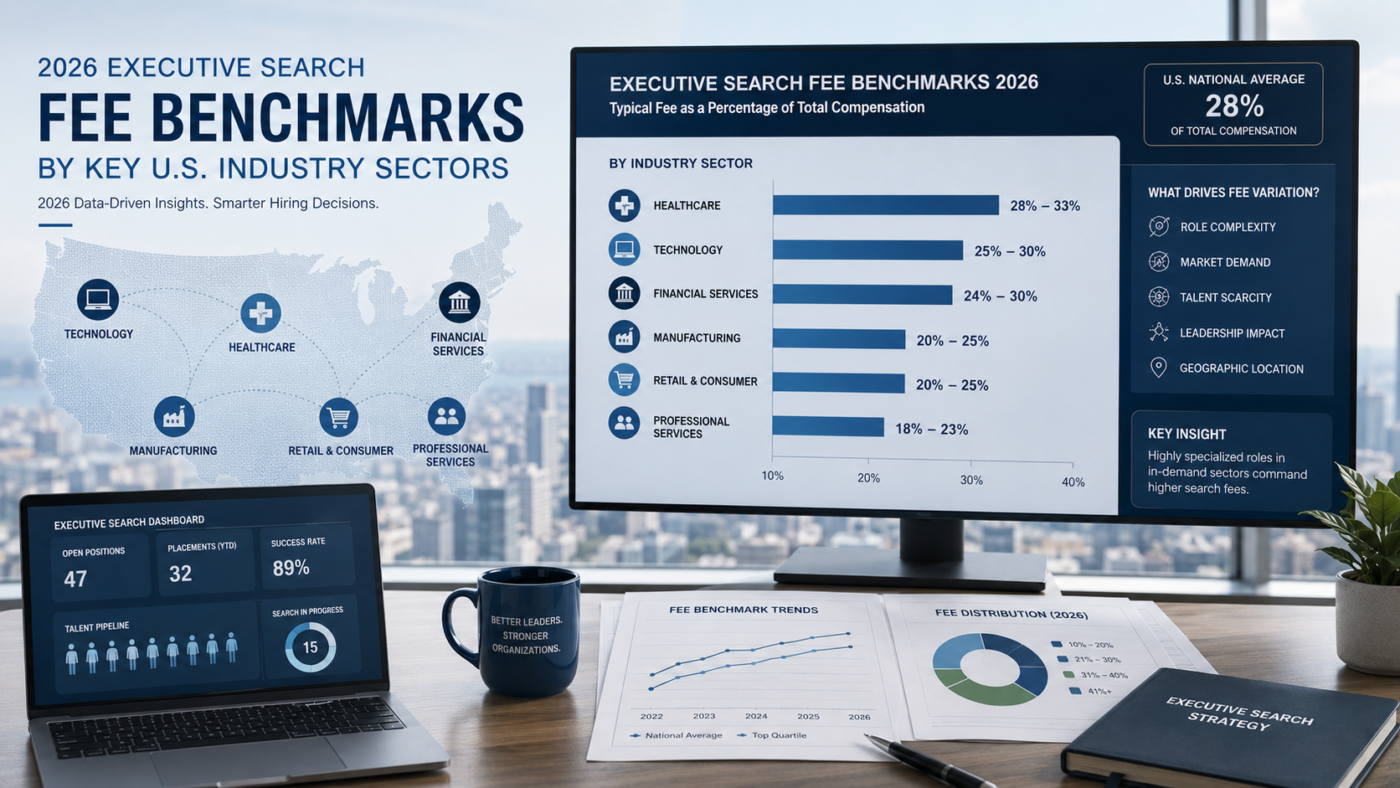
2026 Executive Search Fee Benchmarks by Key U.S. Industry Sectors
Understanding How do fee bands differ by industry (e.g., technology, healthcare, finance, manufacturing, retail, energy) and why? is crucial for strategic talent planning. Industry-specific dynamics, particularly within the U.S., heavily influence executive recruitment costs due to unique talent ecosystems and competitive pressures.
Technology Sector
- Characteristics: An intensely competitive environment for specialized U.S. talent in areas such as Artificial Intelligence/Machine Learning, cybersecurity architecture, and cloud infrastructure.
- Benchmarks (U.S.): 30-38% for retained searches; 25-30% for contingency.
- STAT: The average executive search fee for a Chief Technology Officer (CTO) in a high-growth U.S. SaaS firm is projected at 36% of first-year compensation.
Healthcare/Life Sciences
- Characteristics: High regulatory complexity and demand for specialized medical, scientific, and pharmaceutical expertise within the U.S. healthcare system.
- Benchmarks (U.S.): 30-35% for retained mandates (e.g., Pharma R&D, Clinical Trials leadership); 25-28% for contingency (e.g., Hospital Administration).
Financial Services/FinTech
- Characteristics: Robust demand for digital transformation architects, risk and compliance leaders, and private equity professionals across U.S. financial institutions.
- Benchmarks (U.S.): 32-38% for retained (e.g., Investment Banking, Quantitative Analysis roles); 26-32% for contingency (e.g., Retail Banking leadership).
Manufacturing/Industrial
- Characteristics: A U.S. industry focus on supply chain optimization, advanced robotics integration, and sustainability initiatives.
- Benchmarks (U.S.): 28-33% for retained; 22-27% for contingency.
Retail/Consumer Goods
- Characteristics: Driving forces include e-commerce proficiency, advanced data analytics capabilities, and superior customer experience leadership within the U.S. consumer market.
- Benchmarks (U.S.): 29-34% for retained; 24-29% for contingency.
Energy/Renewables
- Characteristics: Significant investment in the U.S. transition to sustainable energy, demanding expertise in project management, and navigating complex regulatory affairs.
- Benchmarks (U.S.): 31-36% for retained; 26-31% for contingency.
- STAT: The top 3 U.S. industries with the highest average retained executive search fees in 2026 are Tech, Finance, and Energy, consistently averaging above 33%.
U.S. Executive Recruitment Fees by Role Level: Director to Board Mandates
A granular understanding of What are the standard fee differences by role level (Director vs VP vs C-suite vs board) and typical minimum-fee floors for each level? is vital for precise budget allocation and expectation setting with executive search partners.
Director Level Executive Search
- Benchmarks (U.S.): 25-30% for retained engagements; 20-25% for contingency.
- Focus: Functional leadership, meticulous operational execution within a specific domain.
Vice President (VP) Level Executive Search
- Benchmarks (U.S.): 28-33% for retained mandates; 24-28% for contingency.
- Focus: Strategic implementation, robust team management, fostering cross-functional collaboration.
C-suite (CEO, CFO, COO, CTO, CMO, etc.) Executive Search
- Benchmarks (U.S.): 30-40% for retained (often supplemented with additional fixed project fees due to complexity).
- Focus: Visionary leadership, comprehensive P&L responsibility, driving organizational transformation, sophisticated stakeholder management.
- STAT: Executive search fees for C-suite roles in the U.S. typically command a 15-20% premium over VP-level mandates, reflecting their profound complexity and organizational impact.
Board of Directors/Advisors Search
- Benchmarks (U.S.): Often flat fees (e.g., $50,000-$150,000+), or a percentage of the annual director retainer/equity package. This reflects the premium on governance expertise, diverse network access, and strategic oversight.
- Focus: Strategic oversight, impeccable corporate governance, deep industry-specific expertise, and critical diversity initiatives.
Geographic and Market-Size Variations within the U.S.
While this memo primarily focuses on the U.S., it is important to acknowledge that How do fees vary by geography and market size (US vs Europe vs India vs GCC vs APAC), and what local factors drive those differences? The U.S. market itself presents considerable internal variations. For instance, JRG Partners’ deep presence across major U.S. hubs allows for nuanced pricing strategies.

United States Regional Nuances
- Characteristics: A highly mature market characterized by intense competition for premier executive talent.
- Benchmarks: 30-35% (retained) in major U.S. metropolitan hubs like New York City, San Francisco, or Boston; these rates can be slightly lower in secondary U.S. markets where talent pools might be less constrained or compensation structures differ.
- STAT: U.S. retained search fees remain among the highest globally, with an average of 32.5% across industries, a testament to the highly competitive domestic executive talent landscape.
While global markets like Europe, India, the GCC, and APAC exhibit their own distinct fee dynamics, JRG Partners’ core expertise and focus remain acutely on navigating the complexities and delivering exceptional value within the American corporate landscape, leveraging our extensive national network and localized market intelligence.
Pricing Components and Ancillary Charges in U.S. Executive Search
Understanding What line-item components make up the all-in cost (retainer tranches, candidate assessment, advertising, travel, relocation, background checks, guarantee periods)? is fundamental to comprehensive budgeting and negotiation.
Minimum Fee Clauses
- Definition: A foundational fee applied irrespective of the placed candidate’s final remuneration, often utilized to protect executive search firms from lower-paying roles that still demand significant search effort or highly complex, unique mandates.
- Implication: Ensures adequate compensation for the intellectual capital and dedicated effort invested in a challenging U.S. leadership search.
Retainers (Upfront Payments)
- Definition: The initial segment of a retained search fee, remitted to formally commence the executive recruitment project.
- Implication: Serves as a tangible demonstration of client commitment and effectively covers the initial phases of market research, talent mapping, and candidate sourcing efforts undertaken by firms like JRG Partners.
Advertising Costs
- Definition: Expenditures linked to placing job advertisements in premium channels, specialized industry publications, or targeted digital platforms.
- Implication: These costs may be subsumed within the overall professional fee or billed separately, particularly for highly niche U.S. executive roles requiring broad exposure.
Relocation Expenses
- Definition: Costs borne by the candidate for transitioning to a new geographic location for the role (e.g., housing assistance, travel, household goods shipping).
- Implication: Typically a client responsibility, though sometimes administered by the search firm, potentially incurring an administrative charge.
Assessment Tools & Background Checks
- Definition: Costs associated with sophisticated psychometric testing, leadership assessments, and comprehensive background verification processes.
- Implication: Often billed as pass-through expenses or a distinct line item. These are critical components for de-risking high-stakes U.S. executive hires, and JRG Partners integrates best-in-class assessment protocols.
- STAT: Ancillary charges (including assessments, travel, and extended guarantees) can add an average of 5-10% to the base search fee for complex C-suite mandates in the U.S.
Additional Expenses
- These may include travel and accommodation for interviews (both firm consultants and candidates), and candidate engagement activities, all meticulously tracked and reported.
Guarantee Periods
- Definition: A contractual clause outlining the firm’s commitment to re-run a search without an additional professional fee if a placed candidate departs or is terminated within a specified timeframe (e.g., 6-12 months). This minimizes risk for the client.
Impact of AI, RPO, and In-House Recruiting on 2026 U.S. Executive Talent Pricing
A critical strategic consideration for U.S. corporate governance involves understanding How has AI adoption, RPO/embedded search, and subscription models affected average fees and speed-to-hire in 2026? These technological and structural shifts are reshaping the executive talent acquisition paradigm.

Impact of Artificial Intelligence and Data Analytics
- Efficiency Gains: AI-powered sourcing algorithms, advanced candidate screening, and initial digital outreach significantly reduce manual effort, potentially driving down baseline operational costs for more routine U.S. leadership searches.
- Enhanced Precision: AI enables more accurate candidate matching, predictive analytics regarding cultural fit, and talent pool segmentation. This justifies premium fees for firms like JRG Partners that deliver demonstrably higher quality and expedited placements for pivotal U.S. roles.
- Market Intelligence: AI-driven tools provide profound insights into U.S. talent pools, compensation benchmarks, and market trends, empowering both executive search firms and their clients in negotiation and strategic planning.
- STAT: Firms leveraging AI for candidate sourcing and initial screening report a 15-20% reduction in time-to-fill for senior management roles within the U.S., directly impacting cost structures and organizational agility.
Rise of Recruitment Process Outsourcing (RPO) for Senior Roles
- Cost-Effectiveness for Volume: For U.S. organizations with consistent, high-volume senior-level hiring needs, RPO solutions can present a more cost-effective framework compared to traditional per-hire executive search, integrating search capabilities into a holistic talent acquisition strategy.
- Scalability: RPO offers scalable talent solutions, providing an alternative to the episodic nature of discrete executive search engagements.
Sophistication of In-House Executive Recruiting Teams
- Direct Sourcing Capability: Many large U.S. enterprises are establishing formidable in-house executive recruiting functions, leveraging robust internal networks and sophisticated technology to fill roles that historically would have been outsourced.
- Pressure on External Firms: This trend compels external executive search firms, including JRG Partners, to continuously demonstrate superior value, highly specialized sector expertise, unparalleled market access, and a more robust talent architecture, thereby justifying their distinct professional fees relative to internal operational costs.
- STAT: Companies with advanced in-house U.S. executive recruiting capabilities are projected to save 20-30% on executive search costs for non-C-suite roles by 2026, compared to exclusive reliance on external partners.
Negotiation Levers and Fee Structures for Diverse U.S. Buyer Profiles
Strategic negotiation is paramount for optimal value. It is essential to understand What negotiation strategies, contract terms, and service-level clauses (exclusivity, rebate periods, replacement guarantees) most reduce effective cost for employers?
Startup Clients (U.S.)
- Negotiation Levers: May include equity participation in lieu of higher cash retainers, milestone-based payments tied to company growth, reduced guarantee periods, or extended payment terms.
- Fee Structure: Often a blended model of a smaller upfront cash retainer combined with a higher contingency percentage, or a percentage of compensation plus a modest equity grant. Search firms may offer reduced initial rates for promising U.S. startups, recognizing future client potential.
Mid-Market Companies (U.S.)
- Negotiation Levers: Preferred vendor agreements for multiple concurrent hires, negotiated fee reductions for repeat business, and elongated payment schedules.
- Fee Structure: Typically adheres to standard retained search models (28-33%), but firms are often open to negotiation on percentages or minimum fees for a client with a proven track record.
Enterprise Clients (U.S.)
- Negotiation Levers: Volume discounts for multiple simultaneous executive searches, comprehensive master service agreements (MSAs) with predetermined rate cards, multi-year contractual commitments, dedicated account management teams, and integrated value-added services (e.g., talent mapping, bespoke leadership assessment integration).
- Fee Structure: Can negotiate lower percentage rates (e.g., 25-30%) for high-volume or complex, multi-site U.S. mandates. Fixed fees per project for specific roles are also common.
- STAT : U.S. enterprise clients negotiating multi-year master service agreements can achieve an average fee discount of 10-15% compared to one-off search engagements, reflecting the power of strategic partnership.
Key Negotiation Points Across All U.S. Profiles
- Clearly defined scope of work, extended candidate guarantee periods, flexible payment terms, transparent expense caps, exclusivity duration, and the explicit inclusion or exclusion of ancillary services. JRG Partners prioritizes transparent contractual arrangements for all our U.S. partnerships.
Constructing a Per-Hire Cost Model and Comparing U.S. Executive Talent Options
For strategic resource allocation, it is imperative to comprehend How should hiring teams model and compare total cost-per-hire (including internal time cost, vacancy cost, onboarding ramp, and agency fees) so they can choose between external search, in-house recruiters, or hybrid models? This comprehensive approach transcends mere transactional fees, embracing the full economic impact.

Step 1: Precisely Define the U.S. Role and Compensation
- Example: Vice President of Engineering, based in a major U.S. tech hub. Base salary: $250,000; Target Bonus: $50,000. Total First-Year Compensation: $300,000.
Step 2: Calculate External Executive Search Firm Costs
- Retained Search Option (JRG Partners, 30% fee):
- Professional Fee: 30% of $300,000 = $90,000
- Ancillary Charges (e.g., in-depth assessments, necessary travel, 5% of fee): $90,000 * 0.05 = $4,500
- Total External Cost (Retained): $94,500
- Contingency Search Option (25% fee):
- Professional Fee: 25% of $300,000 = $75,000 (payable only upon successful placement)
- Ancillary Charges: Potentially minimal, e.g., $1,000 for premium U.S. job board postings if agreed.
- Total External Cost (Contingency): $76,000
Step 3: Estimate Internal U.S. Recruiting Costs (for comparative analysis)
- Internal Recruiter Allocation: Attributing a portion of a senior internal recruiter’s time (e.g., 25% for a $150,000 FTE = $37,500).
- Internal Technology/Tooling: Costs for LinkedIn Recruiter licenses, Applicant Tracking System (ATS), specialized sourcing tools (e.g., $5,000).
- Targeted Advertising/Job Boards: $3,000
- Assessment Tools: $1,500
- Hiring Manager Opportunity Cost: Valuing the time spent by internal stakeholders (e.g., 40 hours @ $200/hour = $8,000).
- Total Estimated Internal Cost: $55,000
Step 4: Factor in Hidden Costs & Strategic ROI
- Time-to-Fill: External partners, particularly retained firms like JRG Partners, often significantly reduce time-to-fill, minimizing the substantial revenue loss associated with prolonged vacant executive positions.
- Quality of Hire: External firms typically possess access to a broader, higher-quality passive talent pool not accessible to internal teams, leading to more impactful leadership appointments.
- Opportunity Cost: The true cost of not making a critical U.S. leadership hire promptly, or making a suboptimal hire, extends far beyond direct recruitment fees. This includes lost market share, delayed strategic initiatives, and potential organizational instability.
- Onboarding & Relocation: These are consistent costs, irrespective of the recruitment method, and should be factored into the overall TCO (Total Cost of Ownership).
Comparison & Strategic Decision
While the internal cost ($55,000) might initially appear lower than a retained search ($94,500) or contingency ($76,000), a prudent analysis necessitates evaluating the fundamental trade-offs: speed, quality of hire, and internal team bandwidth. For a critical U.S. Vice President of Engineering role, the specialized network, market intelligence, and dedicated focus of a retained executive search firm like JRG Partners often unequivocally justify the higher initial investment. A well-executed retained executive search significantly de-risks the hiring process, aligning with a board’s fiduciary duty to ensure optimal leadership talent. Ultimately, the true value of an executive search firm is measured by the enduring impact of the leader placed.
Frequently Asked Questions (FAQs) for U.S. Executive Search
This section addresses common inquiries from U.S. corporate leadership regarding executive talent acquisition.
-
What constitutes a “good” executive search fee in the U.S. for 2026?
A “good” professional fee is one that delivers the paramount executive candidate for your critical U.S. role within an optimized timeframe, ensuring a robust return on investment. While benchmarks provide a range (typically 28-35% for retained), the true value resides in the firm’s specialized U.S. network, deep industry expertise, and verifiable track record of successful placements.
-
When should I utilize a retained versus a contingency executive search firm for a senior U.S. role?
Engage a retained firm like JRG Partners for critical, strategic, or highly specialized U.S. leadership roles (C-suite, VP, board members, niche technical leaders) where exclusivity, dedicated resources, in-depth candidate assessment, and a comprehensive market scan are indispensable. Contingency is generally more suitable for less senior, high-volume roles, or when expedited placement is paramount and the U.S. talent pool is readily accessible.
-
Are executive search fees negotiable in the U.S. market?
Yes, absolutely. Professional fees are frequently negotiable, contingent on the role’s complexity, urgency, anticipated volume of hires, and your organization’s standing in the U.S. market. Negotiation points can encompass the percentage rate, payment terms, guarantee duration, and the inclusion or exclusion of ancillary charges.
-
How do I assure the quality of candidates presented by a U.S. executive search firm?
Seek firms with profound U.S. industry specialization, a strong historical record of successful leadership placements, robust assessment methodologies, and transparent communication protocols. Request client references, inquire about their proprietary research capabilities, and confirm that their proposed candidate profile rigorously aligns with your strategic requirements. JRG Partners prides itself on an industry-leading placement success rate for critical U.S. roles.
-
What is the typical guarantee period for executive search placements in the U.S.?
The majority of reputable retained executive search firms in the U.S. offer a guarantee period ranging from 6 to 12 months. Should the placed candidate depart or be terminated within this period, the firm typically commits to conducting a new search at no additional professional fee.
-
How can my organization mitigate hidden costs in U.S. executive search?
Demand a detailed, all-inclusive proposal upfront. Explicitly clarify all potential ancillary charges (e.g., travel, assessments, advertising) and establish agreed-upon maximum caps. Ensure the contract unequivocally defines what is both included in and excluded from the base professional fee. Transparency is key to a successful partnership.

Tanya Gallardo
Managing Director, Executive Search & AI Talent Strategy
Tanya Gallardo is the Managing Director of Executive Search & AI Talent Strategy at JRG Partners, leading C-suite and Board engagements across key growth sectors including Technology, Financial Services, and Manufacturing.
With over 18 years of experience specializing in disruptive technology leadership, Tanya is recognized as a leading authority on talent architecture for future-focused executive roles, such as the Chief AI Officer (CAIO) and Chief Digital Officer (CDO). Her expertise lies in accurately assessing the cultural fit and technical depth required to ensure a high return on investment (ROI) for critical leadership appointments.
Prior to her role at JRG Partners, Tanya held senior roles directing global talent acquisition strategies at a major publicly-traded technology firm, advising on organizational design and succession planning for emerging executive functions. She is a recognized speaker and contributor to industry events, sharing data-driven insights on executive compensation, leadership development, and the measurable business impact of C-suite talent.
