



Bringing a surgical robotics platform to market is a monumental achievement, but commercial success is never guaranteed by technical brilliance alone. The transition from a functional prototype to a globally adopted clinical standard requires an executive leadership team capable of orchestrating a vast, interconnected ecosystem. A brilliant mechatronic architecture means nothing if the system lacks the clinical evidence to justify its cost, if surgeons find the interface unintuitive, or if hospital value analysis committees (VACs) reject the economic value proposition.
Building a successful surgical robotics company requires a synchronized executive team that seamlessly spans hardware and software engineering, rigorous clinical trial execution, comprehensive surgeon training programs, and aggressive commercial adoption strategies. When one of these pillars is led by an executive who operates in a silo, the entire platform risks stalling in the “Valley of Death” between regulatory clearance and market penetration.
This comprehensive guide details how to build and evaluate a surgical robotics leadership team capable of navigating the complete product lifecycle. From architecting the initial robotic platform to driving widespread hospital adoption, we map the critical executive competencies required for success. By partnering with dedicated Surgical Robotics Recruiters, ambitious organizations can secure the rare, cross-disciplinary talent necessary to dominate this hyper-competitive sector.

The Sector-Specific Challenge: The Interconnected Ecosystem
In traditional medical devices, the product lifecycle is often linear: engineer the device, run a clinical trial, get regulatory clearance, and hand it to a sales team. Surgical robotics permanently breaks this linear model. A robotic platform is a living, breathing cyber-physical ecosystem.
Hardware modifications impact software latency. Software updates impact FDA cybersecurity compliance. Clinical usability feedback dictates instrumentation redesigns, which in turn alters the cost of goods sold (COGS) and the ultimate health economics narrative required for commercial sales. An effective surgical robotics leadership team must be structurally designed to embrace this continuous feedback loop. If the Chief Medical Officer (CMO) and the VP of Systems Engineering are not in constant, collaborative alignment, the platform will inevitably fail to meet the ergonomic, clinical, or economic demands of the modern operating room.
Leadership Roles and Capabilities: Mapping the Journey
To successfully transition from an engineering concept to a commercially dominant platform, a surgical robotics company must hire exceptional leaders across four distinct pillars: Product Architecture, Clinical Evidence, Surgeon Training, and Commercial Adoption.
1. Product Architecture & Usability (The Engineering Pillar)
Key Roles: VP of Systems Engineering / Chief Technology Officer (CTO)
The foundation of any robotic platform is its core architecture. The engineering leadership must balance the demands of precise mechatronics (kinematics, haptics, instrumentation) with complex software (real-time operating systems, AI, computer vision). Crucially, these leaders must prioritize Human Factors and Usability Engineering (IEC 62366). A robot with mathematically perfect kinematics will still fail if the surgeon’s console induces ergonomic fatigue or if the user interface (UI) increases cognitive load during a critical procedure.
- Core Capabilities: ISO 14971 risk management, bridging the gap between mechanical engineering and agile software development, integrating usability testing early in the design phase, and executing seamless verification and validation (V&V) protocols.
2. Clinical Evidence Generation & Regulatory Strategy (The Validation Pillar)
Key Roles: Chief Medical Officer (CMO) / VP of Clinical & Regulatory Affairs
In the modern healthcare economy, a robotic platform cannot simply be “equivalent” to manual surgery; it must definitively prove superiority in outcomes, reduced complication rates, or faster patient recovery times. The clinical and regulatory leadership is responsible for designing robust clinical trials that generate the peer-reviewed evidence required by both the FDA and hospital purchasing committees.
- Core Capabilities: Designing multi-center clinical trials, managing Key Opinion Leader (KOL) relationships, securing 510(k), De Novo, or PMA clearances, and ensuring post-market clinical follow-up (PMCF) to support long-term claims.
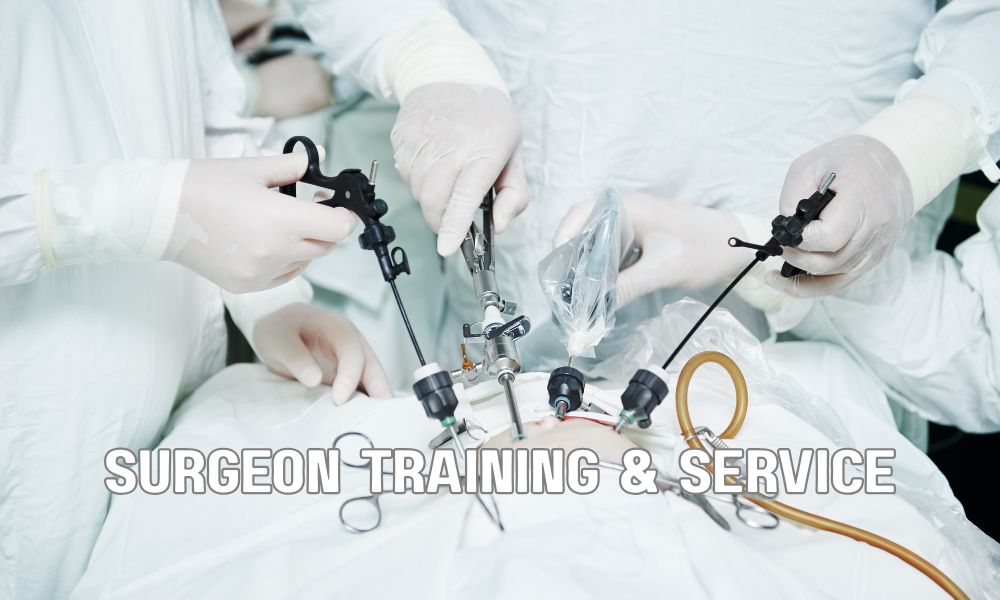
3. Surgeon Training & Service (The Utilization Pillar)
Key Roles: VP of Professional Education / VP of Service Operations
A surgical robot is useless if surgeons lack the confidence to use it. A critical, yet frequently under-resourced, component of the leadership team is the executive responsible for professional education. They must build scalable, simulation-based training curricula that rapidly transition surgeons through the learning curve. Simultaneously, the Service Operations leader must ensure 99.9% uptime, managing field service engineers who can resolve mechanical or software issues instantly to prevent canceled surgeries.
- Core Capabilities: Developing VR/AR training simulators, establishing proctorship programs, managing global field service logistics, and executing remote diagnostic and preventative maintenance protocols.
4. Hospital Adoption & Health Economics (The Commercial Pillar)
Key Roles: Chief Commercial Officer (CCO) / VP of Health Economics and Market Access (HEOR)
The ultimate hurdle is commercial adoption. Hospital CFOs and Value Analysis Committees (VACs) view multi-million-dollar capital equipment as massive liabilities unless they can mathematically prove a return on investment (ROI). The commercial leadership must pivot the sales narrative away from pure clinical novelty and focus ruthlessly on health economics: reduced length of stay (LOS), lower readmission rates, and increased operating room throughput.
- Core Capabilities: Capital equipment sales structuring, establishing Robotics-as-a-Service (RaaS) leasing models, navigating complex hospital procurement networks, and driving the recurring revenue engine through the sale of consumable instrumentation.
Decision Framework: Evaluating the Executive Team
To ensure a balanced and robust leadership team, boards and search committees should evaluate executives based on their ability to bridge the gap between their specific domain and the rest of the organization. The following table provides a matrix for evaluating these cross-functional competencies.
| Executive Domain | Primary Mandate | Critical Cross-Functional Intersection | Fatal Flaw / Hiring Risk |
|---|---|---|---|
| Systems Engineering | Hardware/Software Integration & Architecture | Must collaborate deeply with QA/RA to ensure strict traceability and documentation for FDA audits. | Viewing usability and human factors as an afterthought to pure technical performance. |
| Clinical Affairs (CMO) | Clinical Trial Design & KOL Engagement | Must translate clinical evidence into actionable economic data for the Commercial team (HEOR). | Failing to design trials that capture the economic endpoints required by hospital CFOs. |
| Professional Education | Surgeon Training & Proctorship | Must feed surgeon usability data directly back into the Systems Engineering team for product iteration. | Building complex, unscalable training programs that create bottlenecks in commercial adoption. |
| Commercial (CCO) | Capital Sales & Revenue Generation | Must align with Manufacturing and Service Operations to ensure supply chain readiness before launch. | Selling capital equipment without establishing the recurring revenue models (consumables/service) required for profitability. |
Practical Checklist: Interviewing for Cross-Disciplinary Leadership
When interviewing candidates for a surgical robotics leadership team, it is essential to probe their ability to navigate complex, interconnected environments. Use these targeted interview prompts to uncover their true operational depth:
- For the VP of Systems Engineering: “Walk us through a scenario where surgeon usability feedback directly contradicted the core mechatronic architecture of the platform late in the development cycle. How did you resolve the conflict between clinical requests and engineering timelines?”
- For the Chief Medical Officer: “How do you design a clinical trial that not only satisfies the safety and efficacy requirements of the FDA but also generates the specific health economic data required by a hospital Value Analysis Committee?”
- For the VP of Professional Education: “Surgeons have limited time for off-site training. How do you construct a curriculum that leverages simulation and digital tools to reduce the learning curve and safely accelerate their first autonomous procedure?”
- For the Chief Commercial Officer: “Describe your strategy for navigating a frozen hospital capital budget. How do you structure alternative financing or placement models to secure a robotic system in a highly constrained economic environment?”

Common Gaps and Executive Hiring Mistakes
Building a surgical robotics leadership team is fraught with peril. Companies frequently derail their commercialization timelines by falling into these common hiring traps:
1. Delaying the Commercial and Health Economics Hires
Many engineering-heavy organizations wait until FDA clearance is imminent before hiring a Chief Commercial Officer or VP of Health Economics. This is a catastrophic error. Commercial leaders must be involved early in the process to ensure that the robot’s design and the clinical trial endpoints will actually support a profitable reimbursement and pricing strategy.
2. Underestimating the Importance of Service Operations
A robotic platform that experiences frequent downtime is a massive liability to a hospital’s surgical schedule. Companies often focus entirely on the initial sale and fail to build a robust, global service and preventative maintenance organization. Hiring a VP of Service Operations with deep capital equipment experience is non-negotiable for long-term customer retention.
3. Hiring “Pure Tech” Leaders Without Clinical Empathy
Recruiting elite software and AI leaders from consumer technology companies is appealing, but these leaders often lack an understanding of the intense, high-stress realities of the operating room. Surgical robotics executives must possess deep “clinical empathy”—a profound understanding of the surgeon’s workflow, cognitive load, and patient safety requirements.

Conclusion & Executive Search Strategy
The journey from a brilliant engineering concept to a widely adopted surgical robotics platform is one of the most arduous commercial pathways in the medical device industry. Success requires an executive leadership team that operates not as isolated specialists, but as a cohesive, cross-disciplinary unit. From the VP of Systems Engineering architecting the hardware, to the CMO generating unassailable clinical evidence, to the CCO proving the health economic value to hospital networks—every executive must execute flawlessly.
Because the talent pool possessing this unique blend of technological fluency, clinical understanding, and commercial rigor is incredibly small, standard recruitment methodologies frequently fail. Top-tier surgical robotics executives are highly compensated and heavily entrenched in their current roles. Building a world-class leadership team requires a targeted, confidential approach led by specialized experts. We invite corporate boards, founders, and private equity sponsors to discuss your specific leadership mandate, required technical capabilities, confidentiality needs, and target search timeline with JRG Partners today. By leveraging deep sector intelligence, your organization can secure the transformative talent required to dominate the surgical robotics market.
Frequently Asked Questions (FAQs)
1. Why is Human Factors and Usability Engineering critical in surgical robotics leadership?
A surgical robot is an extension of the surgeon. If the console is non-ergonomic, or if the interface is overly complex, it increases cognitive load and fatigue, leading to clinical errors. Executive leaders (particularly in Systems Engineering and Clinical Affairs) must prioritize usability testing early and often to ensure the platform integrates seamlessly into the high-stress operating room environment.
2. What is the role of Health Economics and Outcomes Research (HEOR) in commercialization?
HEOR is the mechanism by which a company proves financial value to a hospital. While surgeons focus on clinical efficacy, hospital CFOs focus on the bottom line. The commercial leadership team must use HEOR data to mathematically demonstrate that the robot’s upfront capital cost is offset by faster patient recovery times, shorter hospital stays, and increased daily procedural volume.
3. How do surgical robotics companies navigate frozen hospital capital budgets?
A sophisticated Chief Commercial Officer will transition the sales model away from pure upfront capital purchases. They utilize alternative models, such as Robotics-as-a-Service (RaaS), long-term leasing, or placement deals where the hospital agrees to purchase a high volume of consumable instruments in exchange for the capital equipment. This allows the hospital to fund the robot out of the operating budget rather than the capital budget.
4. When should a surgical robotics company hire a VP of Professional Education?
The VP of Professional Education should be hired well before FDA clearance is achieved. They need adequate time to develop sophisticated training curricula, build simulation software, establish proctorship networks with early Key Opinion Leaders (KOLs), and ensure that a robust training pipeline is ready the moment the product launches commercially.
5. How long does a retained executive search for a surgical robotics leader typically take?
A rigorous, retained executive search for a C-suite or senior leadership role in the surgical robotics sector typically requires 12 to 16 weeks. This timeline accounts for comprehensive global market mapping, the confidential extraction of passive candidates from top competitors, deep technical and cultural vetting, and complex compensation and equity negotiations.

Tanya Gallardo
Managing Director, Executive Search & AI Talent Strategy
Tanya Gallardo is the Managing Director of Executive Search & AI Talent Strategy at JRG Partners, leading C-suite and Board engagements across key growth sectors including Technology, Financial Services, and Manufacturing.
With over 18 years of experience specializing in disruptive technology leadership, Tanya is recognized as a leading authority on talent architecture for future-focused executive roles, such as the Chief AI Officer (CAIO) and Chief Digital Officer (CDO). Her expertise lies in accurately assessing the cultural fit and technical depth required to ensure a high return on investment (ROI) for critical leadership appointments.
Prior to her role at JRG Partners, Tanya held senior roles directing global talent acquisition strategies at a major publicly-traded technology firm, advising on organizational design and succession planning for emerging executive functions. She is a recognized speaker and contributor to industry events, sharing data-driven insights on executive compensation, leadership development, and the measurable business impact of C-suite talent.
