


The main financial difference between retained and contingency search lies in what you’re actually paying for: a dedicated search process versus a successful placement.
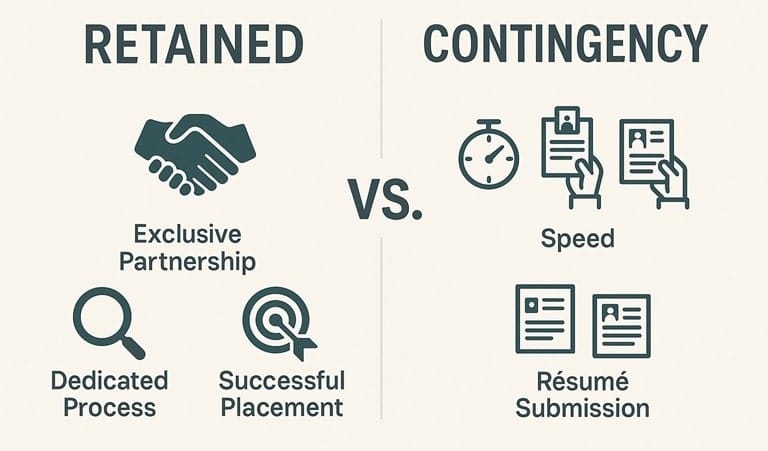
In a retained search, you’re entering into an exclusive partnership with a search firm. This model typically involves a phased fee structure—usually one-third of the expected first-year compensation paid at the start, mid-search, and upon placement. But you’re not just paying for results—you’re investing in a methodical, consultative process. You secure a dedicated team that will deeply understand your business, map the full market, and engage passive, high-caliber candidates you won’t find on job boards. Think of it like hiring a top law firm to litigate a high-stakes case: the retainer ensures full focus and expertise committed to your success.
In contrast, a contingency search is a success-only model. The firm is only compensated if their candidate gets hired—there is no upfront investment. It’s a non-exclusive race, with multiple firms competing to be the first to submit a résumé. This model tends to prioritize speed over strategy, making it better suited to mid-level roles where the candidate pool is more active and visible.
Why This Financial Difference Matters
When hiring for mission-critical leadership roles, especially in operations, Six Sigma, or C-suite positions, the cost of a bad hire far outweighs the upfront retainer. The retained model mitigates hiring risk, ensures deeper due diligence, and delivers fit over fast. Contingency models may save money upfront but often lack the rigorous process needed for high-stakes hiring.
“Ultimately, the financial distinction reflects the depth of the service—something we explore in more detail in our guide on Retained Search vs. Contingency: Which is Right for Your Executive Hire?.”
At JRG Partners, we recommend the retained approach for clients seeking transformational talent—not just résumés.

Tanya Gallardo
Managing Director, Executive Search & AI Talent Strategy
Tanya Gallardo is the Managing Director of Executive Search & AI Talent Strategy at JRG Partners, leading C-suite and Board engagements across key growth sectors including Technology, Financial Services, and Manufacturing.
With over 18 years of experience specializing in disruptive technology leadership, Tanya is recognized as a leading authority on talent architecture for future-focused executive roles, such as the Chief AI Officer (CAIO) and Chief Digital Officer (CDO). Her expertise lies in accurately assessing the cultural fit and technical depth required to ensure a high return on investment (ROI) for critical leadership appointments.
Prior to her role at JRG Partners, Tanya held senior roles directing global talent acquisition strategies at a major publicly-traded technology firm, advising on organizational design and succession planning for emerging executive functions. She is a recognized speaker and contributor to industry events, sharing data-driven insights on executive compensation, leadership development, and the measurable business impact of C-suite talent.
