


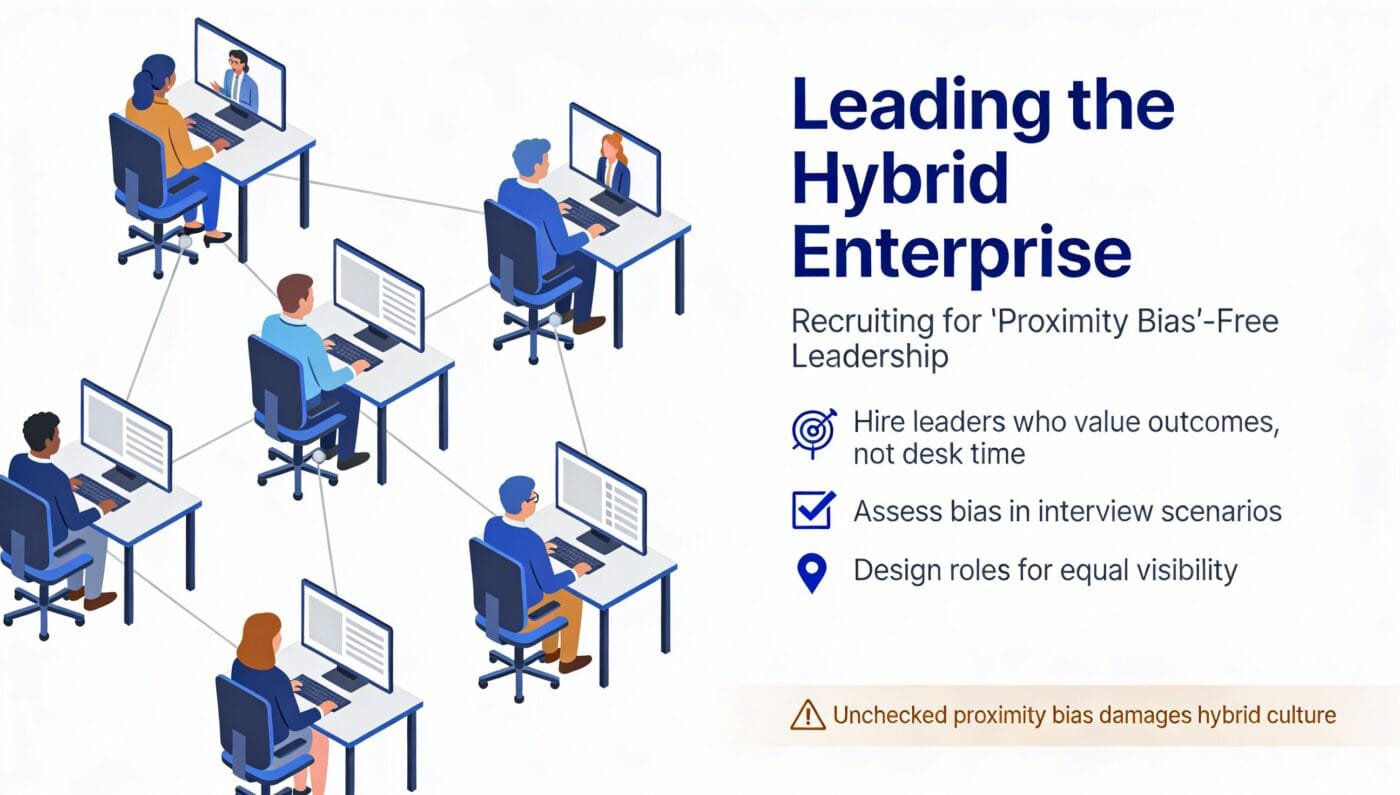
Confidential Briefing on “Leading the Hybrid Enterprise: Recruiting for Proximity Bias-Free Leadership” In an increasingly distributed operational landscape, the ability of an organization to foster innovation and ensure equitable growth hinges directly on its executive leadership. Our research at , a premier US-based executive search firm, indicates a critical emerging challenge: the pervasive, often unconscious, impact of proximity bias.
Category Archives: executive recruiting
COO Executive Recruiting, executive recruiting, Executive Search Challenges, For Employers
Hiring for ‘AI-Powered’ Growth: Executive Talent for 5-Year Strategy

23
Dec
Dec
Hiring for ‘AI-Powered’ Growth: Executive Talent for 5-Year Strategy Key Takeaways AI is no longer a future concept, but a present-day necessity for growth. Executive leadership must possess a strong understanding of AI’s strategic implications. Effective AI integration requires specific skill sets beyond traditional management roles. A well-defined 5-year strategy must inform executive hiring decisions related to AI.
CEO Recruitment, COO Executive Recruiting, executive recruiting, Executive Search Challenges, For Employers
The Autonomous Enterprise: Recruiting Leaders for Highly Automated Businesses

22
Dec
Dec
The Autonomous Enterprise: Recruiting Leaders for Highly Automated Businesses Key Takeaways Autonomous enterprises require leaders with adaptability, strategic vision, and a deep understanding of automation technologies. Successful recruitment strategies must focus on assessing candidates’ potential to manage human-machine collaboration and drive innovation.
COO Executive Recruiting, executive recruiting, Executive Search Challenges, For Employers, Search
Leveraging Predictive Analytics to Identify Future-Proof Executive Talent
18
Dec
Dec
Leveraging Predictive Analytics to Identify Future-Proof Executive Talent Key Takeaways: Predictive analytics offers a data-driven approach to identifying executive talent with the potential to thrive in future, uncertain business environments. By analyzing historical data and identifying key performance indicators (KPIs), organizations can better forecast which candidates possess the skills and attributes needed for long-term success.
CEO Recruitment, COO Executive Recruiting, executive recruiting, For Employers, Search
Succession Planning for the Age of Automation: A Board-Level Guide

17
Dec
Dec
Succession Planning for the Age of Automation: A Board-Level Guide Key Takeaways: Re-evaluate succession planning with automation’s impact at the forefront. Identify key roles resilient to automation and those requiring significant upskilling. Develop proactive strategies for talent development, acquisition, and redeployment. Embrace data-driven insights and agile methodologies in succession planning.
Blog section for Employers and Job Seekers, CEO Recruitment, executive recruiting, For Employers, PE Recruitment Challenges, Search
How AI is Redefining ‘Quality of Hire’ in the C-Suite

17
Dec
Dec
How AI is Redefining ‘Quality of Hire’ in the C-Suite Key Takeaways AI is transforming how organizations identify, assess, and select C-suite leaders. Traditional metrics are being augmented by AI-driven insights into leadership potential and cultural fit. Early adopters are seeing improved retention rates and faster time-to-performance for executive hires.
COO Executive Recruiting, executive recruiting, Executive Search Challenges
Mitigating Bias: Ensuring Ethical AI Usage in Executive Talent Sourcing

16
Dec
Dec
Mitigating Bias: Ensuring Ethical AI Usage in Executive Talent Sourcing Key Takeaways AI in executive talent sourcing offers increased efficiency and wider candidate pools, but introduces potential for bias. Understanding bias sources (data, algorithms, human) is crucial for mitigation. Implementing ethical frameworks, transparency, and continuous monitoring are essential for responsible AI adoption.

14
Dec
Dec
The Rise of the Chief AI Officer (CAIO): When to Hire One and Why Key Takeaways The CAIO role is becoming increasingly vital for organizations seeking to leverage AI strategically. Hiring a CAIO is crucial when AI initiatives become fragmented and lack centralized leadership. A successful CAIO drives innovation, mitigates risks, and ensures responsible AI deployment.

08
Aug
Aug
In today’s hyper-competitive hiring market, a generic supply chain job description simply won’t cut it. The best candidates—especially in roles like logistics manager or procurement specialist —are in high demand, often fielding multiple offers. A vague, cookie-cutter posting not only fails to inspire but also risks attracting the wrong applicants, wasting valuable time and resources.

08
Aug
Aug
Mastering Supply chain Recruitment: Your Ultimate 2025 Guide In 2025, securing top-tier supply chain talent isn’t just an HR function—it’s a critical component of business strategy. As global networks pivot and technology reshapes the industry, the demand for skilled professionals in logistics, procurement, and operations has skyrocketed.