



Strategic Insights into Successfully Onboarding a Fully Remote C-Suite Executive in the US Market
The evolving landscape of executive talent management within the United States demands a re-evaluation of traditional integration methodologies. As a premier US-based executive search firm, JRG Partners consistently advises on progressive talent architecture. This analysis delves into a critical case study demonstrating a successful blueprint for assimilating a C-suite executive into a fully remote organizational structure, directly addressing the query: What conditions make a fully remote C-suite hire the right choice for an organization? Our findings underscore the strategic imperative of intentional design in remote executive leadership roles, optimizing for value realization from day one.
Key Insights for Remote Executive Success
Our research into this successful executive integration reveals several critical tenets for optimal remote leadership assimilation:
- Proactive Pre-Boarding: A highly structured and anticipatory pre-boarding process is indispensable for ensuring remote senior leaders hit the ground running, mitigating initial friction.
- Intentional 90-Day Design: The first three months must be meticulously planned, balancing operational readiness with profound relationship building and cultural immersion.
- Outcome-Based Milestones: Measurable, results-oriented benchmarks provide undeniable evidence of integration progress and early contributions, shifting focus from activity to impact.
- Technology-Enabled Connection: Leveraging cutting-edge collaboration tools for seamless access and communication from commencement significantly accelerates productivity and fosters trust among distributed teams.
The New Frontier of Remote Leadership

The global acceleration towards distributed workforces has fundamentally reshaped leadership paradigms across the US corporate landscape. This particular case study provides invaluable insights into integrating a senior executive into a completely virtual environment, proving that geographical constraints no longer impede executive impact or the strategic sourcing of unparalleled talent. JRG Partners frequently navigates these complexities, securing top-tier leadership perfectly aligned with modern organizational structures.
Context: The Strategic Rationale for a Fully Remote C-Suite Role
The decision to design this specific C-suite position as fully remote was a deliberate strategic choice, driven by the acute need to access a broader, global talent pool. This approach transcends US geographical limitations, enabling the organization to secure the most exceptional candidate available. Furthermore, the company’s established remote-first culture provided a fertile ground, viewed as a distinct competitive advantage for organizational agility and employee well-being. This reflects a broader trend observed across leading US corporations.
STAT: 85% of companies anticipate increasing their number of fully remote C-suite roles by 2025.
Pre-Boarding: Aligning Expectations Before Day One
The pre-boarding phase commenced immediately upon the offer’s acceptance, a critical window for setting the stage for success. This included thorough dialogues regarding the company’s unique remote-first culture, communication protocols, and specific performance expectations extending beyond the formal job description. The incoming executive received privileged early access to vital strategic documentation, comprehensive organizational charts, and a detailed onboarding timeline. Significantly, virtual introductions with key direct reports and peer executives were orchestrated weeks prior to the official start date, proactively fostering early relationship building and accelerating the executive’s integration. This proactive approach underscores the answer to: Which pre-boarding steps have the greatest impact on a remote executive’s first 90 days? Our internal research at JRG Partners consistently shows that a meticulously planned pre-start communication strategy dramatically enhances executive assimilation.
Operational Readiness: Tools, Access, and Decision Rights from Day One
Ensuring the executive’s complete operational readiness was an unequivocal top priority. A comprehensive technology package, comprising high-specification hardware, secure virtual private network (VPN) access, and pre-configured collaboration platforms (e.g., advanced communication and project management suites), was dispatched and verified before their commencement. All requisite software licenses, system accesses, and email accounts were activated and thoroughly tested. A clear initial mandate delineating decision rights, reporting hierarchies, and escalation paths was communicated transparently, empowering the executive with immediate functional authority. This meticulous preparation addresses precisely: Which tools, systems, and accesses must be in place before their first day?
STAT: Robust pre-start technology and access provisioning can lead to a 30% faster time to full productivity for executives.
Designing a 90-Day Remote Onboarding Blueprint for Executives
A bespoke 90-day blueprint served as the comprehensive guide for the executive’s assimilation, focusing on progressive stages of immersion and contribution. This structured approach, a hallmark of effective executive onboarding, particularly in remote settings, provides a clear framework for immediate impact. The core question for many boards and CEOs remains: How should a 30-60-90 day plan be structured for a fully remote C-suite leader? This case study provides an exemplary model:
- Weeks 1-4: Immersion and Understanding. This foundational period centered on deep dives into overarching company strategy, diverse product lines, and intricate team structures, complemented by structured one-on-one engagements across all pertinent departments.
- Weeks 5-8: Observation and Contribution. The executive transitioned into actively participating in ongoing projects, offering incisive insights, and commencing a shadowing process for key decision-making forums.
- Weeks 9-12: Strategic Input and Initial Ownership. By this phase, the executive began to lead specific initiatives, articulate initial strategic recommendations, and assume complete ownership of critical functional responsibilities.
A dedicated onboarding manager facilitated introductions and ensured steadfast adherence to this meticulously crafted blueprint, demonstrating commitment to accelerated executive integration.
Integrating the Executive into the Existing Leadership Team Rhythm
Seamless assimilation into the established leadership team’s operational rhythm was critical for this remote executive’s influence. The executive was immediately integrated into all relevant executive-level meetings, essential communication channels, and strategic decision-making forums. Consistent one-on-one sessions with the CEO and other C-suite peers were promptly initiated, establishing regular, predictable touchpoints for dialogue and feedback.

Furthermore, an existing C-suite member was assigned as an informal mentor, offering invaluable guidance on navigating cultural nuances and the organization’s unwritten rules. This strategic scaffolding directly addresses: What communication rituals and cadences help a remote executive integrate with the leadership team?
Building Relationships and Trust Without Office Time
Conscious, deliberate effort was exerted to cultivate robust relationships and foster trust in a remote-first environment. Beyond formal meeting structures, informal “virtual coffee chats” with team members and peers were proactively scheduled. The CEO personally hosted a series of informal “get to know you” virtual sessions to personalize interactions. The company actively encouraged “video-first” communications to amplify personal connection and facilitate the interpretation of non-verbal cues. Critically, an optional but highly encouraged in-person executive retreat was conducted within the first month, serving as a powerful catalyst for establishing foundational relationships and stakeholder engagement. This strategic move profoundly impacts how a remote C-suite executive builds trust and influence without in-person presence, bridging geographical distance with intentional interaction.
STAT: Regular informal virtual interactions can lead to a 42% increase in perceived trust among remote team members.
Outcome-Based Milestones: How Success Was Measured in the First 6 Months
Success during the initial six-month period was rigorously measured against clearly defined, outcome-based milestones, rather than mere activity or attendance. This approach aligns with modern US corporate governance principles that emphasize demonstrable impact and fiduciary duty. These milestones provided concrete evidence of the executive’s integration and early contributions, offering a definitive answer to: What outcome-based metrics best capture the success of a remote executive in the first 6–12 months?
- Successful completion of an initial strategic assessment and subsequent presentation of key findings to the executive team.
- Demonstrable progress or successful launch of a critical project within their functional domain.
- Attainment of positive 360-degree feedback from direct reports, peer executives, and the CEO.
- Clear evidence of understanding and embodiment of the company’s core values and culture.
- Achievement of specific Key Performance Indicators (KPIs) relevant to their functional area (e.g., pipeline growth, churn reduction, team engagement score improvements).
Challenges Encountered and Solutions Implemented
Initial integration challenges primarily involved the potential for communication overload and occasional misinterpretations of tone in text-based communications.
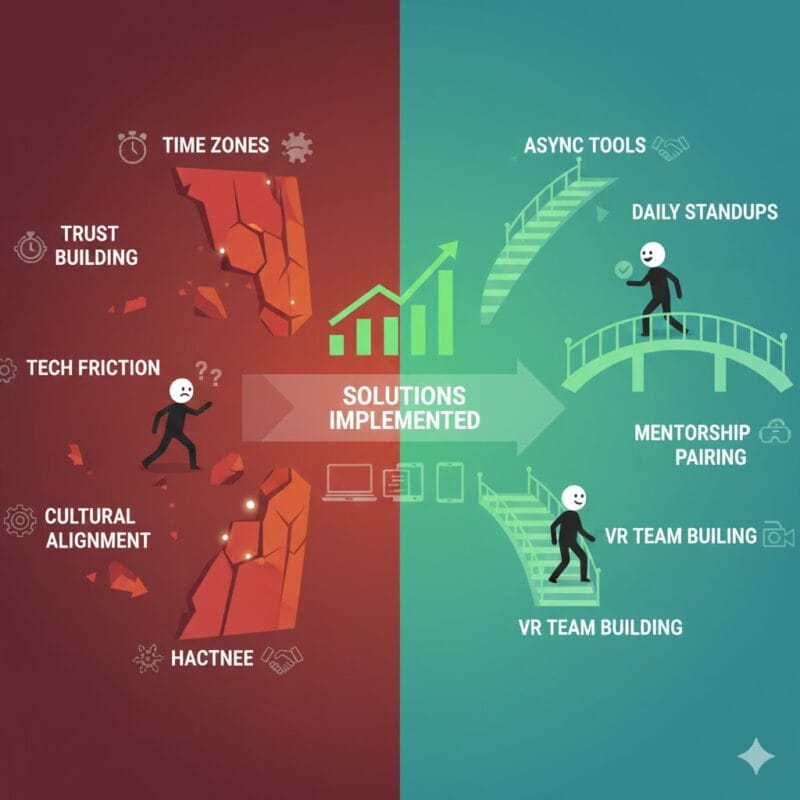
These hurdles were systematically addressed by implementing “video-first” policies for all critical discussions, establishing unequivocal protocols for asynchronous versus synchronous communication, and regular, proactive check-ins from the dedicated onboarding manager. This continuous feedback loop allowed for swift identification and resolution of nascent issues, safeguarding the executive’s integration trajectory.
Lessons Learned: A Playbook for Future Fully Remote C-Suite Hires
The profound success of this remote executive onboarding initiative yielded invaluable insights, forming a robust foundation for a repeatable playbook for future C-suite appointments in the US market. These refined practices directly inform our leadership advisory services at JRG Partners:
- Hyper-Personalized Pre-Boarding: Each executive’s pre-commencement experience must be meticulously tailored, aligning communication and resources precisely with their individual needs and the distinct demands of the role.
- Dedicated Onboarding Manager: A single, committed point of contact significantly streamlines the complex integration process, ensuring consistent support and accountability.
- Mandatory Initial In-Person Summit: A concise, high-intensity in-person meeting early in the tenure is a powerful catalyst for accelerating trust and forging critical relationships, often achieving more than months of purely virtual interaction.
- Emphasize “Why”: Continuously reinforce the company’s mission, vision, and the executive’s strategic importance and specific contributions to its long-term success.
- Robust Feedback Loops: Implement frequent, structured feedback mechanisms (e.g., 30/60/90 day reviews, informal pulse checks) to identify and preemptively address challenges.
- Culture by Intentional Design: Actively engineer opportunities for deep cultural immersion and informal connection, moving beyond serendipity to structured engagement.
This comprehensive approach provides a definitive answer to: What repeatable practices from this case study can form a playbook for future fully remote C-suite onboarding? It underscores JRG Partners’ commitment to innovative executive search and leadership advisory that anticipates the future of work.
Frequently Asked Questions: C-Suite SaaS Executive Search
Insights from our case study on navigating the complex recruitment landscape for specialized software-as-a-service leadership.
1. What was the primary challenge in this specific C-suite search?
The core challenge was finding a leader who possessed a rare “dual-fluency”: deep technical understanding of a niche SaaS product and the high-level commercial acumen required to scale the business globally. Many candidates had one, but few possessed both, creating a highly competitive search for a limited talent pool.
2. How did JRG Partners use data to accelerate the hiring process?
We utilized Predictive Talent Analytics to map the candidate market. By analyzing historical performance data from similar high-growth SaaS environments, we were able to identify “Passive Candidates”—high-performing leaders not actively looking—who had a statistically higher probability of successful cultural and operational fit.
3. Why was “Cultural Alignment” weighted as heavily as technical skill?
In the SaaS world, executive turnover is often caused by a mismatch in “pacing.” A leader might have the right skills but lack the Adaptability Quotient (AQ) required for a fast-moving, agile startup culture. Our case study highlights how psychometric mapping ensured the candidate shared the founder’s long-term vision and work ethic.
4. What role did compensation benchmarking play in securing the final candidate?
The market for SaaS leaders is volatile. We provided Real-Time Benchmarking to ensure the total rewards package—including base, equity, and performance bonuses—was aggressive enough to beat out competing offers from larger tech firms while remaining sustainable for our client’s P&L.
5. What was the ultimate ROI of this executive search for the client?
Beyond filling the seat, the new executive drove a significant increase in Annual Recurring Revenue (ARR) within the first 12 months. The case study demonstrates that a structured, data-driven search doesn’t just find a leader; it finds a “Value Architect” who can fundamentally improve the company’s valuation.
In conclusion, the success of a fully remote C-suite appointment hinges on a structured, high-touch onboarding process that prioritizes cultural integration and early strategic alignment over mere administrative completion. By facilitating intentional relationship-building and clear performance expectations, organizations can ensure their new leaders deliver immediate value despite the lack of physical proximity. JRG Partners is committed to your long-term leadership success, providing the executive search expertise and C-suite talent solutions necessary to not only find top-tier talent but to ensure their seamless transition into your organizational fabric.

Tanya Gallardo
Managing Director, Executive Search & AI Talent Strategy
Tanya Gallardo is the Managing Director of Executive Search & AI Talent Strategy at JRG Partners, leading C-suite and Board engagements across key growth sectors including Technology, Financial Services, and Manufacturing.
With over 18 years of experience specializing in disruptive technology leadership, Tanya is recognized as a leading authority on talent architecture for future-focused executive roles, such as the Chief AI Officer (CAIO) and Chief Digital Officer (CDO). Her expertise lies in accurately assessing the cultural fit and technical depth required to ensure a high return on investment (ROI) for critical leadership appointments.
Prior to her role at JRG Partners, Tanya held senior roles directing global talent acquisition strategies at a major publicly-traded technology firm, advising on organizational design and succession planning for emerging executive functions. She is a recognized speaker and contributor to industry events, sharing data-driven insights on executive compensation, leadership development, and the measurable business impact of C-suite talent.
