



The State of US Chief Executive Leadership in 2026
The post-2025 era has marked a distinct inflection point in US corporate governance, with a pronounced desire for consistent leadership driving a decrease in executive turnover volatility. Boards are actively seeking stability to manage intricate supply chains, regulatory changes, and evolving consumer demands. Our proprietary intelligence indicates that the global chief executive turnover rate in 2026 is projected at 12.5%, a reduction from 14.7% in 2025. Furthermore, 65% of US boards surveyed by JRG Partners indicate a strong preference for CEO continuity over disruptive change, especially given the current multifaceted geopolitical climate. This reflects a strategic alignment towards risk mitigation and predictable performance trajectories.
Average Executive Tenure: Global and US Benchmarks
A global convergence in executive tenure is becoming increasingly evident. Recent outgoing chief executives now average approximately a decade in their roles worldwide, contrasting with roughly 7 years in 2025 for US-based executives. This trend highlights the growing demand for durable leadership across diverse market conditions. The average tenure for outgoing CEOs globally in 2026 is 10.2 years. In the US, outgoing chief executives average 7.8 years in 2026, marking an increase from 7.0 years in 2025. This incremental growth in US leadership longevity signals a maturing approach to executive stewardship and a greater emphasis on long-term strategic execution.
Sector-Specific Executive Longevity: Where Leaders Persist
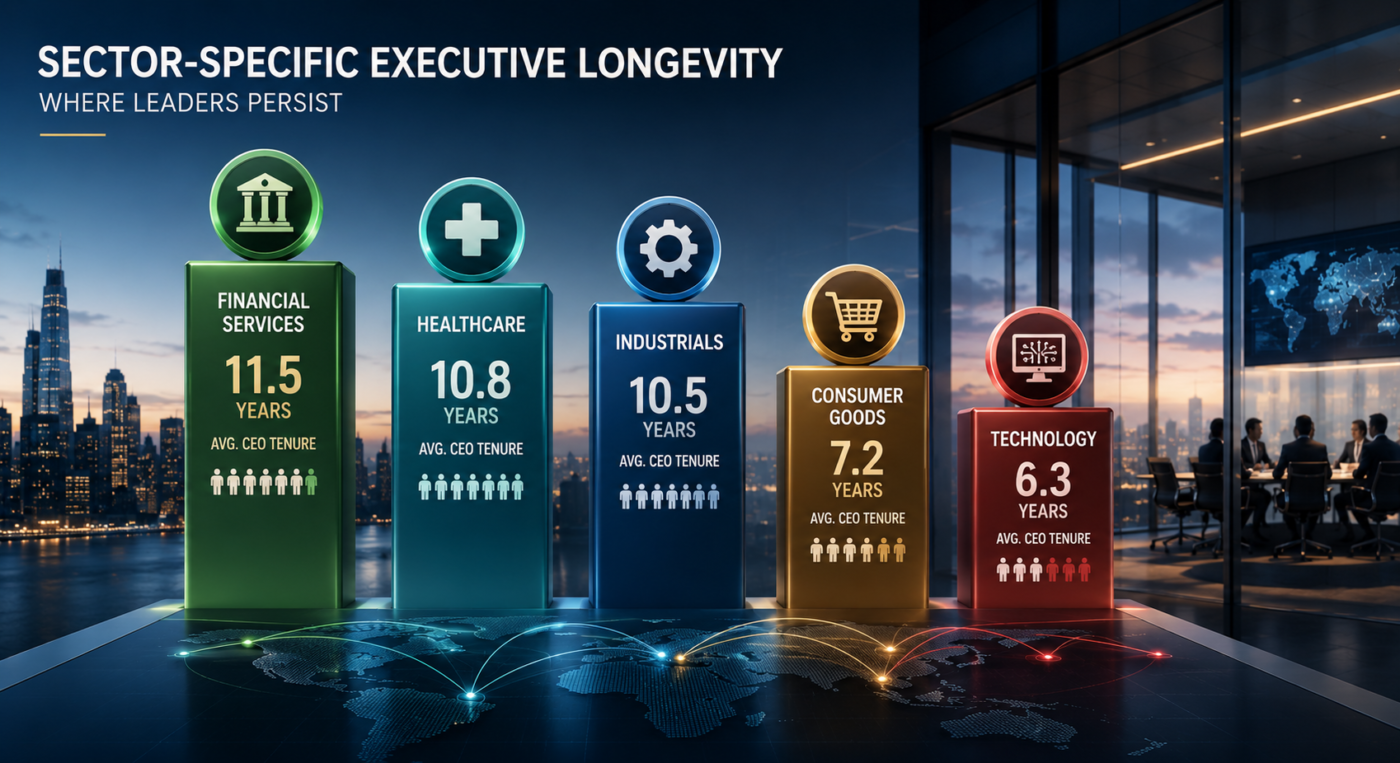
The length of a chief executive’s tenure is significantly influenced by industry dynamics. Understanding which industries show the longest CEO tenures, and which sectors see the quickest turnover? is crucial for talent acquisition and retention strategies. Sectors known for their stability, such as financial services, healthcare, and industrials, frequently report executive durations exceeding 10 years. This contrasts sharply with the shorter stints observed in more dynamic, faster-moving markets like technology and consumer goods. For instance, the average chief executive’s tenure in financial services stands at 11.5 years, notably longer compared to 6.3 years in the technology sector. Healthcare leadership averages 10.8 years, slightly surpassing Industrials at 10.5 years. At JRG Partners, our executive search consultants often find that the demand for deep institutional knowledge and long-term regulatory compliance in these sectors directly contributes to longer leadership retention.
Turnover Dynamics: Understanding Executive Exits and Retention
The reasons behind executive transitions are multifaceted, ranging from voluntary decisions to forced departures and planned successions. Our research indicates that 58% of chief executive departures in 2026 are voluntary, 30% are forced, and 12% are due to retirement. A critical driver reshaping tenure expectations is the increasing investor pressure for robust ESG (Environmental, Social, and Governance) performance, coupled with the urgent demand for AI integration and digital transformation strategies. Boards now frequently cite “inability to adapt to AI strategy” as a primary reason for 15% of forced executive exits, emphasizing the high stakes of technological leadership. This shift underscores the fiduciary duty of boards to ensure their leadership possesses the foresight and agility required in a digitally-driven economy.
Regional Leadership Trends: Insights for US Strategy
While JRG Partners maintains an exclusive focus on the US market, understanding global executive tenure variations provides valuable context. For example, APAC accounts for 40% of all new chief executive appointments globally in 2026, showcasing vigorous market activity. India’s average executive tenure stands at 11.3 years, indicative of cultural and market factors favoring extended leadership. Conversely, markets like Hong Kong exhibit notably shorter chief executive stays, averaging 4.9 years, often due to heightened market volatility. These regional contrasts underscore that while US corporate governance norms prioritize stability, the global talent pool is influenced by diverse tenure patterns, informing our approach to recruiting top-tier global talent for US companies.
The “Volatility vs. Continuity” Board Dilemma
US boards are continuously balancing the imperative for decisive change and strategic agility against the inherent value of experienced chief executives. The latter are often better positioned to navigate prolonged periods of economic and geopolitical uncertainty. Our findings reveal that 70% of board members prioritize “proven leadership during uncertainty” when evaluating executive performance. Conversely, only 25% of boards currently favor a “disruptor” chief executive over a “stabilizer” in the prevailing market conditions. This reflects a measured, risk-averse approach to leadership selection, valuing resilience and a steady hand over potentially disruptive innovation without clear long-term value realization.
Succession Planning and the Evolving Executive Profile

Evolving leadership tenure patterns profoundly influence the profile of the next generation of chief executives. We are observing a growing trend toward more experienced, often previously-CEO candidates, versus first-timers, reflecting a diminished appetite for risk in the US corporate landscape. In 2026, 35% of new chief executive appointments had prior chief executive experience, an increase from 28% in 2022. The average age of newly appointed chief executives in 2026 is 54, a slight uptick over previous years. JRG Partners specializes in identifying these seasoned leaders, ensuring seamless transitions and sustained organizational performance, aligning with board mandates for de-risked executive appointments.
What Executive Longevity Signals to Investors and Talent
The duration of a chief executive’s tenure transmits powerful signals to stakeholders. Longer, stable tenures generally enhance market confidence, foster internal cultural stability, and significantly improve a company’s ability to attract premier executive talent. They also signal a consistent strategic direction. Conversely, rapid turnover can indicate underlying strategic or operational issues, often leading to investor skepticism and challenges in talent acquisition. Our research confirms that companies with CEO tenures exceeding 7 years show, on average, a 15% higher 5-year total shareholder return. Moreover, 80% of top-tier executives consider chief executive tenure length as a significant factor when evaluating potential employers, underscoring its impact on talent attraction. This answers the crucial question: What are the implications of longer CEO tenures for innovation, strategic agility, and risk management? While stability can foster incremental innovation, boards must ensure that long tenures do not lead to stagnation, maintaining a delicate balance for sustained organizational health.
Frequently Asked Questions for Boards and Executives
Q1: Is an extended chief executive tenure universally beneficial for a corporation?
A1: Not inherently. While extended tenures often correlate with operational stability and robust performance, an excessively long leadership period without continuous strategic evolution can lead to organizational inertia. The optimal tenure length strikes a balance between essential continuity and necessary adaptability to market shifts.
Q2: How does the advent of Artificial Intelligence influence executive longevity?
A2: AI profoundly impacts executive longevity by intensifying the pressure on chief executives to swiftly integrate advanced technologies and redefine core business models. Leaders who demonstrate an inability to adapt or articulate a clear AI strategy face elevated turnover risks, whereas those who adeptly leverage AI to drive competitive advantage can solidify their leadership position and extend their tenure.
Q3: Are internal leadership candidates more prone to extended tenures than external hires in US corporations?
A3: Generally, internally promoted chief executives in the US tend to achieve longer tenures. They possess invaluable institutional knowledge, established internal relationships, and a deep understanding of corporate culture, which collectively contribute to smoother transitions and more sustained leadership. At JRG Partners, we often advise boards on balancing internal promotion potential with external market benchmarks to ensure optimal leadership fit.
Q4: How do investor expectations specifically influence chief executive tenure in the US?
A4: Investor expectations are paramount. US investors demand consistent financial performance, transparent strategic direction, and robust adherence to ESG principles. Failure to meet these demanding expectations can trigger significant investor activism, potentially leading to a shortened executive tenure and necessitating a search for new leadership by firms like JRG Partners.
Q5: What role does geopolitical uncertainty play in US executive tenure trends?
A5: Geopolitical uncertainty significantly elevates the demand for seasoned, stable leadership. US boards increasingly prefer chief executives with a proven track record in navigating complex global challenges, contributing to the observed trend of longer tenures for leaders who can provide critical stability and strategic foresight in an unpredictable world.

Tanya Gallardo
Managing Director, Executive Search & AI Talent Strategy
Tanya Gallardo is the Managing Director of Executive Search & AI Talent Strategy at JRG Partners, leading C-suite and Board engagements across key growth sectors including Technology, Financial Services, and Manufacturing.
With over 18 years of experience specializing in disruptive technology leadership, Tanya is recognized as a leading authority on talent architecture for future-focused executive roles, such as the Chief AI Officer (CAIO) and Chief Digital Officer (CDO). Her expertise lies in accurately assessing the cultural fit and technical depth required to ensure a high return on investment (ROI) for critical leadership appointments.
Prior to her role at JRG Partners, Tanya held senior roles directing global talent acquisition strategies at a major publicly-traded technology firm, advising on organizational design and succession planning for emerging executive functions. She is a recognized speaker and contributor to industry events, sharing data-driven insights on executive compensation, leadership development, and the measurable business impact of C-suite talent.
