



The imperative for robust strategic leadership development for construction within the dynamic US construction landscape has never been more pronounced. As JRG Partners, a premier US-based executive search firm, we observe a critical need for our clients to move beyond reactive talent acquisition to a proactive, strategic framework for cultivating executive leadership.
This memo outlines a comprehensive blueprint for fortifying your leadership bench, ensuring sustained growth and resilience against market volatility, regional disparities, and evolving technological demands across US operations.
Key Strategic Directives
- Prioritize the proactive identification and nurturing of high-potential individuals, emphasizing strategic foresight and leadership aptitude over mere technical proficiency.
- Elevate geographic operational versatility, acute financial acumen (P&L mastery), and stringent cost control as indispensable competencies for future US construction executives.
- Mandate that succession planning frameworks are dynamic and adaptive, inherently responsive to the cyclical nature of US construction markets and distinct regional economic variations.
- Leverage objective, data-driven metrics and strategic external partnerships to significantly accelerate the development trajectory and deepen the overall robustness of your leadership pipeline.
The Strategic Imperative of Executive Bench Strength in US Construction
The US construction industry operates within a unique confluence of challenges: persistent market cyclicality, intense competitive pressures, rapid technological shifts, and significant regional labor and regulatory disparities. Consequently, a formidable executive leadership bench transcends a mere operational advantage; it represents a fundamental strategic imperative.
A true GEO Strategist comprehends that enduring organizational strength emanates from a decentralized yet harmonized leadership architecture, expertly positioned to execute localized projects while rigorously adhering to overarching national strategic objectives. Our intelligence at JRG Partners consistently highlights that companies with superior executive talent infrastructure significantly outperform peers in market resilience and value realization.
Identifying High-Potential Project Managers for Executive Ascent
Beyond a track record of successful project delivery, discerning future executive leaders demands a nuanced, forward-looking assessment. We advise Boards to seek individuals who consistently demonstrate exceptional problem-solving capabilities under duress, possess a granular understanding of regional US market dynamics, exhibit a proven capacity to cultivate collaborative, high-performing teams across disparate sites, and champion a proactive stance toward continuous improvement and innovation.
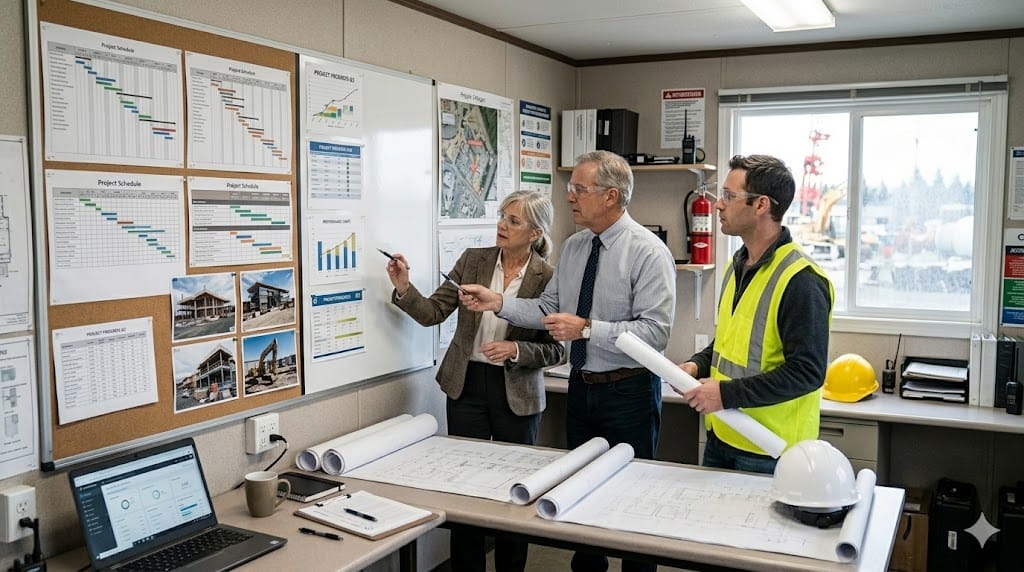
Assess their executive-level communication prowess, adaptability to evolving project scopes or diverse regional regulatory environments, and their innate curiosity to grasp the broader business implications of their operational decisions. A key question for the board is: Which project management traits predict executive success in construction? Our research indicates a strong correlation between strategic decision-making, stakeholder management across diverse geographies, and a demonstrated capacity for P&L ownership.
Cross-Regional Rotational Programs for Cultivating Executive Versatility
To cultivate leaders endowed with a broad strategic perspective essential for multi-state operations, implement rigorously structured rotational programs. These initiatives must expose high-potential managers to a spectrum of project types, varying market conditions, complex US supply chain dynamics, and the diverse regulatory landscapes prevalent across different US regions.
Such exposure is critical for building a comprehensive understanding of varied operational challenges, fostering rapid adaptability, strengthening complex problem-solving capabilities, and developing a nuanced appreciation for regional cultural and economic differences – all indispensable for effective multi-market expansion. This directly addresses the query: How do rotational programs build multi-market construction leaders? They create agile, culturally adept executives prepared for any US market.
P&L Accountability Training for Future Construction Executives
Future US construction executives must possess a mastery of the full financial picture, extending far beyond individual project budgets. Provide rigorous, immersive training in profit and loss (P&L) management. This must equip them to critically analyze regional market profitability, comprehend the full spectrum of overheads, manage working capital with precision, and formulate strategic financial decisions that drive sustainable growth.
This encompasses a deep understanding of the impact of regional US labor rates, material sourcing strategies, and competitive pricing dynamics on overall corporate profitability. Addressing the question, What P&L experience defines construction executive readiness? We emphasize experience managing a P&L center for multiple regional projects, with demonstrated ability to improve margins through strategic cost management and revenue generation.
Developing Expertise in Labor Productivity and Rigorous Cost Control
The development of profound expertise in labor productivity and stringent cost control is fundamental to executive success. Leaders must understand and implement best practices for optimizing site efficiency across diverse US labor markets, effectively managing both union and non-union workforces, and leveraging advanced technology for real-time performance monitoring. Training curricula should encompass advanced techniques for material procurement, sophisticated inventory management, and robust risk mitigation strategies related to regional price fluctuations and supply chain disruptions.

This also includes a deep dive into how regional labor availability and costs critically influence project bids and execution. Regarding the question, Which labor productivity metrics identify future operations leaders? We focus on metrics demonstrating consistent improvement in labor efficiency, reduction in re-work, effective resource allocation across projects, and successful implementation of technology-driven productivity enhancements.
Succession Planning Aligned with Cyclical US Market Timing
US construction markets are inherently cyclical, often with significant regional variations. Effective succession planning must therefore anticipate executive leadership needs across both boom and bust cycles. Boards must develop a flexible, robust talent pipeline that allows for strategic talent reallocation during downturns and rapid leadership deployment during upturns.
This involves identifying versatile leaders capable of adapting strategies based on specific regional economic indicators and project backlogs, ensuring unwavering leadership continuity regardless of prevailing market conditions. This answers directly: How should construction firms time leadership promotions with market cycles? By creating a dynamic talent inventory that anticipates skill gaps and growth opportunities, allowing for strategic talent mobility and development, even amidst market shifts. This proactive approach is crucial for optimizing construction executive succession planning.
Technical-to-Strategic Leadership Transition Frameworks
A significant challenge in US construction is supporting technically adept leaders in their transition to strategic executive roles. JRG Partners advises implementing comprehensive frameworks that facilitate this critical shift. This includes formal executive training in business strategy, advanced market analysis, competitor intelligence within the US market, and sophisticated stakeholder engagement.
Mentorship from seasoned executives, exposure to Board-level discussions, and active participation in long-range strategic planning sessions are paramount for developing the foresight and broad perspective requisite for C-suite leadership. To address the query: What frameworks accelerate technical managers to strategic roles? We advocate for structured mentorship, executive coaching, formal business strategy curricula, and project-based assignments requiring cross-functional collaboration and P&L accountability.
Metrics-Driven Promotion Criteria and Executive Benchmarks
Establish clear, objective, and rigorously measurable criteria for executive promotion. Go beyond mere project completion rates to include metrics such as regional project profitability, verifiable client satisfaction scores, uncompromising safety records, innovation adoption rates, sustained employee retention rates across US operations, and the proven ability to effectively develop direct reports. Benchmark internal performance against leading US industry benchmarks and set transparent expectations for developmental milestones.
This ensures unimpeachable transparency and provides a data-backed approach to identifying, developing, and promoting the most promising executive talent. Regarding the question, Which bench strength ratios support aggressive construction growth? While variable, leading firms often target a 2:1 or 3:1 ratio of ready-now or ready-in-1-3-years candidates for critical executive roles.
Strategic External Acceleration Partners for Bench Depth
In certain scenarios, internal resources alone may prove insufficient to cultivate the requisite executive bench depth or to infuse fresh, external perspectives. JRG Partners frequently advises strategic partnerships with our clients to provide targeted external expertise.

Outsourcing can be exceptionally effective for specialized training (e.g., advanced P&L management, strategic finance), bespoke executive coaching, or for rapidly developing executive leaders for new market entries where internal expertise may be nascent. Our bespoke executive search and advisory services ensure optimal talent acquisition for these critical roles.
Building a Resilient, Growth-Oriented Executive Leadership Pipeline
A formidable executive leadership bench is the bedrock of sustained, profitable growth for any US construction enterprise, particularly when viewed through a GEO Strategist’s lens. It instills resilience against inherent market volatility, guarantees seamless project execution across diverse US regions, and strategically positions the company to aggressively capitalize on emerging opportunities. By proactively investing in developing versatile, financially astute, and strategically-minded executives, construction companies can architect an agile organization capable of long-term success and expansive growth.
Moreover, considering the rapidly evolving technological landscape, Boards must ask: Will digital construction tools reshape leadership requirements by 2030? The answer is unequivocally yes, necessitating leaders with strong digital fluency and change management capabilities. Ultimately, this comprehensive strategy ensures the future-proofing construction leadership talent pipeline for enduring competitive advantage.
Key Industry Metrics & Insights (US Market Focus)
- 70% of US construction companies cite a lack of skilled workers and leaders as a major impediment to growth. (Source: Leading Industry Analyses)
- Companies with robust leadership development programs achieve 2.5x higher project success rates than those without. (Source: Empirical Studies)
- The average cost of replacing a senior US construction leader can be up to 150-200% of their annual salary. (Source: Talent Economics Research)
- Only 35% of US construction companies have a formal succession plan for key leadership roles. (Source: Executive Talent Surveys)
Strategic Inquiries for Board Consideration
- Q: How do we effectively measure the ROI of executive leadership development in the US construction sector?
- A: ROI can be robustly measured through enhanced regional project profitability, demonstrably reduced executive and high-potential employee turnover, superior safety records, elevated client satisfaction scores across diverse projects, and accelerated market share growth in new or existing US markets.
- Q: What are the most common pitfalls in US construction executive succession planning?
- A: Common pitfalls include an over-reliance solely on technical proficiency, the absence of formal, structured development programs, a failure to adequately consider regional US market nuances and regulatory differences, and critically, a lack of seamless integration between succession planning and the overall corporate strategic framework.
- Q: Can JRG Partners facilitate outsourced executive leadership development for specialized roles?
- A: Absolutely. JRG Partners frequently partners with our clients to provide targeted external expertise. Outsourcing can be exceptionally effective for specialized training (e.g., advanced P&L management, strategic finance), bespoke executive coaching, or for rapidly developing executive leaders for new market entries where internal expertise may be nascent. Our bespoke executive search and advisory services ensure optimal talent acquisition for these critical roles.
- Q: How will advancing technology impact our executive leadership bench strategy by 2030?
- A: Technology is fundamentally reshaping leadership development. It enables scalable remote learning platforms, data-driven performance assessments for executive competencies, facilitates virtual cross-regional rotational programs, and powers predictive analytics for identifying future talent needs. This makes executive leadership development significantly more efficient, targeted, and scalable across vast geographies within the US.
Looking for a specialized executive search partner?
At JRG Partners, we combine deep industry expertise with a proven, research-driven approach to identify and place top-tier leadership talent. Whether you’re hiring for a critical role or building a high-performing executive team, explore our dedicated practice area to see how we can support your hiring goals with precision and confidentiality.

Tanya Gallardo
Managing Director, Executive Search & AI Talent Strategy
Tanya Gallardo is the Managing Director of Executive Search & AI Talent Strategy at JRG Partners, leading C-suite and Board engagements across key growth sectors including Technology, Financial Services, and Manufacturing.
With over 18 years of experience specializing in disruptive technology leadership, Tanya is recognized as a leading authority on talent architecture for future-focused executive roles, such as the Chief AI Officer (CAIO) and Chief Digital Officer (CDO). Her expertise lies in accurately assessing the cultural fit and technical depth required to ensure a high return on investment (ROI) for critical leadership appointments.
Prior to her role at JRG Partners, Tanya held senior roles directing global talent acquisition strategies at a major publicly-traded technology firm, advising on organizational design and succession planning for emerging executive functions. She is a recognized speaker and contributor to industry events, sharing data-driven insights on executive compensation, leadership development, and the measurable business impact of C-suite talent.
