


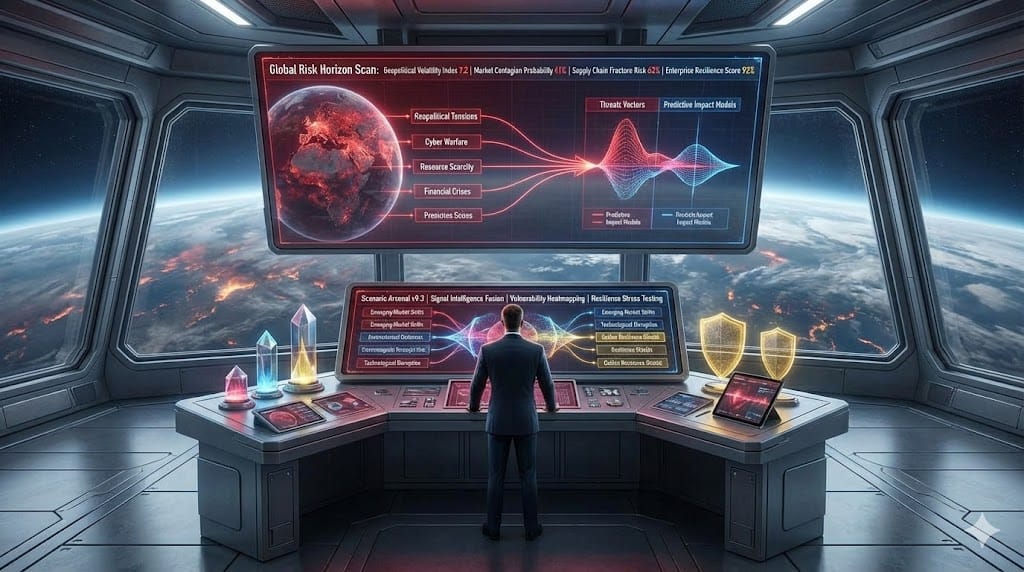
The contemporary geopolitical and economic landscape demands an evolution in executive leadership, moving beyond conventional risk mitigation to proactive strategic foresight. As your Global Head of Research & Leadership Advisory, I emphasize that understanding what distinguishes foresight executives from traditional risk managers is paramount.
Foresight leaders possess an inherent capacity to perceive nascent trends, construct resilient strategies across multiple future states, and transform potential vulnerabilities into significant market advantages. This transformative shift, from reactive crisis management to anticipatory strategic positioning, is now a core executive competency, not merely a specialized discipline. JRG Partners is acutely aware of the imperative to identify and secure C-suite talent capable of navigating such complex and volatile operating environments within the US market, ensuring robust governance and sustained value realization.
Proactive horizon scanning and rigorous scenario planning empower our leaders to anticipate disruptions, mitigate inherent risks, and uncover latent opportunities. Integrating future-oriented thinking across all organizational functions forges a resilient, agile enterprise adept at adapting to multiple plausible futures. The true value of foresight is now measurable through enhanced crisis navigation and sustained competitive advantage, proving its critical return on investment in an era of constant, unprecedented change.
Defining Executive Foresight as a Core Leadership Imperative
In a world characterized by unprecedented Volatility, Uncertainty, Complexity, and Ambiguity (VUCA), or more recently, Brittle, Anxious, Non-linear, and Incomprehensible (BANI) conditions, the strategic imperative for executives has shifted dramatically. Leadership today necessitates a profound understanding of strategic foresight – moving beyond mere prediction towards informed preparedness.
This involves distinguishing dynamic adaptation from static, long-range planning, which often relies on linear projections. The contemporary leadership paradigm cultivates a future-oriented mindset, recognizing it as a profound strategic advantage and a fiduciary duty to shareholders. JRG Partners’ proprietary executive search methodologies are meticulously designed to uncover individuals adept at these forward-thinking competencies, critical for boards seeking transformative talent.
Advanced Horizon Scanning Frameworks for Navigating Global Dynamics
Effective anticipation begins with systematic environmental scanning. For US-based C-suite leadership, understanding which horizon scanning frameworks work best for C-suite leadership is critical for identifying emerging trends and deciphering weak signals that often precede significant shifts. Leveraging frameworks such as PESTLE (Political, Economic, Social, Technological, Legal, Environmental), STEEPLE (adding Ethics), and DESTEP (adding Demographics) allows leaders to comprehensively map macro-environmental shifts affecting market dynamics and competitive landscapes.
The identification of “wild cards” – low-probability, high-impact events – and disruptive forces across geopolitics, technology, and market structures is integral. Sophisticated techniques for data collection and analysis, including Delphi studies, expert panels, trend extrapolation, and cross-impact analysis, provide the intelligence required for informed decision-making. These advanced analytical approaches are non-negotiable for US enterprises aiming for long-term viability.
Rigorous Scenario Planning and Strategic Stress Testing Protocols
Moving beyond singular forecasts, constructing a spectrum of plausible future scenarios is foundational to strategic resilience. Our methodology for scenario construction involves identifying critical uncertainties and driving forces to create distinct, coherent narratives of the future. The question of how do scenario planning exercises improve strategic decisions lies in their capacity to enable strategic stress testing, evaluating business models, supply chain resilience, and investment portfolios against extreme yet plausible conditions.

War gaming exercises, simulating competitor reactions and geopolitical shifts, refine strategic responses, preparing organizations for a diverse array of eventualities. For executives, this cultivates an adaptive strategic posture rather than a rigid adherence to a single presumed future.
Cross-Functional Integration: Weaving Foresight into Organizational Fabric
For foresight to truly permeate an enterprise, breaking down traditional silos is essential. Embedding foresight responsibilities across R&D, operations, finance, marketing, and human resources creates a robust talent architecture. Establishing dedicated foresight councils or working groups fosters interdepartmental collaboration and knowledge sharing, enriching the collective future intelligence.
By integrating foresight insights into strategic planning cycles, innovation pipelines, and enterprise risk management frameworks, organizations can cultivate a shared language and understanding of future-oriented thinking throughout their ranks. This holistic approach ensures that strategic anticipation is not confined to a single department but becomes an organizational reflex.
Developing Robust Early Warning Systems and Intelligence Networks
Designing robust systems for continuous monitoring of critical global and market indicators is a competitive imperative. The strategic advantage derived from understanding what early warning networks deliver competitive intelligence advantage cannot be overstated. Leveraging advanced AI, big data analytics, and predictive modeling for identifying anomalies and emerging threats is crucial.
Beyond technology, building diverse human intelligence networks – engaging geopolitical experts, industry analysts, academic researchers, and cultural observers – provides invaluable qualitative insights. Key indicators for continuous monitoring include geopolitical stability indices, technological breakthrough trackers, commodity price volatility, regulatory shifts, and evolving consumer sentiment. This multi-faceted approach enables proactive rather than reactive responses.
Crafting Adaptive Decision Architecture for Multiple Future Realities
In an environment of persistent ambiguity, developing adaptive strategies means crafting robust plans that remain effective across a range of plausible scenarios. Understanding how should organizations architect decisions for multiple futures involves curating a portfolio of strategic options, investing in flexibility and agility to pivot rapidly in response to unfolding events.
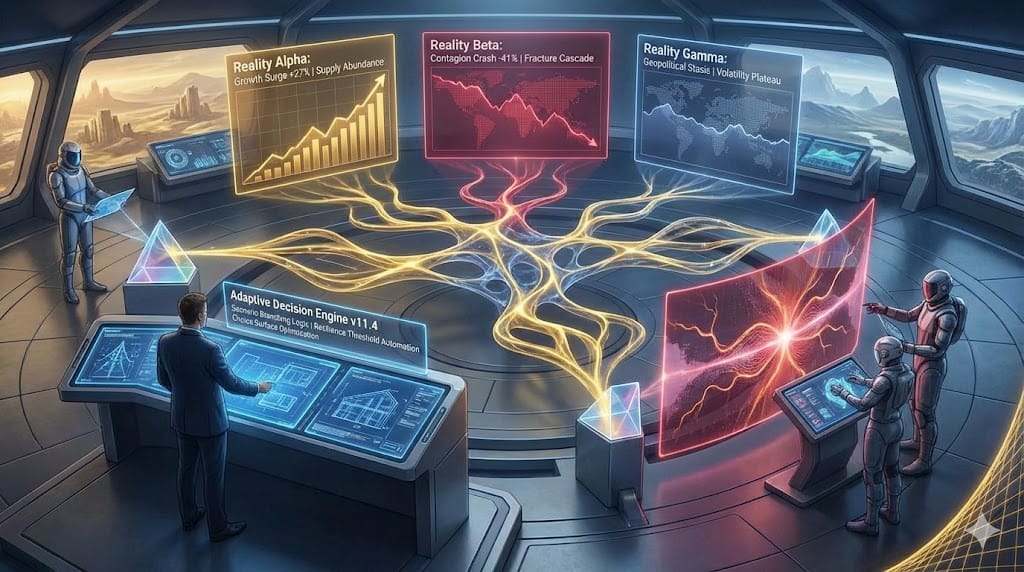
Decision-making frameworks under uncertainty emphasize balancing calculated risk and latent opportunity when future outcomes are ambiguous. The importance of strategic optionality and pursuing “no-regret” moves – actions beneficial across all plausible scenarios – provides critical organizational resilience. This iterative decision architecture enables continuous adjustment, crucial for the US corporate landscape.
Quantifying Foresight’s Value Realization: ROI in Crisis Navigation
Demonstrating foresight’s impact on financial performance and organizational resilience is now quantifiable, moving beyond the intangible. Addressing which metrics quantify foresight executive impact involves analyzing how organizations leveraged foresight to navigate major geopolitical conflicts, economic downturns, or technological disruptions.
Key metrics for demonstrating ROI include reduced recovery times from adverse events, minimized financial losses from anticipated shifts, enhanced reputational capital through proactive leadership, and securing first-mover advantages in nascent markets. These concrete outcomes underscore the strategic necessity of foresight capabilities in modern corporate governance.
Cultivating Organization-Wide Foresight Capability: A Talent Imperative
Developing robust foresight capability organization-wide requires a concerted investment in talent development. Training and upskilling programs are essential for equipping executives and employees with foresight methodologies and tools. Fostering a culture of curiosity, critical thinking, and comfort with ambiguity is paramount. While integrating advanced analytical platforms and data visualization tools is beneficial, the core lies in human intellect and intuition.
The critical question of will AI foresight tools replace human strategic intuition by 2030 suggests a synergistic future, where AI augments rather than supplants executive judgment. This continuous learning environment, championed by committed leadership, ensures that future thinking is embedded into daily operations and strategic dialogue. Given the competitive US talent market, identifying and cultivating leaders who can establish what organizational structures embed foresight capability is a core focus for JRG Partners.
The strategic foresight executive is not merely a visionary but a pragmatic architect of future resilience and competitive advantage. JRG Partners remains your trusted advisor in identifying and securing these transformative leaders who possess the rare blend of strategic acumen and anticipatory intelligence to steer your organization through the complexities of tomorrow’s global and market risks. Through our specialized executive search methodologies, we pinpoint visionaries who can systematically identify emerging market shifts, enabling boards to implement proactive C-suite talent solutions that successfully mitigate disruptive threats before they impact corporate effectiveness.

Tanya Gallardo
Managing Director, Executive Search & AI Talent Strategy
Tanya Gallardo is the Managing Director of Executive Search & AI Talent Strategy at JRG Partners, leading C-suite and Board engagements across key growth sectors including Technology, Financial Services, and Manufacturing.
With over 18 years of experience specializing in disruptive technology leadership, Tanya is recognized as a leading authority on talent architecture for future-focused executive roles, such as the Chief AI Officer (CAIO) and Chief Digital Officer (CDO). Her expertise lies in accurately assessing the cultural fit and technical depth required to ensure a high return on investment (ROI) for critical leadership appointments.
Prior to her role at JRG Partners, Tanya held senior roles directing global talent acquisition strategies at a major publicly-traded technology firm, advising on organizational design and succession planning for emerging executive functions. She is a recognized speaker and contributor to industry events, sharing data-driven insights on executive compensation, leadership development, and the measurable business impact of C-suite talent.
