


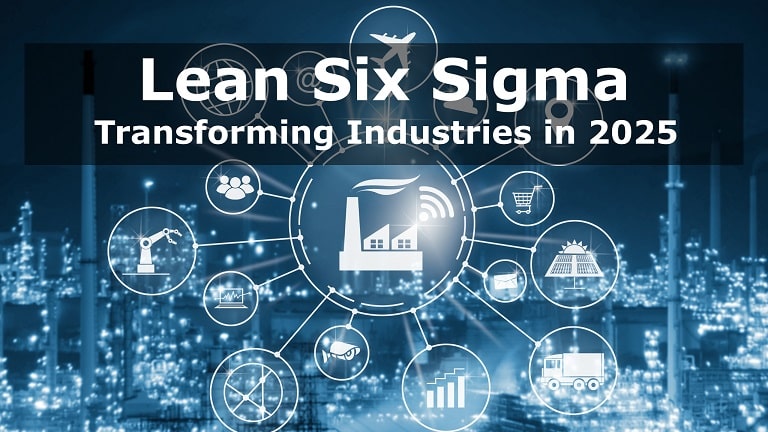
- Manufacturing: Smarter, Leaner, Faster
- Healthcare: Leaning Into Patient-Centered Excellence
- Financial Services & FinTech: Streamlining Speed and Trust
- Pharmaceuticals: From Research to Market, Faster and Safer
- Why These Industries Are Adopting Lean Six Sigma Faster Than Ever
- Final Thoughts: Lean Six Sigma Is Not Just Relevant—It’s Revolutionary
In an era where innovation moves at lightning speed and operational excellence determines long-term viability, Lean Six Sigma (LSS) has re-emerged as a powerful engine of transformation. While many view it as a tool for manufacturing optimization, 2025 tells a different story—one where Lean Six Sigma is not just about quality control, but about strategic agility, digital enablement, and sustained competitiveness across industries.
As global markets become more complex, organizations in healthcare, logistics, finance, and pharmaceuticals are embracing LSS to reduce inefficiencies, improve customer satisfaction, and accelerate time-to-value. These industries are not just adapting—they’re thriving, powered by the structured, data-driven rigor of Lean Six Sigma.
In an era where innovation moves at lightning speed and operational excellence determines long-term viability, Lean Six Sigma (LSS) has re-emerged as a powerful engine of transformation.
Manufacturing: Smarter, Leaner, Faster

Lean Six Sigma has always had a deep footprint in manufacturing, but in 2025, it’s been redefined. The convergence of LSS with Industry 4.0 technologies like AI, robotics, and IoT has transformed traditional factories into data-driven, hyper-efficient production ecosystems.
Modern manufacturers use LSS not just to eliminate waste, but to:
-
Predict and prevent equipment failure using real-time data
-
Design agile workflows that accommodate high customization demands
-
Reduce cycle time and increase throughput in high-volume environments
For example, a European automotive plant recently implemented an LSS-driven smart scheduling system, reducing idle machine time by 42% and saving $5.3M annually.
Healthcare: Leaning Into Patient-Centered Excellence

Few sectors have felt the pressure to transform more than healthcare. With rising patient loads, compliance demands, and staff burnout, Lean Six Sigma is becoming a critical strategy for systemic improvement.
In 2025, hospitals and clinics use LSS to:
-
Streamline surgical prep and discharge processes
-
Reduce patient handoff errors and medication waste
-
Optimize nurse-to-patient ratios based on real-time data
A flagship medical center in Singapore used Lean Six Sigma to redesign its Emergency Department workflow, cutting patient wait times from 90 to 35 minutes while improving patient satisfaction scores by 25%.
Logistics & Supply Chain: Turning Chaos into Control

Supply chains in 2025 are more global, more interconnected, and more vulnerable than ever before. From geopolitical shifts to natural disasters and demand unpredictability, logistics firms are turning to Lean Six Sigma to bring resilience and consistency to their operations.
Today, LSS is helping logistics teams:
-
Eliminate bottlenecks in warehousing and last-mile delivery
-
Use DMAIC frameworks to diagnose delays in real-time
-
Standardize procedures across continents and vendors
A U.S.-based eCommerce company recently applied Lean Six Sigma to improve its delivery routing algorithm. The result? On-time delivery increased by 33%, and fuel expenses dropped by $2.7M annually.
Financial Services & FinTech: Streamlining Speed and Trust

Banking, insurance, and fintech companies are under constant pressure to deliver faster, remain compliant, and build trust. In 2025, Lean Six Sigma is empowering these firms to:
-
Shorten underwriting and loan approval cycles
-
Automate and error-proof regulatory documentation processes
-
Minimize fraud through root-cause analysis and data audits
An Indian FinTech startup integrated Lean Six Sigma principles into its onboarding flow, reducing KYC processing time from 72 hours to under 30 minutes—a change that helped it onboard 1.5 million users in Q1 alone.
Pharmaceuticals: From Research to Market, Faster and Safer

The pharmaceutical industry balances one of the most complex mandates—speed to market, safety, and stringent compliance. In 2025, Lean Six Sigma plays a pivotal role in optimizing every stage of the value chain.
Applications include:
-
Accelerating clinical trials by removing non-value-adding activities
-
Reducing batch failures in drug manufacturing
-
Enhancing quality systems to meet ever-evolving global standards
A pharmaceutical firm in Hyderabad leveraged LSS to reduce batch release time from 12 days to 7, resulting in quicker product launches and increased capacity without additional capital investment.
Why These Industries Are Adopting Lean Six Sigma Faster Than Ever
What unites these diverse sectors is their shared need for repeatable excellence under pressure. Whether you’re saving lives, shipping packages, or transferring funds, variability and inefficiency are threats to growth.
Lean Six Sigma’s blend of data discipline and human-centric problem-solving makes it a universal solution in 2025. The rise of real-time data, AI, and automation doesn’t replace Lean Six Sigma—it amplifies its power.
LSS-trained leaders now work cross-functionally with data scientists, product managers, and developers to design resilient, scalable, and customer-focused operations that adapt to change—not react to it.
Final Thoughts: Lean Six Sigma Is Not Just Relevant—It’s Revolutionary
Lean Six Sigma is no longer confined to process engineers and black belts. In 2025, it’s a strategic language spoken by CXOs, developers, clinicians, and analysts alike. It’s the common thread uniting operational clarity with technological sophistication.
For any organization facing complexity, Lean Six Sigma offers structure. For any leader seeking agility, it offers clarity. And for any team striving for excellence—it provides a path forward.
If you’re looking to stay competitive, reduce inefficiencies, and delight customers in 2025 and beyond, there’s one principle to remember: What can be improved, can be transformed. And Lean Six Sigma is how you do it.
If your business isn’t already adopting Lean Six Sigma, now is the time. The competitive edge is real. The efficiency gains are measurable. And the impact—whether on patients, profits, or production lines—is undeniable.
If your business isn’t already adopting Lean Six Sigma, now is the time. The competitive edge is real. The efficiency gains are measurable. And the impact—whether on patients, profits, or production lines—is undeniable. To drive this transformation and secure the necessary expertise, consider partnering with Lean Six Sigma Executive Recruiters like JRG Partners.

Tanya Gallardo
Managing Director, Executive Search & AI Talent Strategy
Tanya Gallardo is the Managing Director of Executive Search & AI Talent Strategy at JRG Partners, leading C-suite and Board engagements across key growth sectors including Technology, Financial Services, and Manufacturing.
With over 18 years of experience specializing in disruptive technology leadership, Tanya is recognized as a leading authority on talent architecture for future-focused executive roles, such as the Chief AI Officer (CAIO) and Chief Digital Officer (CDO). Her expertise lies in accurately assessing the cultural fit and technical depth required to ensure a high return on investment (ROI) for critical leadership appointments.
Prior to her role at JRG Partners, Tanya held senior roles directing global talent acquisition strategies at a major publicly-traded technology firm, advising on organizational design and succession planning for emerging executive functions. She is a recognized speaker and contributor to industry events, sharing data-driven insights on executive compensation, leadership development, and the measurable business impact of C-suite talent.
