


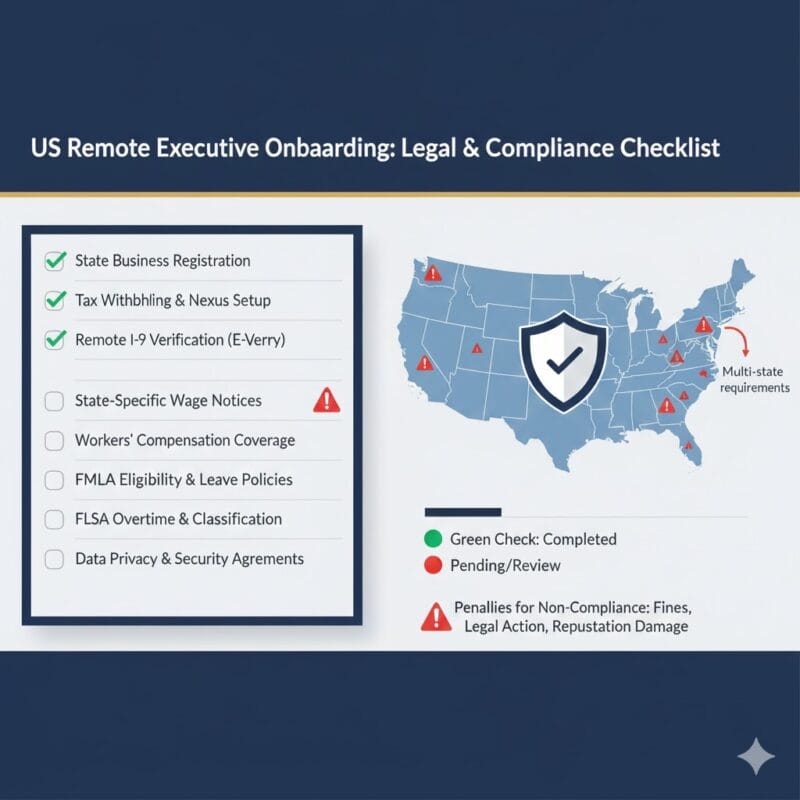
Navigating the Complexities of Distributed Executive Talent Acquisition in the United States
As organizations increasingly embrace a distributed leadership model, the strategic advantages of accessing a broader talent pool must be weighed against a rapidly evolving and intricate regulatory landscape. Securing exceptional senior talent requires not only a sophisticated search process, where JRG Partners excels with a proven track record of placing transformative leaders, but also a forensic understanding of legal and compliance implications.
A critical area of focus is determining Which states have the most restrictive remote work compliance requirements? The answer profoundly impacts our talent architecture and operational risk profile. This briefing outlines the critical considerations for engaging US-based virtual executive hires, underscoring our fiduciary duty to mitigate emergent risks.
Key Takeaways for Board Oversight
- Jurisdictional Patchwork is Paramount: Companies must navigate a complex, often conflicting tapestry of federal, state, and local statutes when employing distributed leaders across the United States.
- Misclassification Risks Are High: Incorrectly classifying a virtual executive as an independent contractor instead of an employee can lead to severe financial penalties, back taxes, and significant legal liabilities.
- Proactive Policy Adaptation is Essential: Standard employment agreements and corporate handbooks are often insufficient; bespoke policies and agreements, meticulously tailored to the executive’s physical work location, are critical for risk mitigation.
- Tax and Equity Demand Multi-State Expertise: Withholding requirements, nexus implications, and equity compensation rules vary dramatically across jurisdictions, necessitating specialized legal and tax counsel to ensure value realization.
- Data Security and Termination Protocols: Robust cybersecurity measures and meticulously drafted post-employment clauses are vital to protect company assets, intellectual property, and to mitigate post-departure risks within a remote operational framework.
The Evolving Landscape of Remote Executive Employment
The rise of distributed leadership models represents a significant paradigm shift in corporate governance and talent strategy. While offering strategic advantages such as access to a wider pool of C-suite talent and enhanced organizational agility, it also introduces inherent legal complexities. Understanding the “Employer of Record” concept is crucial for virtual operations, particularly when expanding into new US jurisdictions without a physical footprint, directly impacting our approach to talent architecture and governance.
Employment Classification: Employee vs. Contractor for Remote Executives
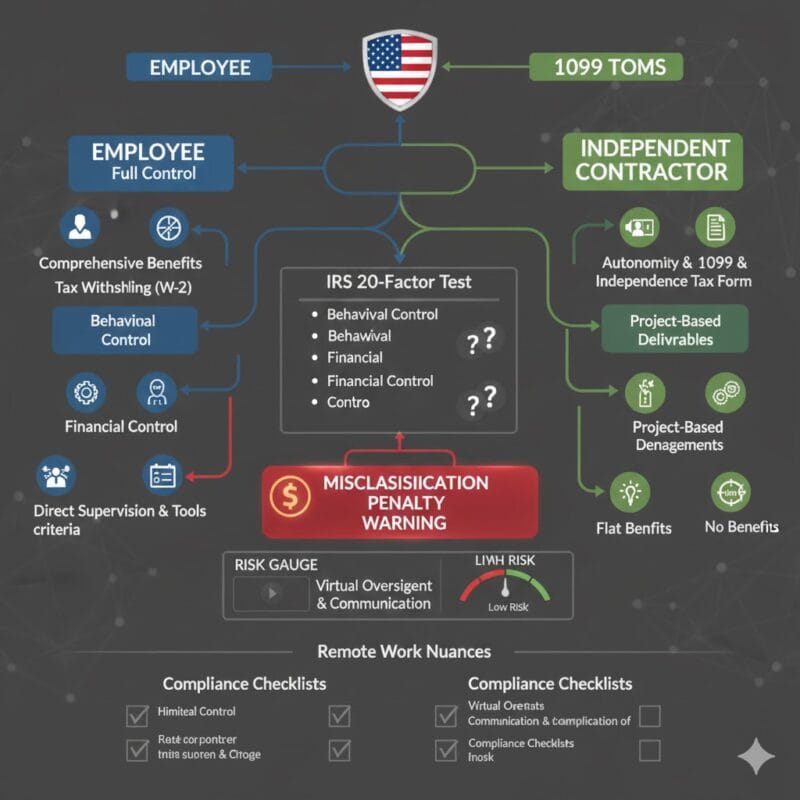
One of the most immediate and impactful areas of legal scrutiny involves employment classification risks. Misclassifying an off-site senior leader, even inadvertently, as an independent contractor when they legally qualify as an employee, carries substantial repercussions. JRG Partners advises a rigorous approach to ensure compliant talent structures for our clients.
Navigating Federal (IRS) and State-Specific Tests:
- Behavioral control: The extent to which the company directs or controls how the executive performs their work, including training and instructions.
- Financial control: Assessment of financial aspects such as expense reimbursement, investment in work equipment, and opportunity for profit or loss.
- Type of relationship: Factors like benefits provision, the existence of written contracts, and the permanency of the relationship.
High-Stakes Consequences of Misclassification:
- Back wages, unpaid overtime, and claims for benefits.
- Significant payroll tax liabilities, penalties, and interest.
- Severe reputational damage and potential class-action lawsuits.
Best Practices for Executive Roles:
- Conduct a comprehensive review of duties and actual operational independence.
- Implement clear, compliant independent contractor agreements only where legally appropriate and rigorously defensible.
- Ensure that the executive’s role truly aligns with the specific state and federal criteria for independent contractor status to avoid substantial non-compliance charges.
State-Specific Wage and Hour Compliance Requirements
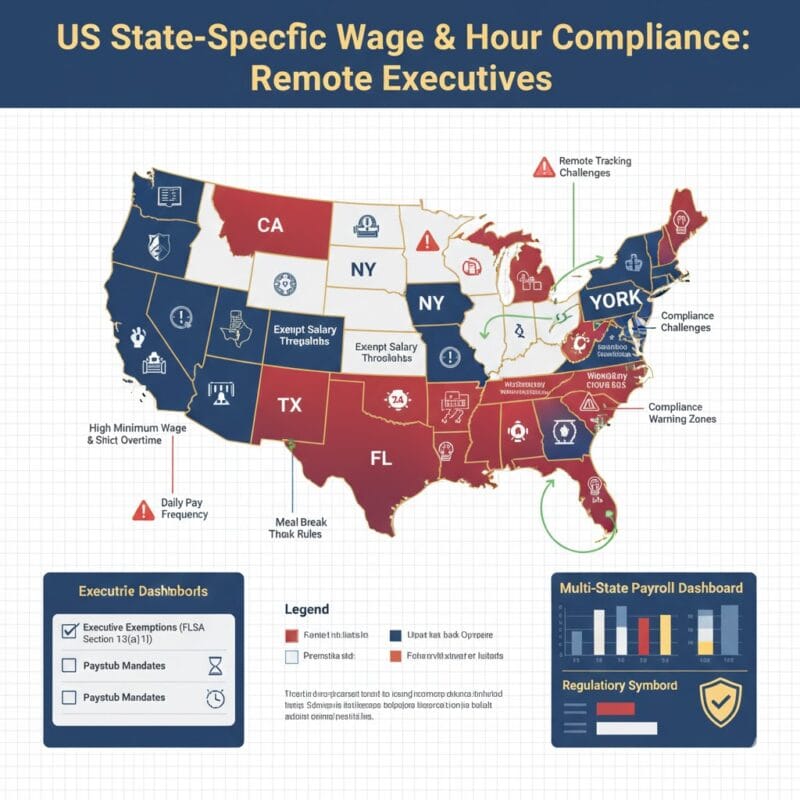
The patchwork of US state and local wage and hour laws poses significant compliance hurdles for distributed senior teams. While the Federal Fair Labor Standards Act (FLSA) provides a baseline, many states impose stricter mandates.
Minimum Wage and Overtime Exemptions:
- Careful application of the “executive exemption” duties test and salary basis is paramount, often against stricter state and local thresholds.
- Ensuring remote senior leaders meet both federal and local criteria for exempt status is a complex exercise.
Meal and Rest Periods:
- Mandatory breaks and detailed documentation requirements vary significantly by state, demanding tailored adherence for off-site executives.
- Compliance becomes particularly challenging for executives managing diverse team locations.
Paid Sick Leave and Vacation Accrual:
- Local and state mandates for paid leave often include specific accrual, usage, and carryover rules.
- Compliance with state-specific payout rules for accrued vacation upon termination is also crucial.
Reimbursement of Business Expenses:
- Numerous state laws mandate reimbursement for necessary business expenses incurred by virtual employees (e.g., internet, phone, home office supplies).
- Developing clear, auditable expense policies tailored to remote work is a strategic necessity.
A recent survey indicated that over 65% of US businesses find multi-state wage and hour compliance to be their most challenging remote workforce legal issue.
Tax Withholding and Nexus Implications Across States
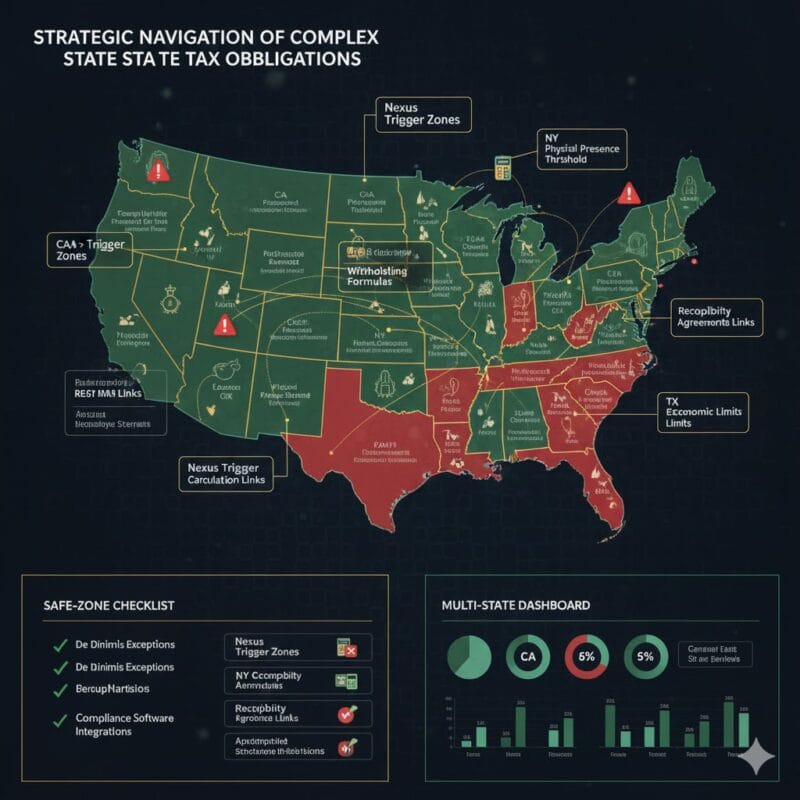
The presence of a remote executive can dramatically alter a company’s tax footprint across the United States. Understanding How does hiring remote executives create tax nexus in new states? is a critical question for financial governance and risk management.
Establishing “Nexus” for Remote Operations:
- A virtual executive’s presence may establish a taxable presence for the company in their state of residence, impacting corporate income tax, sales tax, and payroll tax obligations.
- This triggers a complex array of regulatory compliance requirements for an organization.
State Income Tax Withholding Obligations:
- “Situs of employment” rules determine where income should be taxed, a particularly complex area for multi-state executives.
- Understanding reciprocal agreements between states and “convenience of the employer” rules is essential for accurate withholding.
State Unemployment Insurance (SUTA) and Disability Contributions:
- Mandatory contributions and reporting obligations are based on the executive’s physical work location, requiring precise tracking.
Sales and Use Tax Considerations:
- A remote leader can potentially trigger sales tax nexus, obligating the company to collect and remit sales tax in that new state, requiring sophisticated tax counsel.
Approximately 40% of companies that hired remote employees in a new state encountered unforeseen state tax liabilities within the first year.
Workers’ Compensation and Insurance Coverage for Remote Workers
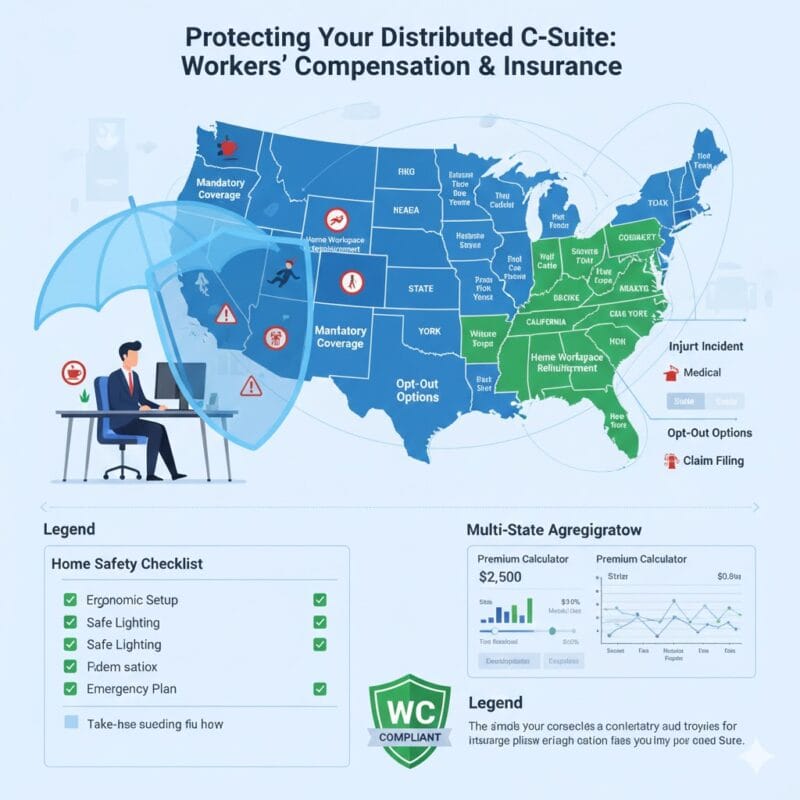
Ensuring adequate What workers compensation rules apply to executives working from home? is a critical risk management component, particularly as traditional workplace boundaries blur.
Jurisdiction for Workers’ Compensation Coverage:
- Determining the applicable state for workers’ compensation coverage, typically where the employee regularly performs work, presents unique challenges for leaders who travel or work from multiple locations.
Defining “Course and Scope of Employment” in a Home Office:
- Addressing injuries sustained during work activities within a remote executive’s home requires careful policy definition.
- Distinguishing work-related incidents from purely personal activities is crucial for liability assessment.
General Liability and Property Insurance:
- Ensuring adequate coverage for company-owned equipment utilized in home offices is imperative.
- Reviewing existing insurance policies for remote work exclusions is a proactive step.
Directors and Officers (D&O) Liability Insurance:
- Evaluating heightened D&O risks in a geographically distributed executive environment is a critical governance concern.
Data Privacy and Cybersecurity Obligations by Location
With executive leaders accessing sensitive company data from varied locations, understanding What data privacy laws affect remote executive access to company systems? is fundamental to our security architecture and regulatory adherence.
Compliance with State-Specific Data Privacy Laws:
- Adhering to burgeoning state laws like CCPA/CPRA (California), VCDPA (Virginia), and CPA (Colorado) is critical for protecting both employee and customer data.
- Data subject rights (e.g., access, deletion, opt-out) must be managed carefully for remote employees and those they interact with.
Robust Cybersecurity Protocols for Remote Access:
- Mandatory use of VPNs, multi-factor authentication, and secure network configurations are non-negotiable.
- Establishing secure equipment provisioning, regular software updates, and rigorous maintenance is essential.
Data Breach Notification Requirements:
- Understanding varying state laws regarding notification timelines, content, and recipients in the event of a breach is a critical component of our incident response plan.
Training and Policy Enforcement:
- Regular, mandatory cybersecurity and data privacy training for all remote executives is indispensable.
- Strict Acceptable Use Policies and comprehensive BYOD (Bring Your Own Device) guidelines must be enforced.
The average cost of a data breach in the US reached $9.48 million in 2023, with remote work cited as a significant contributing factor to increased vulnerability.
Non-Compete and Confidentiality Agreement Enforceability
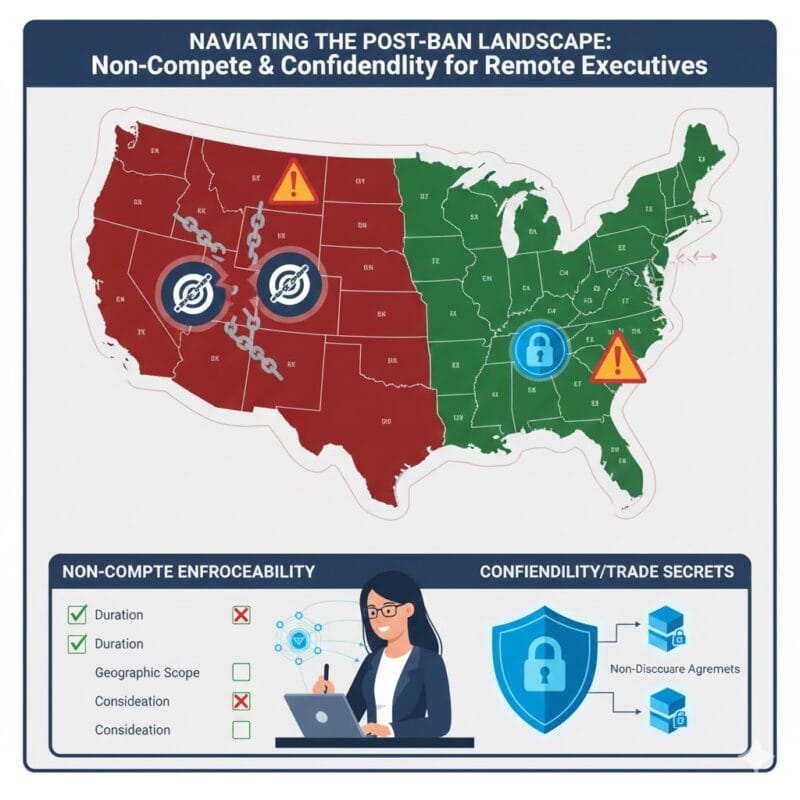
Protecting proprietary information and legitimate business interests remains paramount. However, How do state laws impact non-compete enforceability for executives? The answer is dynamic and often challenging.
The Evolving Landscape of Non-Compete Enforceability:
- States like California, Oklahoma, and North Dakota have strict limitations or outright bans on these clauses.
- The Federal Trade Commission (FTC) has proposed a rule that could broadly ban non-compete agreements, fundamentally altering the landscape.
- In other states, enforceability hinges on strict “reasonableness” tests concerning scope, duration, and geography.
Confidentiality and Trade Secret Protection:
- Agreements protecting proprietary company information and trade secrets generally hold broader enforceability, even in a distributed setting.
- Defining and robustly safeguarding trade secrets within a remote executive environment is a continuous imperative.
Non-Solicitation Clauses (Employees and Customers):
- Enforceability often depends on the same “reasonableness” factors as non-competes, varying significantly by state.
- Strategic drafting is essential to protect legitimate business interests without undue restraint on executive mobility.
Equity Compensation: State Securities and Tax Considerations
Attracting and retaining top-tier executive talent often involves sophisticated equity compensation structures. However, for a geographically dispersed leadership team, understanding How should equity grants be structured for multi-state executives? is a highly specialized area.
State Securities (“Blue Sky”) Law Compliance:
- Registration or exemption requirements for offering stock options, restricted stock units (RSUs), or other equity awards to leaders vary by state.
- Compliance with state-specific disclosure obligations is crucial to avoid regulatory pitfalls.
Multi-State Taxation of Equity Compensation:
- The complexities of federal and state income tax on grants, vesting, and exercise of equity awards are substantial.
- Apportionment challenges arise for executives who reside or work in multiple states during the equity lifecycle, necessitating expert tax counsel.
Disclosure and Communication:
- Providing clear, transparent, and compliant disclosures to remote executives regarding the terms, risks, and tax implications of their equity awards is a governance best practice.
Mismanagement of equity compensation compliance leads to 15% of executive-level legal disputes, primarily due to complex multi-state tax and securities laws.
Termination, Severance, and Remote Work-Specific Clauses
The exit strategy for a remote executive requires as much foresight and legal diligence as their onboarding. What termination clauses must be included in remote executive contracts? The answer depends heavily on the laws of the executive’s work location.
At-Will Employment vs. State-Specific Protections:
- Understanding how individual states temper at-will employment with public policy exceptions or implied contract theories is crucial.
Just Cause and Wrongful Termination Claims:
- The importance of consistent performance management and thorough documentation for remote executives cannot be overstated to mitigate risks of discrimination or retaliation claims.
Severance Agreements:
- Compliance with state-specific requirements for validity, consideration, and revocation periods (e.g., OWBPA for age waivers) is essential.
- Structuring severance to include the treatment of outstanding equity and post-employment obligations requires careful legal review.
Remote Work-Specific Termination Clauses:
- Clear requirements for the return of company property (physical and digital assets) are vital.
- Data deletion and certification clauses for company information on personal devices are increasingly important safeguards.
- Carefully drafted dispute resolution mechanisms (e.g., arbitration agreements) are recommended.
Onboarding and Policy Distribution for Remote Executives
A robust and compliant onboarding process is the first line of defense against future legal challenges for remote executive hires.
Ensuring Compliant Digital Onboarding:
- Adherence to remote I-9 verification rules and procedures is critical.
- Valid electronic signature protocols must be established across various states.
Comprehensive Remote Work Policies:
- Dedicated remote work agreements outlining expectations, schedules, and conduct are foundational.
- Addressing home office safety and ergonomic considerations proactively is a best practice.
Handbook Acknowledgment and Distribution:
- Ensuring executives receive and acknowledge state-specific policy addenda or tailored handbooks is imperative for legal defensibility.
Frequently Asked Questions: Legal & Compliance Executive Hiring
1. What are the core competencies JRG Partners looks for in a Chief Legal Officer (CLO)?
Beyond technical legal acumen, we prioritize strategic business partnership. A modern CLO must serve as a trusted advisor to the Board, demonstrating expertise in corporate governance, enterprise risk management, and the ability to align legal strategy with long-term commercial objectives.
2. How does the recruitment process ensure “cultural fit” for sensitive legal roles?
We utilize a rigorous, competency-based vetting process. This includes multiple rounds of evaluation focused on leadership style, crisis management, and ethical judgment. By mapping the candidate’s past performance against the organization’s specific culture and regulatory environment, we ensure a seamless integration.
3. Why should a firm use a specialized recruiter instead of a generalist for compliance hires?
Compliance is a highly regulated and nuanced field. Specialized recruiters like JRG Partners have deep industry-specific knowledge (e.g., SEC, FINRA, HIPAA, or GDPR) and access to “passive” talent—elite leaders who are not actively on the job market but possess the exact regulatory expertise your firm requires.
4. What is the typical timeline for filling a senior legal executive position?
Most high-impact legal searches are completed within 8 to 12 weeks. This timeline allows for in-depth market mapping, comprehensive interviewing, and the confidential nature of offer negotiations required for C-suite and senior-level placements.
5. Does JRG Partners provide interim solutions for legal and compliance leadership?
Yes. We offer interim Chief Legal Officer and General Counsel solutions for companies undergoing rapid transitions, major litigation, or restructuring. These interim leaders stabilize operations and mitigate risk while the search for a permanent executive is finalized.
Conclusion: Proactive Compliance as a Strategic Imperative
The strategic imperative for any organization operating with a distributed executive team is a holistic, integrated compliance strategy. The complexities outlined – from jurisdictional patchworks to nuanced tax and equity implications – demand ongoing legal review and agile adaptation to regulatory changes. At JRG Partners, we recognize that robust compliance is not merely a legal checkbox but a foundational element for successful executive talent acquisition and retention, ensuring long-term value realization and mitigating enterprise risk. By proactively addressing these challenges, especially concerning What termination clauses must be included in remote executive contracts?, boards can fortify their governance framework and sustain a competitive advantage in the global talent market. JRG Partners remains your strategic ally in this effort, providing the executive search excellence and legal leadership recruitment expertise necessary to secure General Counsel and compliance officers capable of navigating these intricate regulatory landscapes.

Tanya Gallardo
Managing Director, Executive Search & AI Talent Strategy
Tanya Gallardo is the Managing Director of Executive Search & AI Talent Strategy at JRG Partners, leading C-suite and Board engagements across key growth sectors including Technology, Financial Services, and Manufacturing.
With over 18 years of experience specializing in disruptive technology leadership, Tanya is recognized as a leading authority on talent architecture for future-focused executive roles, such as the Chief AI Officer (CAIO) and Chief Digital Officer (CDO). Her expertise lies in accurately assessing the cultural fit and technical depth required to ensure a high return on investment (ROI) for critical leadership appointments.
Prior to her role at JRG Partners, Tanya held senior roles directing global talent acquisition strategies at a major publicly-traded technology firm, advising on organizational design and succession planning for emerging executive functions. She is a recognized speaker and contributor to industry events, sharing data-driven insights on executive compensation, leadership development, and the measurable business impact of C-suite talent.
