



In today’s intricate and fast-evolving US economic environment, the fundamental role of a corporate board in upholding organizational financial integrity and ensuring robust executive accountability has never been more paramount. Boards serve as the ultimate custodians of a firm’s fiscal health, orchestrating resilient frameworks, demanding transparent reporting, and guiding judicious capital allocation.
Category Archives: executive recruiting
executive recruiting, Executive Search Challenges, PE Recruitment Challenges
Case Study: The 100-Day Plan for a PE-Backed CFO

13
Feb
Feb
The appointment of a Chief Financial Officer in a private equity (PE)-backed enterprise marks a pivotal moment, demanding immediate impact and a clear trajectory toward value realization. This confidential analysis delves into the strategic imperatives and operational blueprint for a newly appointed PE-backed CFO, exploring What should a newly hired PE-backed CFO accomplish in the first 30, 60, and 100.
executive recruiting, Executive Search Challenges, For Employers
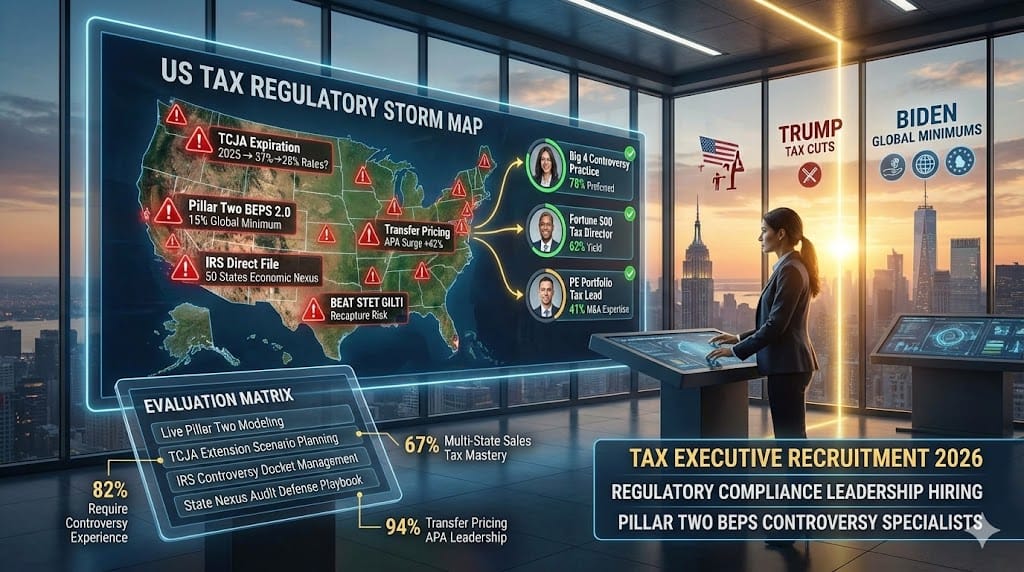
Recruiting Tax and Regulatory Compliance Executives in a Shifting US Landscape
13
Feb
Feb
As GLOBAL HEAD OF RESEARCH & LEADERSHIP ADVISORY at , a premier US-based executive search firm, I am presenting a critical analysis regarding the evolving executive talent landscape for tax and regulatory compliance leadership. The traditional perception of these functions as purely operational or ‘back-office’ is fundamentally outdated.
executive recruiting, Executive Search Challenges
Why Your Next VP of Financial Planning & Analysis (FP&A) Needs Data Science Skills

13
Feb
Feb
As Global Head of Research & Leadership Advisory at , I am consistently tracking the seismic shifts impacting executive talent requirements across the US corporate landscape. A critical observation from our recent analyses and numerous high-level engagements is the evolving mandate for Financial Planning & Analysis (FP&A) leadership.
executive recruiting, Executive Search Challenges, For Employers, PE Recruitment Challenges
The Role of the Finance Executive in Value Creation for PE Firms

13
Feb
Feb
The Strategic Architect: How the Finance Executive Drives Value Creation in Private Equity Firms In the high-stakes environment of US private equity, the finance executive’s mandate has undergone a profound evolution. No longer merely a steward of financial reporting or a keeper of records, the modern financial leader within a PE-backed enterprise is an indispensable strategic partner, intrinsically linked to.
executive recruiting, Executive Search Challenges, PE Recruitment Challenges
Sourcing Finance Leaders with ESG and Sustainability Reporting Expertise

13
Feb
Feb
The convergence of financial performance and environmental, social, and governance (ESG) factors has instigated a profound paradigm shift within the executive suite. As businesses in the US navigate an increasingly complex regulatory and stakeholder landscape, the mandate for finance leaders to possess deep expertise in ESG and sustainability reporting is no longer aspirational; it is a fundamental pillar of fiduciary.
CEO Recruitment, executive recruiting, Executive Search Challenges
Evaluating a Candidate? Experience with Revenue-Based Financing and Alternative Capital

13
Feb
Feb
In the current dynamic economic environment, the ability of executive leadership to navigate complex capital markets is paramount. The strategic imperative for modern US enterprises to secure optimal funding has led to a paradigm shift in how we assess top-tier talent. Traditional capital avenues are increasingly complemented, or even supplanted, by innovative funding structures.
executive recruiting, Executive Search Challenges, For Employers
The New Relationship Between the CFO and the CIO: Driving Digital ROI

13
Feb
Feb
In an era defined by relentless technological advancement and market disruption, the efficacy of an enterprise’s digital investment portfolio is paramount for sustained competitive advantage. Our latest advisory research at underscores a profound paradigm shift: the relationship between the Chief Financial Officer and the Chief Information Officer is no longer transactional but foundational to value creation.
executive recruiting, Executive Search Challenges, For Employers
Attracting Top Finance Talent for Pre-IPO and SPAC-Ready Companies

13
Feb
Feb
In the current dynamic capital markets landscape, the ability to attract, secure, and retain top-tier finance talent represents a pivotal strategic differentiator for enterprises on the precipice of a public market debut—be it through an Initial Public Offering (IPO) or a Special Purpose Acquisition Company (SPAC) transaction.
executive recruiting, Executive Search Challenges
The Chief Risk Officer (CRO): Mitigating Geopolitical and Supply Chain Shocks

13
Feb
Feb
In an era defined by profound global interconnectedness and unprecedented volatility, the mandate of the modern Chief Risk Officer (CRO) has undergone a significant paradigm shift. No longer confined to traditional financial risk management, today’s CRO is a strategic architect, indispensable to safeguarding enterprise longevity amidst complex external pressures.