


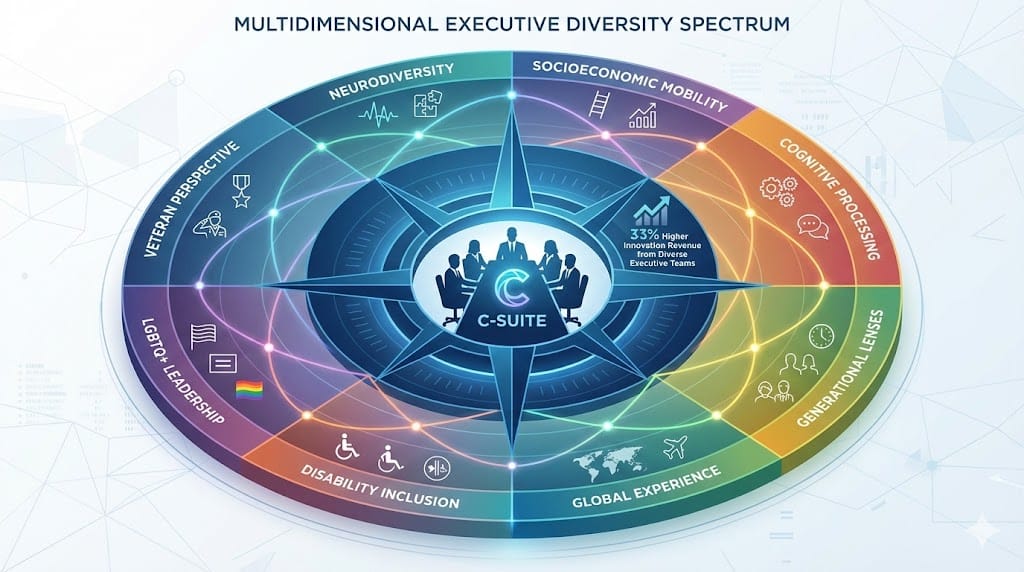
The contemporary business landscape in the US demands a profound evolution in how we define and pursue executive diversity. While foundational efforts addressing visible demographic markers like gender and race remain critically important, leading organizations recognize that true executive talent strategy transcends these initial benchmarks.
A new paradigm shift** is underway, recognizing that a truly multifaceted spectrum of backgrounds and perspectives is paramount for sustained competitive advantage. Our latest research indicates a pressing need to explore deeply impactful dimensions. For instance, in an era of unprecedented complexity, discerning what cognitive diversity dimensions outperform gender quotas? becomes a strategic imperative for every forward-thinking board.
Key Strategic Imperatives
- True executive diversity transcends visible demographic markers, embracing a multifaceted spectrum of backgrounds and perspectives. This includes vital elements like cognitive styles, socioeconomic histories, neurodiversity, and global lived experiences.
- A broader approach to diversity is a strategic imperative for navigating complex global challenges, fostering superior decision-making and enhancing organizational resilience.
- Organizations that cultivate holistic executive diversity gain a distinct competitive advantage through enhanced innovation, deeper market penetration, and robust strategic planning.
- Measuring the impact of this expanded diversity requires sophisticated metrics that capture intersectional value rather than simplistic checkboxes.
The Evolving Imperative for Executive Talent Architecture
Traditional diversity metrics, primarily focused on visible characteristics, are increasingly insufficient for the modern strategic challenges facing US corporations. The increasing complexity of global markets, geopolitical landscapes, and technological disruption demands a richer tapestry of executive thought and experience.
JRG Partners has consistently observed that a leadership cohort with diverse experiential foundations demonstrates significantly enhanced resilience, adaptability, and foresight. This comprehensive approach to talent architecture is no longer a matter of corporate social responsibility alone; it is a fiduciary duty to shareholders, directly impacting long-term value realization.
Cognitive Diversity: Unlocking Strategic Foresight
Beyond surface-level attributes, the true power of a leadership team often lies in its cognitive composition. Exploring various thinking styles, problem-solving approaches, and information processing methods among executives is essential. The strategic advantage of combining analytical, intuitive, systemic, and creative minds at the leadership table is undeniable. Varied cognitive frameworks reduce critical blind spots and foster more robust strategic planning. Studies consistently show that companies with high cognitive diversity outperform less diverse peers in problem-solving and innovation by 35%.

To truly advance organizational capabilities, discerning what cognitive diversity dimensions outperform gender quotas? is a question boards must actively address. This requires deliberate recruitment strategies focused on intellectual breadth.
Socioeconomic Lenses: Amplifying Market Acumen
Leaders’ lived experiences of varying economic conditions profoundly shape their understanding of consumer behavior, market gaps, and global inequalities. This deep empathy and real-world perspective enable an organization to anticipate and respond to diverse customer needs and emerging market segments with unparalleled insight.
Developing inclusive product and service strategies informed by authentic socioeconomic understanding leads to greater market resonance. For instance, how do socioeconomic backgrounds predict market expansion success? is a crucial query that informs our executive search strategies at JRG Partners, ensuring we identify leaders who can bridge market divides. Research indicates that 40% of consumers feel better represented by brands whose leadership reflects diverse socioeconomic realities.
Inter-Industry Cross-Pollination: Catalyzing Breakthrough Innovation
The strategic value of executives with leadership experience across disparate sectors (e.g., technology, healthcare, government, finance) cannot be overstated. Transferring best practices, disruptive ideas, and problem-solving methodologies between industries fuels exponential innovation. This approach deliberately breaks free from industry-specific silos, fostering novel solutions to complex challenges.
Understanding which industry backgrounds create strongest innovation chemistry? is a critical differentiator for building future-ready C-suites. Leading business analyses suggest that 45% of breakthrough innovations occur at the intersection of different industries or disciplines.
Functional Versatility: Optimizing Organizational Cohesion
Bringing together executives with deep expertise from various core functions (e.g., engineering, marketing, finance, legal, operations, HR) at the strategic apex ensures a holistic, 360-degree view of organizational strengths, weaknesses, opportunities, and threats.
This functional diversity is key to optimizing resource allocation and integrated strategic execution through comprehensive perspectives. Addressing what functional diversity gaps cripple executive decision quality? directly improves overall governance and operational excellence.
Generational Synergy: Future-Proofing Leadership
The strategic importance of combining insights from multiple generations (e.g., Baby Boomers, Gen X, Millennials, Gen Z) in executive leadership is becoming increasingly apparent. This balance of institutional memory and foundational wisdom with forward-looking adaptability and emerging trends is critical for talent pipeline sustainability and market responsiveness.

Analyzing how do generational tensions reveal blind spots in strategy? allows organizations to proactively address potential misalignments and foster a more dynamic leadership culture. Organizations with multigenerational leadership teams report 20% higher employee engagement and innovation.
Neurodiversity: A Competitive Edge in Complex Problem-Solving
Recognizing and valuing the unique strengths associated with neurodiverse conditions (e.g., autism spectrum, ADHD, dyslexia, dyspraxia) offers a distinct competitive advantage. Different neurological wirings can provide unparalleled strengths in pattern recognition, detailed analysis, creative problem-solving, and unique perspectives crucial for complex strategic environments.
Leveraging neurodiversity is not just inclusive; it’s a strategic imperative. Exploring which neurodiverse traits enhance C-suite problem-solving? unveils powerful, often untapped, intellectual capital. Teams including neurodivergent individuals can be 30% more productive and innovative.
Global Lived Experience: Navigating International Dynamics
There is a critical distinction and strategic advantage inherent in executives who possess extensive global lived and professional experience compared to those with solely domestic expertise. These leaders are uniquely equipped to navigate nuanced geopolitical landscapes, cultural sensitivities, and international market dynamics with authenticity and insight.
This enables the building of truly global strategies that resonate across diverse cultural contexts and foster international partnerships. Understanding what global experiences prevent domestic market assumptions? is vital for any US-based firm with international aspirations. Organizations with globally experienced leaders are 50% more likely to successfully enter new international markets.
Measuring Intersectional Value: Advanced ROI Frameworks
Moving beyond single-axis diversity metrics is essential to truly understand the complex, synergistic value created by intersecting identities and experiences. Developing sophisticated analytical frameworks to assess the collective impact of expanded diversity on strategic outcomes, financial performance, and innovation is a profound challenge, yet a necessity.

Quantifying the qualitative benefits of deeply integrated, multidimensional executive diversity is where the rubber meets the road. JRG Partners actively assists boards in developing these advanced metrics, recognizing that companies effectively measuring intersectional diversity report 15% higher ROI on diversity initiatives.
Implementation Strategies: Building a Truly Diverse Executive Pipeline
At JRG Partners, our proprietary executive search methodologies are meticulously designed to identify and attract these broader forms of executive diversity. We go beyond conventional candidate profiles, leveraging advanced analytics and deep behavioral interviewing techniques to uncover hidden talent. Our commitment is to partner with boards and C-suite leaders to not only fill critical roles but to strategically enhance their entire leadership ecosystem.
- Rethinking talent acquisition and recruitment processes to identify and attract broader forms of diversity, including non-traditional career paths and skill sets.
- Developing inclusive leadership programs and mentorship initiatives that support diverse executive growth, ensuring equitable access to career advancement opportunities.
- Fostering an organizational culture that champions psychological safety, encouraging authentic expression of diverse perspectives and constructive dissent.
Conclusion: The Geo-Strategic Imperative of Holistic Executive Diversity
The expansion of executive diversity beyond traditional demographic markers is not merely a social responsibility or a human resources initiative; it is a profound geo-strategic necessity for competitive advantage and global leadership in the US market. The future success of American corporations hinges on their ability to build leadership teams whose composition mirrors the multifaceted complexity of the world they operate in. Boards and C-suite executives must commit to this broadened vision of talent.
Ultimately, the question becomes not just about who is at the table, but how should boards quantify multidimensional diversity ROI? This commitment to a holistic, future-focused diversity framework will define market leaders for the next generation.
FAQs
Why focus beyond gender and race when these visible dimensions of diversity still face significant barriers?
Focusing beyond gender and race is an expansion, not a replacement. These visible dimensions remain critical areas of focus for equity and representation. However, to address the complex global challenges of today’s business environment, a broader definition of diversity, encompassing cognitive styles, socioeconomic backgrounds, and neurodiversity, is essential for unlocking deeper organizational capabilities and strategic advantage. It’s about building a more resilient and insightful leadership team without diminishing the importance of traditional diversity initiatives.
How can organizations practically identify and recruit for these broader types of diversity, which are often less visible?
This requires moving beyond surface-level resumes. Organizations must implement sophisticated behavioral interviewing, psychometric assessments for cognitive styles, and a deliberate focus on candidates’ varied life experiences and career trajectories. JRG Partners specializes in these advanced executive search methodologies, helping clients develop competency models that value diverse problem-solving approaches and unique professional journeys. Building a culture of psychological safety also encourages candidates to share less visible aspects of their diversity.
What are the biggest challenges in implementing a holistic, multi-dimensional diversity strategy at the executive level?
Key challenges include overcoming unconscious bias in traditional talent pipelines, developing metrics that accurately capture intersectional value, fostering a truly inclusive culture that supports diverse thinking, and gaining C-suite and board buy-in for this expanded vision. It also requires significant investment in leadership development programs tailored to support non-traditional executive paths and perspectives.
Is there a risk of “diversity fatigue” or diluting focus by expanding the scope of diversity too widely?
The risk of “diversity fatigue” exists if initiatives are poorly defined or lack clear strategic alignment. However, by reframing diversity as a geo-strategic imperative for competitive advantage and a driver of innovation and superior performance, rather than merely a compliance or HR initiative, this risk is mitigated. Expanding the scope is about enriching the definition and deepening the impact, ensuring every dimension of diversity is tied back to organizational outcomes and value realization.
How do you ensure that focusing on these broader dimensions doesn’t overshadow ongoing efforts to address traditional forms of discrimination?
Maintaining a dual focus is critical. Efforts to address traditional forms of discrimination (e.g., gender, race, ethnicity) must remain foundational and robust, reinforced by clear policies, accountability, and ongoing training. The expanded scope of diversity builds upon this foundation, creating a more comprehensive and resilient talent strategy that addresses both historical inequities and future strategic needs. Both are essential for creating an equitable and high-performing executive team.
While standard compliance frameworks often reduce organizational diversity to simple demographic tallies, true competitive advantage requires a much more sophisticated approach to human capital. At JRG Partners, we have seen that limiting your sourcing strategies to highly visible metrics can lead to cognitive monocultures that fail to adapt to complex market shifts. To build a highly resilient, adaptive leadership team capable of navigating systemic disruption, progressive corporate boards must look beyond gender and race by expanding the scope of executive diversity. Intentionally integrating cognitive diversity, varied socioeconomic backgrounds, and non-traditional career trajectories into your C-suite pipeline is the definitive mechanism required to eliminate strategic blind spots, accelerate innovation velocity, and maximize long-term corporate effectiveness.

Tanya Gallardo
Managing Director, Executive Search & AI Talent Strategy
Tanya Gallardo is the Managing Director of Executive Search & AI Talent Strategy at JRG Partners, leading C-suite and Board engagements across key growth sectors including Technology, Financial Services, and Manufacturing.
With over 18 years of experience specializing in disruptive technology leadership, Tanya is recognized as a leading authority on talent architecture for future-focused executive roles, such as the Chief AI Officer (CAIO) and Chief Digital Officer (CDO). Her expertise lies in accurately assessing the cultural fit and technical depth required to ensure a high return on investment (ROI) for critical leadership appointments.
Prior to her role at JRG Partners, Tanya held senior roles directing global talent acquisition strategies at a major publicly-traded technology firm, advising on organizational design and succession planning for emerging executive functions. She is a recognized speaker and contributor to industry events, sharing data-driven insights on executive compensation, leadership development, and the measurable business impact of C-suite talent.
