


While retained search offers a rigorous and tailored approach for high-level, high-stakes roles, contingency search can be the better option in specific scenarios—especially when speed, cost sensitivity, or role volume are key factors.
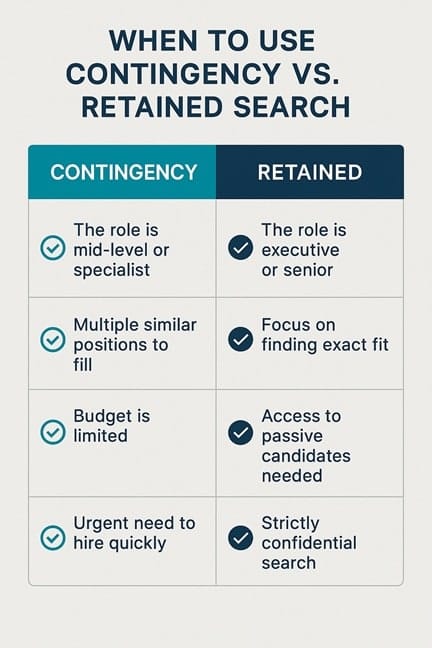
1. When the Role Is Non-Executive or Mid-Level
Contingency search is best suited for mid-management or specialist roles where the talent pool is relatively active and accessible. These candidates are often applying to jobs, responding to outreach, and open to recruiter contact. In such cases, speed and résumé volume can yield results without the need for extensive vetting or market mapping.
2. When You’re Hiring for Multiple Similar Positions
If you’re filling multiple roles of the same type—like 10 regional sales managers or several software engineers—a contingency model can be effective. The incentive structure motivates firms to deliver quickly, and the lower complexity of the role reduces the risk of misalignment.
3. When the Budget Doesn’t Support a Retainer
For startups or small businesses with limited hiring budgets, contingency recruiting may provide a way to access external talent sourcing without upfront investment. The “no-hire, no-fee” structure reduces financial risk—although it also comes with limitations in terms of commitment, strategy, and access to passive talent.
4. When Time-to-Hire Is the Primary Metric
In urgent hiring scenarios—such as replacing a recently exited team member where coverage is critical—contingency firms can help fill the gap quickly. Their networks and speed-focused models are designed to deliver candidates fast, albeit with less depth.
When to Rethink Contingency
Contingency is not ideal for confidential, strategic, or C-suite roles. If the position directly impacts company culture, growth trajectory, or executive leadership, it’s better to partner with a retained search firm that can guarantee focus, alignment, and access to top-tier passive talent.
🔗 For more, see our deep dive on Retained vs. Contingency: Which Is Right for Your Executive Hire?

Tanya Gallardo
Managing Director, Executive Search & AI Talent Strategy
Tanya Gallardo is the Managing Director of Executive Search & AI Talent Strategy at JRG Partners, leading C-suite and Board engagements across key growth sectors including Technology, Financial Services, and Manufacturing.
With over 18 years of experience specializing in disruptive technology leadership, Tanya is recognized as a leading authority on talent architecture for future-focused executive roles, such as the Chief AI Officer (CAIO) and Chief Digital Officer (CDO). Her expertise lies in accurately assessing the cultural fit and technical depth required to ensure a high return on investment (ROI) for critical leadership appointments.
Prior to her role at JRG Partners, Tanya held senior roles directing global talent acquisition strategies at a major publicly-traded technology firm, advising on organizational design and succession planning for emerging executive functions. She is a recognized speaker and contributor to industry events, sharing data-driven insights on executive compensation, leadership development, and the measurable business impact of C-suite talent.
