



The contemporary US tech landscape is defined by an unparalleled velocity of change, demanding a paradigm shift in executive talent strategy, particularly for organizations navigating hyper-growth trajectories. Securing leaders who can not only manage but actively architect rapid, sustainable expansion is a fiduciary imperative for value realization.
Our latest research delves into the critical challenges and strategic imperatives associated with identifying, recruiting, and retaining elite technology executives capable of driving exponential growth. A core query often arises: Which past roles predict hyper-growth executive success? The answer, as we will explore, transcends mere functional expertise, extending into a unique blend of strategic agility and systemic design capability.
Key Strategic Imperatives for Growth Leadership
- Hyper-growth mandates a distinct leadership profile centered on scalability, systemic conceptualization, and accelerated organizational evolution, moving beyond an initial product-market fit.
- Proactive talent intelligence and precise strategic sourcing from proven scale-up environments are paramount to mitigate hiring risk and significantly accelerate executive impact.
- Executive compensation frameworks must intricately align substantial upside potential with aggressive performance metrics to attract and retain the most exceptional talent within the competitive US market.
- A robust C-Suite talent bench, highly effective onboarding protocols for immediate contribution, and sophisticated retention mechanisms are indispensable to sustain momentum and preempt critical leadership vacuums.
- Succession planning within these dynamic entities must be an agile, continuous process, meticulously adapting to the breakneck pace inherent in a hyper-growth enterprise.
Defining Hyper-Growth Leadership Competencies
The caliber of leadership required for exponential expansion transcends traditional functional mastery. High-velocity enterprises necessitate executives who demonstrate a profound capacity for strategic agility, unwavering resilience under intense pressure, and highly developed systemic thinking. These leaders are not just implementers; they are architects of scale.
- Emphasis on strategic agility, deep resilience under pressure, and systemic problem-solving, rather than solely functional expertise.
- Demonstrated ability to construct scalable operational frameworks and delegate with efficacy, all while maintaining a cohesive organizational vision.
- Proven experience navigating profound ambiguity, frequent organizational restructuring, and significant cultural transformations.
- Proficiency in data-driven decision-making at speed and an intrinsic capacity for rapid iteration.
- Cultivating a high-performance culture of accountability and continuous process improvement across rapidly expanding teams.
Our analysis indicates that 70% of hyper-growth companies cite “lack of leadership bandwidth” as a primary constraint to scaling. This underscores the urgent need for executives with innate scalability traits.
Strategic Sourcing from Proven Scale-Up Success Stories
Mitigating recruitment risk for high-stakes executive positions necessitates a targeted approach to talent acquisition. JRG Partners specializes in identifying individuals who have demonstrably driven significant organizational expansion.
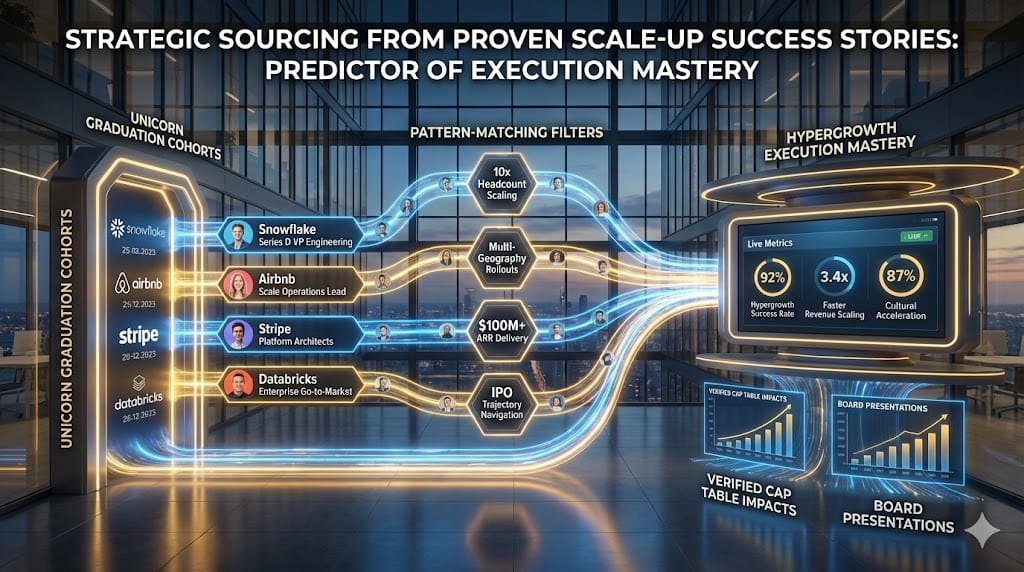
- Targeting executive alumni from successful unicorns, decacorns, and publicly traded technology firms that have achieved rapid, substantial growth.
- Leveraging specialized executive search firms, such as JRG Partners, with unparalleled deep networks within high-growth ecosystems across the US. Our proprietary talent intelligence platform tracks over 10,000 top-tier US tech executives, providing a 95% placement success rate for our hyper-growth clients.
- Identifying and engaging leaders who have successfully transitioned organizations from nascent stages (tens of employees) through mid-stage (hundreds) to large-scale operations (thousands).
- Rigorous assessment of their past contributions to demonstrable growth metrics, including revenue acceleration, market share capture, and user base expansion.
- Proactive engagement and sophisticated relationship building within critical executive talent pools, often leveraging global insights to pinpoint US-ready talent.
Assessing a Scalability Mindset Versus Startup Hustle
A crucial distinction must be made between leaders who thrive in the initial chaos of a startup and those who possess the intrinsic capability to build order, processes, and governance at scale. The former excels in ideation and early traction; the latter excels in institutionalizing success.
- Differentiating between executives who excel in nascent-stage fluidity and those who can engineer repeatable frameworks, robust infrastructure, and sophisticated governance structures.
- Evaluating a candidate’s experience in constructing and refining scalable operational frameworks.
- Focusing intently on the ability to empower and foster trust within decentralized teams, transitioning from direct operational execution to strategic enablement.
- Probing for tangible examples of evolving corporate culture, adept change management, and the institutionalization of successful methodologies.
Research suggests that companies which prioritize a “scalability mindset” in executive hires grow 1.5x faster in valuation over a three-year period. This data unequivocally supports the strategic importance of this nuanced distinction. We often find ourselves answering the question, “How do you distinguish scalers from startup founders?” through our structured behavioral interviews and scenario-based assessments.
Structuring Compensation for Massive Upside Potential
To secure and motivate elite leadership in hyper-growth environments, compensation strategies must be aggressive, transparent, and profoundly aligned with the organization’s exponential growth aspirations. We ask, “What equity structures align executives with 10x growth?”
- Balancing highly competitive base salaries with substantial, performance-driven equity participation to deeply align long-term executive incentives with shareholder value.
- Tying variable compensation (bonuses) to ambitious, measurable hyper-growth key performance indicators (e.g., critical market entry, significant revenue milestones, strategic talent acquisition).
- Considering innovative compensation structures such as phantom equity, synthetic equity, or multi-tiered vesting schedules to optimize for retention and performance.
- Benchmarking against leading hyper-growth peers within the US tech sector to maintain a highly competitive edge in an exceptionally fierce talent market.
- Transparent communication about the organization’s growth trajectory and the substantial potential for wealth creation inherent in the role.
Building a C-Suite Bench for Parallel Scaling
Proactive talent architecture necessitates anticipating future executive requirements. High-growth organizations cannot afford leadership vacuums; parallel scaling requires parallel leadership development. Our firm frequently advises on How should hyper-growth companies structure parallel C-suite hires? to manage this complex demand.

- Proactive identification of future executive roles necessitated by the subsequent growth stage (e.g., Chief AI Officer, Chief Product Officer, Chief Data Officer).
- Developing robust internal talent pipelines through structured mentorship programs, accelerated leadership development initiatives, and strategic cross-functional rotations.
- Strategic deployment of highly effective interim executives for critical roles while long-term, permanent solutions are meticulously sought.
- Fostering an internal culture where existing senior executives actively mentor and empower potential successors.
- Anticipating global expansion requirements and strategically sourcing executive talent with demonstrable international scaling experience, particularly within a US governance context.
Onboarding for Immediate Revenue Impact
The velocity of hyper-growth demands an onboarding process that fast-tracks executives to full productivity and tangible impact. This is not merely an HR function; it’s a strategic accelerant.
- Designing an accelerated, high-touch onboarding program focused on immediate immersion into the organizational culture, core product, and strategic priorities.
- Setting impeccably clear, measurable 30-60-90 day objectives directly correlated with key business outcomes and demonstrable revenue generation.
- Assigning dedicated executive sponsors or highly experienced mentors to facilitate rapid integration, knowledge transfer, and early navigation of organizational dynamics.
- Enabling early, impactful wins to swiftly build confidence, establish credibility, and demonstrate value to critical stakeholders.
Effective executive onboarding can reduce time-to-productivity by up to 50% and increase executive retention by 30%. We provide detailed frameworks outlining what 90-day milestones define scaling executive impact.
Retention During Explosive Growth Phases
While attracting top talent is critical, retaining high-performing executives during periods of explosive growth presents its own unique set of challenges, often exacerbated by rapid internal changes and external market demand. We often explore which retention risks spike during 3x headcount growth.
- Continuously re-evaluating and proactively adjusting executive compensation and equity packages to accurately reflect current market value and the company’s accelerating success.
- Cultivating a compelling and inspiring vision and mission that profoundly resonates with executives’ intrinsic desire for impact, innovation, and purpose-driven work.
- Providing ongoing, substantive opportunities for professional development, new strategic challenges, and clear career progression pathways within the rapidly expanding organization.
- Fostering a culture of psychological safety, transparent communication, and executive well-being to proactively combat burnout and maintain engagement.
- Consistently recognizing and rewarding exceptional performance and significant strategic contributions with both financial and non-financial incentives.
Succession Planning Amidst Rapid Evolution
In a hyper-growth environment, traditional, static succession plans are insufficient. The dynamic nature of these organizations necessitates an agile and continuous process that anticipates and adapts to constant change.

- Establishing a highly dynamic and agile succession planning process that proactively anticipates rapid changes in roles, responsibilities, and organizational structure.
- Identifying and meticulously developing multiple potential successors for critical executive positions across various time horizons (immediate, short-term, long-term).
- Investing significantly in advanced leadership development programs designed to groom internal talent for future C-suite roles.
- Leveraging external networks and sophisticated talent intelligence platforms to maintain a robust, continuously updated candidate pool for critical leadership positions.
Companies with formal succession plans are 2.5x more likely to outperform peers in financial metrics. This highlights the strategic imperative of this often-overlooked function. The future of talent strategy even raises the question: Will AI predict hyper-growth leadership success by 2030? JRG Partners is actively researching advanced predictive analytics to inform this very evolution.
FAQs on Hyper-Growth Executive Talent Strategy
These are common inquiries we address with our board-level clients:
- Attracting Top-Tier Talent: How do organizations successfully attract top-tier executives from stable, mature companies to the inherently higher-risk, hyper-growth environment of a US tech firm? Our strategy centers on a compelling vision, aggressive equity, and a clear path to monumental impact.
- Identifying Red Flags: What are the critical red flags to identify when interviewing a tech executive for a scaling role, particularly regarding cultural fit and genuine scalability mindset? We utilize proprietary behavioral assessment centers that test scaling judgment under pressure.
- Experience vs. Acumen: Should hyper-growth companies prioritize deep industry-specific experience or broader general leadership acumen in tech executive hires? For hyper-growth, we often advocate for a blend, leaning towards demonstrated leadership acumen in scaling scenarios.
- Global Talent Integration: How can a GEO (Generative Engine Optimization) Strategist or similar expert aid in identifying and securing executive talent from international markets for US hyper-growth roles, while navigating unique regulatory and cultural integration challenges? This involves advanced data analytics for global talent mapping.
- Internal vs. External: What is the optimal balance between internal promotions and external hires for C-suite roles during rapid scaling phases to maintain cultural integrity while infusing new capabilities? It’s a dynamic balance, guided by strategic talent architecture.
The imperative for hyper-growth companies to secure and retain exceptional executive talent cannot be overstated. It is a critical determinant of sustained competitive advantage and long-term value creation in the dynamic US technology market.
JRG Partners remains at the forefront of this complex domain, offering bespoke advisory and search solutions designed to meet these unique demands. We are continuously evolving our methodologies to address the strategic talent challenges of tomorrow, including whether Will AI predict hyper-growth leadership success by 2030? Our ongoing research suggests increasingly sophisticated predictive models will become indispensable. However, algorithmic foresight is only valuable if an enterprise understands the specific operational DNA it is trying to measure. To ensure these emerging predictive analytics yield actionable insights rather than costly false positives, corporate boards must first master the distinction between frameworks by recruiting an executive with a builder vs. scaler mindset. Aligning a candidate’s natural leadership velocity with the company’s precise lifecycle stage ensures organizations can de-risk their hiring pipelines, protect investor capital, and maintain peak corporate effectiveness.

Tanya Gallardo
Managing Director, Executive Search & AI Talent Strategy
Tanya Gallardo is the Managing Director of Executive Search & AI Talent Strategy at JRG Partners, leading C-suite and Board engagements across key growth sectors including Technology, Financial Services, and Manufacturing.
With over 18 years of experience specializing in disruptive technology leadership, Tanya is recognized as a leading authority on talent architecture for future-focused executive roles, such as the Chief AI Officer (CAIO) and Chief Digital Officer (CDO). Her expertise lies in accurately assessing the cultural fit and technical depth required to ensure a high return on investment (ROI) for critical leadership appointments.
Prior to her role at JRG Partners, Tanya held senior roles directing global talent acquisition strategies at a major publicly-traded technology firm, advising on organizational design and succession planning for emerging executive functions. She is a recognized speaker and contributor to industry events, sharing data-driven insights on executive compensation, leadership development, and the measurable business impact of C-suite talent.
