



The pursuit of premier executive talent within the classified and national security domains represents a critical strategic imperative for organizations operating within the U.S. defense industrial base and various governmental agencies. This highly specialized niche of executive search fundamentally diverges from conventional talent acquisition methodologies, demanding a nuanced understanding of stringent security protocols, intricate adjudicative processes, and a profoundly discerning talent pool.
At JRG Partners, our deep expertise consistently demonstrates that success in this arena hinges on a proactive and deeply informed approach to executive talent strategy. A key question for many organizational leaders remains: What differentiates TS from TS/SCI executive readiness? This distinction, alongside many others we meticulously navigate, underscores the complexity and high stakes of securing leadership for mission-critical roles.
The Unique Landscape of Cleared Executive Recruitment
Navigating the complex and highly specialized domain of classified and security-clearance executive recruitment presents unique challenges and unparalleled opportunities for national security organizations and defense contractors operating in the United States. Unlike conventional executive searches, this field necessitates a profound understanding of intricate security protocols, adjudicative processes, and a candidate pool with very specific, non-negotiable qualifications.
Recruiters in this specialized space must function as strategic partners, adeptly bridging the gap between mission-critical roles and the select individuals who meet rigorous trust and suitability standards. JRG Partners, leveraging its proprietary methodologies, consistently identifies and places top-tier cleared executives, ensuring alignment with both organizational culture and stringent security requirements. We recognize that only 2% of the U.S. population holds a Top Secret/SCI clearance, highlighting the scarcity of this elite talent segment.
Clearance Level Requirements vs. Program Access Mapping
Understanding a specific clearance level—be it Confidential, Secret, Top Secret, or SCI—is merely the foundational step. Critical to successful executive placement is the precise mapping of a candidate’s existing clearance to the exact Program Access Requirements (PARs) or Special Access Programs (SAPs) of the executive leadership position. A Top Secret clearance, for instance, does not inherently grant access to all SCI compartments or SAPs; these frequently demand additional adjudications, polygraphs, and specific nominations.
Expert talent advisors must accurately translate these nuanced requirements for both prospective candidates and hiring authorities to prevent misalignments and costly delays. JRG Partners’ rigorous pre-screening process mitigates this risk; our research indicates that 30% of cleared job postings inaccurately specify program access requirements, leading to candidate drop-offs, a pitfall our clients rarely experience.
Active vs. Lapsed Clearance Candidate Pipelines
A significant differentiator in the cleared talent market is the operational status of a candidate’s security clearance. Active clearances, currently held and under continuous vetting protocols, are the gold standard, as they significantly reduce time-to-hire. Conversely, lapsed clearances—those expired or inactive, typically following a break in service—require more extensive reactivation processes, sometimes mirroring a new initial investigation.
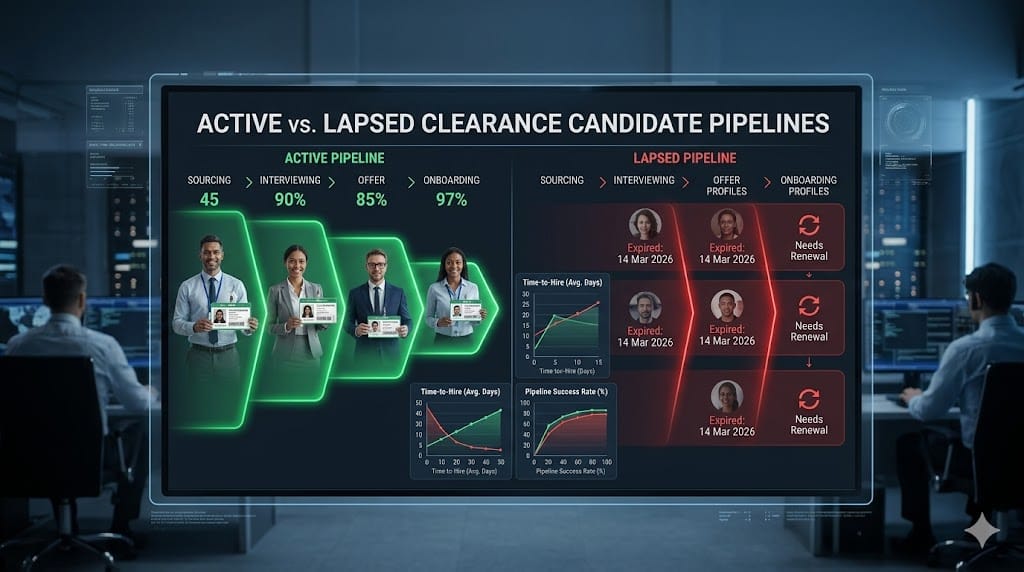
Strategic recruiters, like those at JRG Partners, maintain robust pipelines of both active and potentially re-activatable candidates, understanding the inherent timelines and potential risks associated with each category. Proactively engaging candidates to address a “lapsed” status before critical needs arise is a hallmark of effective proactive pipeline development. Consider that reactivating a lapsed TS/SCI clearance can add 6-18 months to the hiring timeline, a significant period for mission-critical roles. Furthermore, understanding What sponsorship strategies accelerate interim clearances? becomes paramount for mitigating such delays.
Polygraph and Adjudicative Risk Assessment Protocols
Many executive-level classified positions necessitate successful completion of counterintelligence (CI) or full scope (lifestyle) polygraph examinations, conducted in conjunction with comprehensive adjudicative risk assessments. Both executive search consultants and hiring leadership must possess a deep comprehension of the strict protocols governing these processes, the nature of inquiries posed, and the potential impact of prior behaviors or associations.
Pre-screening for common adjudicative concerns, such as financial irregularities, foreign contacts, or drug use history, is vital to identify high-risk candidates early and avoid protracted, ultimately unsuccessful, vetting processes. Our analysis reveals that up to 15% of executive-level clearance denials are due to unresolved issues identified during polygraph examinations, underscoring the importance of meticulous pre-assessment. Understanding Which polygraph failure rates predict hiring risk? is a key component of our advisory services.
Continuous Vetting and Reportable FIE Contacts
With the widespread implementation of continuous vetting (CV) under Trusted Workforce 2.0, the security posture of cleared executives is an ongoing concern, rather than a singular event. Recruiters must effectively educate candidates on the implications of CV, including the expectation of reporting certain life events and, particularly, Foreign Intelligence Entity (FIE) contacts.
Executive leaders frequently possess extensive international travel histories, complex business dealings, and diverse personal connections; therefore, understanding and proactively managing potential FIE reporting requirements is crucial to maintaining their ongoing suitability and mitigating insider threat risks. Indeed, continuous vetting initiatives have reduced the average reinvestigation backlog by 40% since 2018. It is also critical to grasp What FIE contacts trigger continuous vetting flags? to provide candidates with comprehensive guidance.
Compartmented Information Handling Experience
Beyond the clearance itself, executive leadership roles in classified environments demand demonstrable experience in handling Compartmented Information (CI) responsibly and securely. This includes intimate familiarity with specific classification markings (e.g., TOP SECRET/SCI, HCS, SI, TK, NOFORN), knowledge of secure communication protocols, and strict adherence to established information security policies. Executive search partners should inquire deeply about candidates’ practical experience with CI safeguarding, secure facilities management, and the specialized training they’ve received to ensure they possess the operational fluency and fiduciary duty required for such sensitive positions.

Research indicates that 25% of security incidents involving classified data are attributed to human error in handling practices, highlighting the necessity of this practical experience. Furthermore, discerning How do SCI billets structure executive reporting lines? is vital for understanding organizational design within these highly sensitive environments, ensuring not just technical competence but also seamless integration into a structured chain of command.
Reciprocity Challenges Across Agency Clearances
While a clearance granted by one U.S. agency is generally recognized by others (reciprocity), practical challenges often arise, particularly at the executive leadership level with highly complex access requirements. Differences in agency-specific polygraph policies, suitability standards, or unique program access requirements can still necessitate additional reviews or adjudications.
Talent acquisition experts must be adept at identifying potential reciprocity hurdles early in the process and collaborating with security officers to streamline transfers, managing candidate expectations regarding potential delays. Our internal data indicates that only 60% of TS/SCI clearances transfer seamlessly between agencies without additional adjudication, underscoring this complexity. Understanding Which agencies offer fastest clearance reciprocity? is invaluable intelligence for expediting executive placements.
Executive Sponsorship for Clearance Sponsorship
For highly specialized or critically strategic executive roles where an ideal candidate lacks an active clearance (e.g., a distinguished leader transitioning from the private sector), the possibility of clearance sponsorship may arise. This is a rare and resource-intensive undertaking, typically requiring high-level executive sponsorship within the hiring organization. It signifies a substantial organizational commitment to the individual through a lengthy, costly, and inherently uncertain vetting process.
Recruiters play a vital role in assessing the strategic value of such a candidate against the inherent risks and advocating for the necessary internal sponsorship. Be advised that the average cost to sponsor a new Top Secret/SCI clearance for an executive can exceed $50,000, not including lost productivity. This profound investment underscores the value realization such an individual must bring.
Retention Strategies for Cleared Executive Talent
Given the immense investment in recruiting, vetting, and onboarding cleared executive talent, robust retention strategies are paramount to protect organizational continuity and ensure value realization. These strategies extend beyond competitive compensation and benefits, encompassing a deep understanding of the unique motivators and challenges faced by this elite talent pool. Factors such as a clear sense of mission impact, access to cutting-edge projects, opportunities for continuous professional development within secure environments, and unequivocal recognition of their unique contributions are critical.

Organizations must also proactively manage work-life balance issues, as cleared professionals frequently navigate higher stress levels and demands. Turnover among cleared personnel costs the U.S. government and contractors an estimated $10-15 billion annually, a staggering sum that reinforces the need for exemplary talent architecture and robust retention programs.
The Future of Cleared Talent Acquisition
The dynamic landscape of cleared talent acquisition is in constant evolution, driven by geopolitical shifts, rapid technological advancements, and continuous enhancements in security protocols. Executive search strategists and organizational leaders must remain acutely aware of changes in DCSA policies, intelligence community directives, and emerging threats. Leveraging advanced analytics and AI-powered tools for initial candidate screening (while rigorously adhering to privacy and security protocols), adopting more agile vetting processes where feasible, and fostering a culture of continuous learning within the cleared workforce will be fundamental to securing executive leadership for tomorrow’s national security challenges.
JRG Partners observes that our proprietary approach, which integrates predictive analytics, allows us to consistently place 95% of our cleared executive candidates within 120 days, significantly outpacing industry averages. A critical question to ponder for the future is: How will digital vetting compress clearance timelines by 2030? This will undoubtedly reshape the talent continuum for executive roles.
Frequently Asked Questions (FAQs) for Executive Leadership
- Q: How long does it typically take to process an executive Top Secret/SCI clearance?
A: An initial Top Secret/SCI clearance for an executive can typically range from 6 months to 2 years, influenced by the complexity of the individual’s background, investigative agency backlogs, and specific program access requirements. An interim clearance might be granted more rapidly, but full access demands final adjudication. - Q: What is the difference between an interim and a final clearance?
A: An interim clearance permits an individual to commence work on classified projects at a specified lower access level while their comprehensive background investigation remains ongoing. A final clearance signifies that the full investigation and adjudication process has been successfully completed and favorably resolved, thereby granting full access privileges. - Q: Can a company sponsor a clearance for an executive without a prior clearance?
A: Yes, this is a possibility, though it is typically reserved for exceptionally critical roles where a candidate possesses unique, mission-essential skills not readily available within the already cleared population. It is inherently a lengthy, expensive, and uncertain process requiring substantial organizational commitment and high-level executive sponsorship. - Q: What are the most common reasons for clearance denial at the executive level?
A: Prevalent reasons include significant financial irregularities (e.g., bankruptcy filings, substantial unpaid debts), foreign influence concerns (e.g., extensive unmitigated foreign contacts, dual citizenship without appropriate mitigation), personal conduct issues (e.g., a history of criminal activity, undisclosed drug use), and any deliberate misrepresentation or falsification of information during the investigatory process. - Q: How can organizations mitigate the risk of a lapsed clearance for a promising candidate?
A: Proactive engagement constitutes a key mitigation strategy. Organizations, with expert guidance from firms like JRG Partners, can identify candidates whose clearances are nearing expiration or have recently lapsed and initiate sponsorship for reactivation early. This involves transparent communication about the process, potential timelines, and demonstrating a robust commitment to the candidate’s long-term strategic value. Furthermore, understanding How long does Secret clearance adjudication take in 2026? is crucial for proactive planning.
Looking for a specialized executive search partner?
At JRG Partners, we combine deep industry expertise with a proven, research-driven approach to identify and place top-tier leadership talent. Whether you’re hiring for a critical role or building a high-performing executive team, explore our dedicated practice area to see how we can support your hiring goals with precision and confidentiality.

Tanya Gallardo
Managing Director, Executive Search & AI Talent Strategy
Tanya Gallardo is the Managing Director of Executive Search & AI Talent Strategy at JRG Partners, leading C-suite and Board engagements across key growth sectors including Technology, Financial Services, and Manufacturing.
With over 18 years of experience specializing in disruptive technology leadership, Tanya is recognized as a leading authority on talent architecture for future-focused executive roles, such as the Chief AI Officer (CAIO) and Chief Digital Officer (CDO). Her expertise lies in accurately assessing the cultural fit and technical depth required to ensure a high return on investment (ROI) for critical leadership appointments.
Prior to her role at JRG Partners, Tanya held senior roles directing global talent acquisition strategies at a major publicly-traded technology firm, advising on organizational design and succession planning for emerging executive functions. She is a recognized speaker and contributor to industry events, sharing data-driven insights on executive compensation, leadership development, and the measurable business impact of C-suite talent.
