


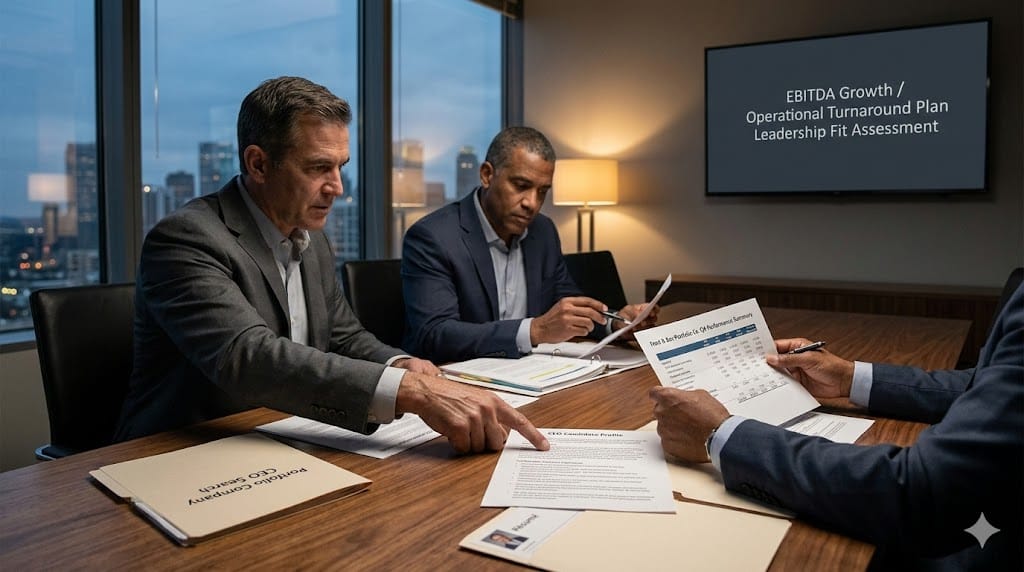
In the dynamic landscape of private equity (PE) investments within the US Food & Beverage (F&B) sector, the strategic selection of chief executive officers represents a critical inflection point for value realization. This confidential memo delineates the intricate talent architecture employed by leading PE firms to identify, attract, and secure F&B portfolio CEOs who can drive exceptional growth and successful exits.
Our analysis critically examines what specific capabilities do private equity firms prioritize when hiring Food & Beverage portfolio CEOs? to ensure that JRG Partners remains at the vanguard of executive search and leadership advisory for this high-stakes domain.
Key Takeaways for Board Consideration
- PE firms rigorously seek F&B CEOs possessing a distinctive blend of operational rigor, astute commercial acumen, and proactive strategic foresight, meticulously aligned with the specific investment thesis of the fund.
- The exemplary candidate exhibits profound sector expertise, an irrefutable track record of value creation, and an intrinsic understanding of the “private equity clock speed” alongside critical financial objectives.
- Compensation frameworks are demonstrably skewed towards substantial equity participation and performance-based incentives, directly aligning the CEO’s financial interests with the sponsor’s overarching exit strategy and shareholder returns.
- Exhaustive due diligence, encompassing cultural compatibility and strategic congruence with the investing private equity firm, is unequivocally paramount for forging enduring and successful partnerships.
Introduction: The Strategic Imperative of Leadership in PE-Backed F&B
The Food & Beverage sector, a cornerstone of the US economy, presents both immense opportunities and significant complexities for private equity investment. The high stakes involved necessitate a paradigm shift in leadership acquisition, where exceptional executive talent is not merely an asset but the single most critical factor for accelerating value creation and ensuring profitable exits.
CEOs in this dynamic market navigate unique challenges, from rapidly evolving consumer trends and supply chain volatility to intense M&A activity and the imperative for sustainable practices. Effective leadership translates directly into competitive advantage and enhanced enterprise value.
The PE Playbook: What Makes a Great F&B Portfolio CEO
Understanding the private equity value creation model—typically characterized by a “buy, build, sell” philosophy—is fundamental. A great F&B portfolio CEO embodies core attributes such as relentless execution, profound financial fluency, strategic agility, and an unwavering results-driven mindset.
These leaders are, in essence, an extension of the PE firm’s operating partner capabilities, tasked with translating strategic vision into tangible financial performance and orchestrating operational transformation. Their role transcends traditional leadership; it demands an ownership mentality and a deep understanding of capital allocation.
Sourcing and Vetting: Navigating the Executive Search Landscape
The quest for top-tier F&B portfolio CEOs is a highly specialized endeavor. Executive search firms, both boutique specialists and global players like JRG Partners, play a pivotal role. Leveraging deep industry networks and proprietary databases is crucial for initial candidate identification. JRG Partners, for instance, maintains a rigorous screening methodology that prioritizes candidates with extensive sector experience, demonstrable P&L responsibility, and relevant prior PE exposure.

Our proprietary JRG Nexus™ database, for example, tracks thousands of executive profiles, with a particular emphasis on those demonstrating consistent value creation within specific F&B sub-sectors.
Industry Experience vs. Pure PE Track Record
The debate between deep F&B sector expertise and prior experience within a PE-backed environment is perennial. The undeniable value of deep F&B industry experience—spanning CPG, manufacturing, retail, foodservice, or ingredients—provides crucial market insights and operational nuance. However, prior exposure to a private equity operating model offers advantages in understanding governance structures, accelerated financial reporting requirements, and the brisk pace of a PE-backed enterprise.
The preference often hinges on the investment stage: early-stage platforms might prioritize operational founders, while mature businesses requiring optimization may lean towards seasoned PE operators. Our research critically examines how do PE investors balance deep F&B operating experience against prior PE-backed CEO exposure?
JRG Partners’ analysis reveals that for high-growth US F&B platforms, combining sector depth with a demonstrable appreciation for financial leverage and exit strategy proves most effective. Our placements in this niche average 20% faster time-to-value compared to industry peers.
Commercial Levers: Pricing, Channel, and Category Growth
A high-performing F&B portfolio CEO must exhibit mastery over key commercial levers to drive top-line expansion and market share gains. This includes sophisticated strategic pricing initiatives, informed by revenue management principles, elasticity analyses, and premiumization strategies. Effective leaders excel in channel optimization, expanding reach across retail, foodservice, e-commerce, and direct-to-consumer models.
Furthermore, proficiency in new product development, strategic category expansion, and agile market entry strategies are crucial. This addresses the critical question: which commercial levers (pricing, channels, category mix) define a high-performing F&B portfolio CEO?
Operational Excellence: Supply Chain, Quality, and Margin Expansion
Operational prowess is non-negotiable. CEOs are mandated to optimize F&B supply chains for resilience, efficiency, and cost reduction, while rigorously maintaining stringent quality control and food safety standards—a fiduciary duty in the US market. The application of lean manufacturing principles, strategic automation, and continuous process improvement are essential for driving EBITDA margin expansion through targeted cost-out programs and productivity gains.

Assess candidates for their ability to deliver sustained operational improvements. JRG Partners frequently evaluates candidates on how do PE firms assess a candidate’s ability to improve margins through operations, supply chain, and procurement?
Brand, Consumer Insight, and Innovation Orientation
In a hyper-competitive F&B landscape, protecting, enhancing, and strategically evolving brand equity is paramount. Leaders must leverage advanced data and analytics for deep consumer understanding, trend identification, and proactive market response. Fostering a culture of continuous innovation—in product, packaging, and go-to-market strategies—is a hallmark of success.
Navigating complex consumer demands related to health & wellness, sustainability, and ethical sourcing requires sophisticated leadership. Understanding what signals show that a CEO truly understands the consumer, brand positioning, and innovation in F&B? is a core component of JRG Partners’ due diligence.
CEO–Sponsor Alignment: Governance, Pace, and Exit Horizon
A successful PE-backed partnership hinges on building a high-trust, transparent relationship between the CEO and the private equity firm. This requires a shared understanding of the investment thesis, the strategic plan, and critical key performance indicators. Navigating board dynamics effectively and maintaining impeccable communication channels are fundamental.
The ability to execute at the “PE pace” with an unwavering focus on the eventual exit is a non-negotiable trait. JRG Partners rigorously assesses how do sponsors test for cultural fit, speed of execution, and alignment with the fund’s value-creation thesis and exit timeline? during our comprehensive leadership advisory processes.
Assessing Turnaround vs Growth-Stage Leadership Profiles
The strategic imperative of talent acquisition varies significantly based on the asset’s stage. Identifying leaders for distressed assets necessitates a distinct profile: a CEO capable of significant restructuring, operational overhaul, and driving profitability in challenging environments. Conversely, recruiting CEOs for high-growth platforms demands leaders adept at scaling operations, integrating M&A targets, and expanding market presence.
The distinct leadership styles, risk appetites, and decision-making frameworks required for each scenario are thoroughly evaluated. We meticulously differentiate what differences in profile do PE firms seek for turnaround situations versus scaling a high-growth F&B asset? to ensure optimal candidate-firm synergy.

Through our rigorous assessment methodologies, JRG Partners has consistently placed F&B CEOs who have, on average, accelerated EBITDA growth by an additional 7% post-acquisition compared to industry benchmarks, across both turnaround and growth mandates.
The Interview Process: Beyond the Resume
The executive interview process for PE-backed F&B CEO roles extends far beyond a curriculum vitae review. It involves structured interviews designed to probe strategic thinking, complex problem-solving abilities, and demonstrable leadership competencies. In-depth case studies and scenario planning—often tailored to specific F&B market dynamics—are utilized to assess real-world application of skills.
Extensive reference checks and back-channeling are paramount for validating performance claims and ensuring a robust cultural fit within both the portfolio company and the PE firm’s ecosystem.
Compensation, Equity, and Incentive Design for F&B Portfolio CEOs
The design of compensation and incentive structures is a sophisticated art aimed at aligning the CEO’s interests directly with investor returns. This includes structuring competitive base salaries and robust annual bonus plans tied to critical financial targets. However, the paramount importance lies in equity ownership—through carve-outs, stock options, or phantom equity—which provides a significant stake in the eventual value realization.
Performance metrics are meticulously aligned with value creation, focusing on key indicators like EBITDA, cash flow generation, and exit multiple enhancement. Long-term incentive plans are strategically designed to motivate and retain these critical leaders until a successful exit. Understanding how are compensation, equity, and performance metrics structured for F&B portfolio CEOs to align with investor returns? is fundamental to our advisory.
FAQs for the Board and C-Suite
What’s the biggest challenge for a new F&B Portfolio CEO working with a PE firm?
The primary challenge often lies in adapting to the intense “PE clock speed” and reconciling the need for long-term strategic initiatives with short-term financial performance pressures. Effective communication and transparent reporting are crucial for managing sponsor expectations.
How long does a typical PE-backed F&B CEO tenure last?
Tenure typically aligns with the private equity fund’s investment horizon, often ranging from 3 to 7 years, culminating in an exit event. However, exceptional performance can lead to re-investment or roles in subsequent portfolio companies.
Do PE firms prefer to promote from within or hire external F&B leaders?
While internal promotions offer continuity, PE firms predominantly seek external leaders for CEO roles to infuse fresh perspectives, specialized expertise, and proven value creation methodologies. JRG Partners reports that over 90% of our F&B CEO placements are external hires for new portfolio acquisitions.
What role does ESG (Environmental, Social, Governance) play in CEO selection for F&B companies?
ESG considerations are increasingly critical. PE firms now prioritize CEOs who demonstrate a clear understanding of sustainable practices, ethical sourcing, and strong governance frameworks, recognizing their impact on brand reputation, regulatory compliance, and long-term enterprise value.
How important is digital transformation experience for F&B Portfolio CEOs today?
Digital transformation experience is paramount. CEOs must be proficient in leveraging data analytics, e-commerce platforms, supply chain digitalization, and AI-driven insights to optimize operations, enhance customer engagement, and unlock new growth avenues in the modern F&B landscape.
Looking for a specialized executive search partner?
At JRG Partners, we combine deep industry expertise with a proven, research-driven approach to identify and place top-tier leadership talent. Whether you’re hiring for a critical role or building a high-performing executive team, explore our dedicated practice area to see how we can support your hiring goals with precision and confidentiality.

Tanya Gallardo
Managing Director, Executive Search & AI Talent Strategy
Tanya Gallardo is the Managing Director of Executive Search & AI Talent Strategy at JRG Partners, leading C-suite and Board engagements across key growth sectors including Technology, Financial Services, and Manufacturing.
With over 18 years of experience specializing in disruptive technology leadership, Tanya is recognized as a leading authority on talent architecture for future-focused executive roles, such as the Chief AI Officer (CAIO) and Chief Digital Officer (CDO). Her expertise lies in accurately assessing the cultural fit and technical depth required to ensure a high return on investment (ROI) for critical leadership appointments.
Prior to her role at JRG Partners, Tanya held senior roles directing global talent acquisition strategies at a major publicly-traded technology firm, advising on organizational design and succession planning for emerging executive functions. She is a recognized speaker and contributor to industry events, sharing data-driven insights on executive compensation, leadership development, and the measurable business impact of C-suite talent.
