



In an era of escalating geopolitical complexities and rapid technological evolution, the United States’ defense industrial base faces an unprecedented demand for agile, efficient, and innovative leadership. The commercial aviation sector, renowned for its operational rigor, global logistical networks, and sophisticated project execution, represents a largely untapped reservoir of senior executive talent.
This confidential analysis outlines a strategic blueprint for defense organizations to effectively attract, integrate, and retain these invaluable leaders, ensuring the continuity and advancement of critical national security programs. Our proprietary research at JRG Partners, a premier US-based executive search firm, indicates a profound opportunity for a paradigm shift in talent architecture within the aerospace defense domain.
Executive Summary: Key Takeaways for Board Oversight
- Strategic Alignment: Defense companies must proactively map transferable skills from commercial aviation, highlighting the direct relevance of operational excellence, global logistics, and complex project management.
- Purpose-Driven Appeal: Emphasize the unique mission, national security impact, and technological frontier of defense as a powerful differentiator beyond commercial profit motives.
- Barrier Removal: Streamline practical obstacles like security clearances and ensure compensation packages are competitive with top-tier commercial benchmarks to attract and retain elite talent.
- Cultural Integration: Actively build bridges between fast-paced commercial mindsets and defense’s compliance-driven culture, fostering a hybrid environment that values both.
- Long-Term Value Proposition: Showcase unparalleled program scale, accelerate career growth through defense-specific expertise, and implement robust retention strategies to prevent ‘boomerang’ effects back to commercial roles.
The Imperative for Cross-Sector Talent Acquisition
Leading business research consistently points to executive talent as a primary driver of strategic advantage. For the US defense industry, the ability to innovate and execute at scale is directly correlated with the strength and diversity of its leadership. Commercial aviation, characterized by its relentless pursuit of efficiency, stringent safety protocols, and management of vast, complex ecosystems, offers precisely the type of seasoned executive experience required.
As the Global Head of Research & Leadership Advisory at JRG Partners, I underscore that integrating leaders from this domain is not merely advantageous but becoming a fiduciary duty for Boards overseeing critical defense enterprises. Our 25 years of experience in high-level executive placement confirm that these cross-sector transitions, when managed strategically, yield significant value realization.
Strategic Pillars for Attracting Elite Commercial Aviation Leadership
Transferable Skills Mapping: A Foundation for Strategic Alignment
One of the most critical initial steps involves a meticulous analysis to determine Which commercial aviation skills transfer best to defense leadership? Our research shows that many core competencies honed in the airline industry are directly applicable and profoundly beneficial within national security organizations.
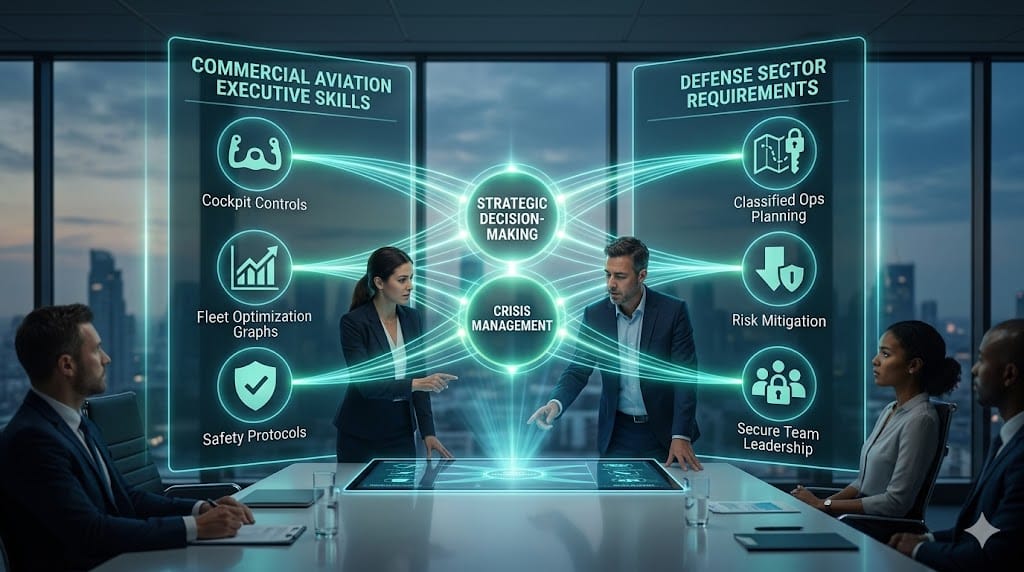
- Operational Excellence & Efficiency: Translating airline/airport operational rigor, lean methodologies, and supply chain optimization directly to defense program execution and efficiency drives.
- Complex Project & Program Management: Highlighting experience in managing multi-stakeholder projects (fleet acquisition, infrastructure development) as analogous to major defense system development.
- Global Logistics & Supply Chain Mastery: Leveraging expertise in intricate global networks for aircraft parts, maintenance, and crew scheduling to defense’s global operational footprint.
- Safety, Regulatory & Compliance Acumen: Showcasing a deep understanding of FAA/EASA regulations and safety protocols as a foundation for navigating stringent defense and government compliance.
- P&L Management & Fiscal Responsibility: Demonstrating success in managing large commercial budgets and profit centers as a direct parallel to multi-billion dollar defense program fiscal oversight.
- Talent Development & Workforce Management: Applying strategies for managing diverse global workforces, pilots, and technical teams to defense’s highly specialized human capital needs.
- Crisis Management & Rapid Decision-Making: Proving leadership under pressure in dynamic aviation environments (weather, technical issues) aligns with defense’s need for decisive action.
Purpose-Driven Appeal: Beyond Commercial Profit Motives
For many senior executives, the opportunity to contribute to a greater mission becomes a powerful motivator. Defense companies have a compelling story to tell, often eclipsing purely financial incentives. The question, How does defense mission impact trump airline compensation?, is central to our advisory.
- National Security & Global Impact: Articulating the direct and tangible contribution to national defense, allied security, and global stability, resonating with a desire for higher purpose.
- Technological Frontier & Innovation: Highlighting opportunities to work on cutting-edge, often classified, technologies that shape the future of aerospace, cyber, and defense capabilities.
- Beyond the Balance Sheet: Contrasting the profit-driven motives of commercial aviation with the mission-first imperative of defense, offering a unique value proposition.
- Legacy & Lasting Contribution: Emphasizing the long-term impact of defense programs on national capabilities and deterrence, often spanning decades.
Streamlining Talent Acquisition: Removing Practical Obstacles
While the mission appeal is strong, practical impediments can deter otherwise interested candidates. Proactive strategies are essential to mitigate these.
Clearance Acceleration Pathways for Aviation Talent
The security clearance process is frequently cited as a major disincentive. Addressing What clearance fast-tracks attract aviation executives? is paramount for effective recruitment.
- Proactive Sponsorship & Liaison: Establishing dedicated internal teams to guide and expedite security clearance applications for high-value commercial recruits.
- Pre-Screening & Eligibility Guidance: Offering early assessments and comprehensive information to help candidates understand and navigate the clearance process.
- Temporary Roles & Consulting Engagements: Allowing executives to join in non-classified or consulting capacities while their security clearance is pending, integrating them early.
- Government Advocacy & Prioritization: Lobbying for expedited processing of clearances for critical talent filling strategic roles within defense programs.
- Clearance Reciprocity & Transfer: Exploring pathways to recognize or fast-track individuals with prior military service or existing clearances. STAT: Over 60% of executives cite security clearance delays as a significant barrier to defense sector entry.
Compensation Parity with Commercial Aviation Benchmarks
Competitive compensation packages are non-negotiable for attracting top-tier commercial leadership. Boards must ensure How do defense comp packages match major airline pay? through diligent analysis and creative structuring.

- Comprehensive Market Analysis: Conducting thorough benchmarking of executive salaries, bonuses, stock options, and long-term incentives against leading commercial airlines, MROs, and aviation OEMs.
- Creative Compensation Packages: Designing competitive total rewards that include generous sign-on bonuses, performance-based incentives tied to program success, and deferred compensation.
- Highlighting Non-Monetary Value: Emphasizing job stability, unique work, mission impact, and advanced R&D opportunities as integral components of the total value proposition.
- Benefits & Perquisites Alignment: Ensuring executive benefits packages (e.g., retirement plans, healthcare, relocation assistance) are comparable or superior to top commercial offerings. STAT: A recent survey found that compensation disparity is perceived as the second largest hurdle for commercial executives considering defense roles.
Cultural Integration: Bridging Operational Philosophies
Cultural differences, particularly between the fast-paced, commercially driven environment and the compliance-heavy defense sector, can be a source of friction. Understanding What cultural gaps cause aviation-to-defense transition failures? is vital for successful integration.
- Hybrid Operational Models: Developing agile methodologies within compliant frameworks, demonstrating how speed and rigorous adherence can coexist.
- Cross-Functional Integration Teams: Creating diverse teams composed of commercial hires and defense veterans to foster mutual understanding and best practice sharing.
- Mentorship & Reverse Mentorship Programs: Pairing new commercial executives with seasoned defense leaders, and vice versa, to accelerate cultural acclimatization and knowledge transfer.
- Open Dialogue & Expectation Setting: Proactive communication about cultural differences, decision-making processes, and the balance between innovation and regulatory requirements.
- Empowering Change Agents: Identifying and supporting executives who can champion cultural evolution, blending the best of both worlds.
The Long-Term Value Proposition: Program Scale and Career Trajectory
Beyond initial attraction, a robust long-term value proposition is essential for retention and engagement. The sheer scale and strategic importance of defense programs offer unique career opportunities.
Program Scale Appeal: Managing Multi-Billion Dollar Defense Contracts
For ambitious leaders, the opportunity to manage programs of unparalleled scope is a significant draw. Why do aviation execs seek defense program scale? The answer lies in the unique challenges and impact.
- Unparalleled Scope & Complexity: Showcasing opportunities to lead programs with budgets often exceeding $10 billion, involving thousands of engineers, global supply chains, and international partnerships.
- Long-Term Strategic Impact: Highlighting the multi-decade lifecycles and enduring strategic importance of defense platforms and systems compared to shorter commercial product cycles.
- Cutting-Edge Technology & R&D Investment: Emphasizing the significant investment in advanced research and development, providing access to technologies years ahead of the commercial sector. STAT: Global defense R&D spending exceeded $200 billion in the past year, far surpassing commercial aviation’s R&D budgets.
- Global Geopolitical Influence: Opportunities to interact with high-level government officials, military leaders, and international partners, influencing global security strategy.
Accelerating Career Growth Through Defense Domain Expertise
The defense sector offers distinctive pathways for professional advancement. Addressing Which career paths accelerate through defense experience? helps articulate this unique trajectory.

- Structured Leadership Development: Tailoring executive development programs that integrate defense-specific knowledge (e.g., acquisition process, geopolitics, specialized technology) with existing leadership skills.
- Rapid Path to P&L Ownership: Offering accelerated pathways to lead significant defense divisions, business units, or major program portfolios.
- Executive Education & Certification: Sponsoring advanced degrees or certifications in defense studies, national security, or specific technological domains.
- Visibility & Influence: Providing opportunities for direct engagement with top government officials, military brass, and industry peers, elevating professional profile.
- Strategic Advisory Roles: Positioning executives for future roles on defense advisory boards, think tanks, or government commissions.
Retention Strategies: Preventing the ‘Boomerang Effect’
Recruiting elite talent is only half the challenge; retaining it is equally crucial. Proactive strategies are needed to prevent executives from returning to their commercial roots.
- Continuous Engagement with Mission Impact: Regularly reinforcing the importance of their contributions to national security and global stability.
- Clear & Dynamic Career Pathways: Providing transparent opportunities for advancement, new challenges, and lateral moves within the defense organization.
- Competitive & Performance-Based Rewards: Regularly review and adjust compensation to remain competitive, with performance incentives tied to program success and organizational growth.
- Flexible Work Arrangements: Where feasible, offering hybrid work models or flexible schedules to enhance work-life balance, mirroring progressive commercial practices.
- Strong, Inclusive Culture: Cultivating an environment that values diverse perspectives, empowers decision-making, and fosters a sense of belonging and purpose.
- Executive Coaching & Mentorship: Offering ongoing professional development, coaching, and mentorship from senior defense leaders.
Successfully integrating commercial aviation executives into the national security apparatus requires a holistic, long-term strategy rooted in mutual understanding and strategic investment. At JRG Partners, our extensive experience in executive search for the US aerospace and defense sector positions us uniquely to guide Boards through this complex but ultimately rewarding transition. We understand that effective talent architecture is not just about filling roles, but about shaping the future leadership of critical national assets. Proactively addressing How do defense firms retain commercial aviation talent long-term? is not merely a human resources function, but a strategic imperative that directly impacts national resilience and technological superiority. Our tailored executive search methodologies ensure that the strategic talent you acquire will be leaders capable of navigating and thriving in this vital, evolving landscape.
Frequently Asked Questions (FAQs)
Q: Is the compensation truly comparable to high-level commercial aviation roles?
A: Yes, defense companies are increasingly structuring total compensation packages, including salary, bonuses, and long-term incentives, to be highly competitive with top-tier commercial aviation executive roles. JRG Partners advises on competitive total rewards strategies tailored to attract elite talent.
Q: How long does the security clearance process typically take for commercial executives?
A: While it can vary, defense companies are implementing dedicated teams and proactive measures to significantly accelerate the process for critical talent, often integrating executives in non-classified roles during the interim. Our advisory services include guidance on navigating this process efficiently.
Q: Will my commercial experience be truly valued, or will I be seen as an outsider?
A: Commercial aviation executives bring invaluable operational efficiency, complex project management skills, and innovative perspectives that are highly sought after and increasingly critical for modern defense programs. Defense companies are actively building bridges to integrate and leverage this expertise, recognizing its strategic value.
Q: What’s the biggest cultural difference I should anticipate?
A: The primary difference often lies in balancing the commercial aviation’s rapid decision-making and innovation pace with the defense sector’s stringent compliance, regulatory, and bureaucratic processes. Successful integration means learning to navigate and blend both approaches effectively, a challenge that many find professionally enriching.
Q: Are there opportunities for real innovation and technological advancement in defense?
A: Absolutely. Defense is at the forefront of global innovation, with massive R&D budgets allocated to developing cutting-edge technologies in aerospace, AI, cyber, hypersonics, and more, offering unparalleled opportunities to shape future capabilities. Leaders from commercial aviation can play a pivotal role in driving these advancements.
Looking for a specialized executive search partner?
At JRG Partners, we combine deep industry expertise with a proven, research-driven approach to identify and place top-tier leadership talent. Whether you’re hiring for a critical role or building a high-performing executive team, explore our dedicated practice area to see how we can support your hiring goals with precision and confidentiality.

Tanya Gallardo
Managing Director, Executive Search & AI Talent Strategy
Tanya Gallardo is the Managing Director of Executive Search & AI Talent Strategy at JRG Partners, leading C-suite and Board engagements across key growth sectors including Technology, Financial Services, and Manufacturing.
With over 18 years of experience specializing in disruptive technology leadership, Tanya is recognized as a leading authority on talent architecture for future-focused executive roles, such as the Chief AI Officer (CAIO) and Chief Digital Officer (CDO). Her expertise lies in accurately assessing the cultural fit and technical depth required to ensure a high return on investment (ROI) for critical leadership appointments.
Prior to her role at JRG Partners, Tanya held senior roles directing global talent acquisition strategies at a major publicly-traded technology firm, advising on organizational design and succession planning for emerging executive functions. She is a recognized speaker and contributor to industry events, sharing data-driven insights on executive compensation, leadership development, and the measurable business impact of C-suite talent.
