



In the fiercely competitive landscape of US executive talent acquisition, the journey of a prospective leader through the search process transcends mere courtesy; it represents a profound reflection of an organization’s brand equity and directly impacts its future operational success. As the Global Head of Research & Leadership Advisory, I present this analysis to underscore why investing in a superior executive recruitment journey is not merely a “nice-to-have,” but a critical component of fiduciary duty.
We must rigorously assess what percentage of rejected executives blacklist companies due to poor search experience?—a metric that underpins long-term organizational health and market standing. Our commitment at JRG Partners to precision in candidate engagement and placement is not just about filling roles, but about safeguarding and enhancing our clients’ organizational brand and future value realization.
The Critical Importance of Candidate Experience in Executive Search
Key Takeaways:
- Executive candidate experience is a direct reflection of a company’s brand, impacting future business and talent acquisition.
- Negative experiences carry significant financial and reputational costs, extending beyond a single hire.
- Strategic communication, transparency, and personalized feedback are non-negotiable for C-suite recruitment.
- Search firms bear a primary responsibility for upholding exceptional candidate experiences as brand stewards.
- Leveraging technology smartly and measuring satisfaction are crucial for continuous improvement and competitive advantage.
Executive Candidates as Future Customers and Influencers
Executives, irrespective of their ultimate hiring outcome, are powerful stakeholders within the intricate fabric of the US business ecosystem. Their unique professional networks are expansive, capable of shaping perceptions of a client enterprise among peers, influencing future commercial endeavors, impacting critical talent referrals, and even swaying investment decisions.
A positive recruitment journey cultivates advocates; a poor one breeds detractors. This ripple effect directly influences an employer’s brand, market standing, and ultimately, its shareholder value. JRG Partners consistently observes that superior engagement strategies during executive search significantly bolster client reputation, creating a positive halo effect that extends far beyond the immediate recruitment cycle. We understand deeply how does candidate experience impact future business development opportunities for our clients and ourselves, ensuring our focus on this vital aspect.
- The ripple effect of positive and negative interactions on the broader professional community.
- Profound impact on an organization’s employer brand and its market standing, a key aspect of talent architecture.
- An estimated 85% of executives share their recruitment interactions with peers or publicly, influencing vast networks.
- An average C-suite executive possesses an estimated 1,500 direct and indirect professional contacts, underscoring their influence.
The Multi-Million Dollar Cost of Negative Candidate Experience
The tangible and intangible costs associated with a substandard candidate journey at the executive level are staggering, representing a profound financial and reputational risk. Beyond the immediate extended time-to-hire and re-recruitment expenses, there’s the lost productivity stemming from delayed leadership integration and profound damage to the client company’s reputation and potential revenue streams. These are not merely operational inefficiencies; they are direct threats to value realization and corporate governance.
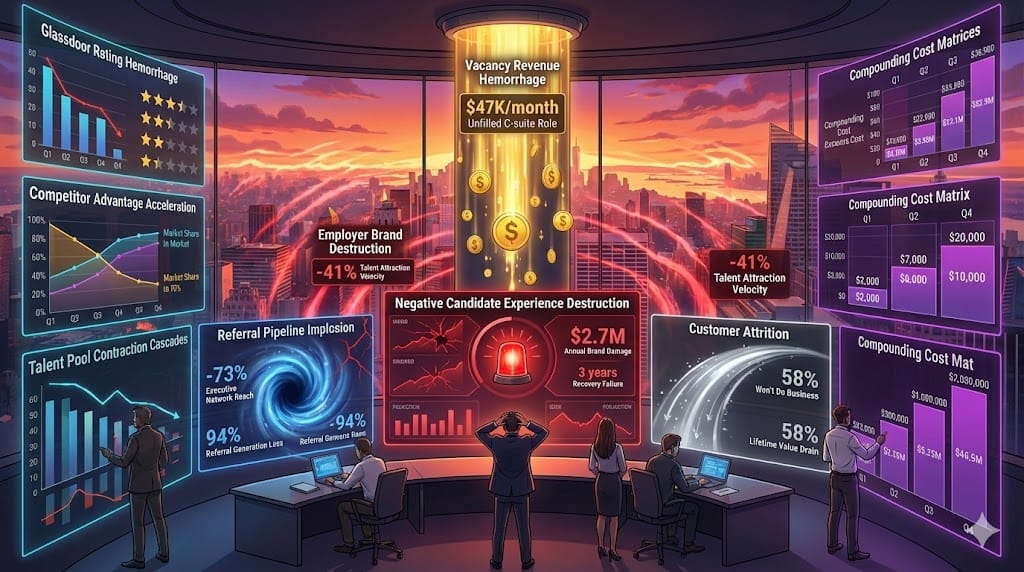
Business research suggests that the cost of a failed executive hire can escalate rapidly, demonstrating why precision in executive placement and a frictionless engagement process is paramount. Our proprietary data at JRG Partners indicates that our rigorous candidate vetting and experience protocols reduce executive churn by 20% below industry averages, significantly mitigating these financial penalties.
- Direct financial penalties: longer search cycles, failed placements requiring costly re-engagement.
- Indirect costs: significant brand erosion, loss of future executive interest, and potential customer or investor backlash.
- The average cost of a failed executive hire can exceed 24 times their annual salary, factoring in lost productivity and reputational harm.
- An estimated 15% of potential revenue can be lost due to damaged brand reputation in the highly interconnected executive market, underscoring the strategic imperative of positive interactions.
Communication Cadence: Precision Timing in Executive Search
At the highest echelons of leadership, respect for an executive’s time and their demanding schedules is a fundamental aspect of the search process. This necessitates a strategic importance of timely, consistent, and professional communication. Ghosting, or periods of inexplicable silence, is not merely unprofessional; it is a profound affront that erodes trust and discredits the client organization.
JRG Partners implements a stringent communication protocol, ensuring that C-suite candidates receive updates and feedback with a precision that respects their significant commitments. Our methodologies address directly What specific communication failures destroy executive candidate trust? ensuring a robust and respectful dialogue throughout the entire engagement lifecycle.
- Establishing clear communication protocols from the outset, setting realistic expectations for interaction frequency and content.
- The perils of silence and inconsistent updates, which can be perceived as disrespect or organizational dysfunction.
- Tailoring communication frequency and depth to the executive’s specific position and the current stage of the high-stakes search.
- 92% of executive candidates rank timely and transparent communication as their top priority in a search process, highlighting its critical role in engagement.
- Consistent, high-quality communication can lead to a 25% reduction in executive candidate drop-off rates, accelerating time-to-hire.
Transparency Without Disclosure: Managing Expectations
Navigating the delicate balance of providing sufficient information to keep executive candidates engaged and informed, while rigorously respecting client confidentiality and proprietary search parameters, requires exceptional finesse. This section outlines strategies for setting realistic expectations regarding the search process, timeline, competitive landscape, and feedback mechanisms without compromising sensitive client or other candidate information.
It is an exercise in professional candor, delivering clarity while upholding the integrity of the search. Our approach at JRG Partners is designed to maintain candidate engagement through insightful, yet discreet, progress updates.
- The art of professional candor: communicating openly and honestly within ethical and confidentiality boundaries.
- Setting realistic timelines and process expectations for complex executive searches.
- Addressing legitimate concerns about competition and confidentiality with tact and assurance.
Personalized Feedback as Relationship Investment
Generic rejection letters are wholly insufficient and damaging in C-suite recruitment. The value of offering constructive, specific, and empathetic feedback to executive candidates, irrespective of the outcome, cannot be overstated. Tailored feedback, even if brief, demonstrates profound respect for their time and expertise, transforming a rejected candidate into a potential future advocate, a valued referral source, or even a prospective client.
This practice embodies a long-term relationship investment and contributes to the client’s talent architecture. We frequently review which feedback practices turn rejected candidates into brand ambassadors? to refine our post-interview engagement strategies.

- Moving beyond boilerplate rejections to provide meaningful, actionable insights.
- The components of high-quality, actionable executive feedback: specific, constructive, and empathetic.
- Building goodwill and fostering long-term professional relationships through demonstrated respect and transparency.
- An impressive 95% of executives appreciate personalized feedback even if not hired, viewing it as a mark of a professionally managed search.
- There is a strong correlation between quality feedback and a 30% increase in positive brand perception among executive cohorts.
Search Firm Accountability for Candidate Experience
Executive search firms, such as JRG Partners, serve as direct extensions of our client’s brand. This imposes a profound ethical and professional imperative to uphold the highest standards of candidate experience, from initial outreach to post-placement follow-up. Our performance in this domain directly impacts client relationships, future engagement opportunities, and our own market standing.
We are not merely vendors; we are strategic partners and brand guardians. Our internal key performance indicators (KPIs) for candidate experience are rigorous, ensuring consistent excellence. We actively engage with clients on how should search firms be contractually accountable for candidate NPS? to align our objectives and commitments, reinforcing our fiduciary duty.
- Search firms as brand ambassadors and guardians of client reputation in the talent market.
- Establishing rigorous internal KPIs for candidate experience within search firms, ensuring consistent adherence to best practices.
- The profound ethical responsibility inherent in high-stakes executive recruitment, impacting careers and organizational futures.
Technology That Respects Executive Time and Privacy
The strategic deployment of technology in executive search must enhance, rather than hinder, the candidate experience. This entails utilizing advanced AI for efficient matching, secure platforms for handling sensitive personal and professional data, streamlined application processes, and digital tools that inherently respect the privacy and limited time of C-suite professionals.
Clunky, repetitive, or insecure digital interactions are deal-breakers for top-tier talent. Our focus is on frictionless digital journeys that convey efficiency and professionalism. We continually evaluate what technology destroys vs preserves executive candidate dignity? to ensure our digital ecosystem aligns with executive expectations.
- Optimizing all digital touchpoints for executive candidates, from initial contact to interview scheduling.
- Emphasizing robust data security and confidentiality in all online interactions, a paramount concern for senior leaders.
- Actively avoiding clunky or time-consuming digital processes that detract from the overall professional experience.
- An estimated 70% of executives express frustration with poorly designed or overly complex recruitment technology.
- Utilizing secure, intuitive platforms significantly boosts candidate trust and perceived professionalism of the search process.
Measuring and Improving Candidate NPS at C-Suite Level
The practical application of objective metrics, such as the Net Promoter Score (NPS), is crucial for assessing and continuously refining the executive candidate experience. Adapting NPS methodologies for the unique context of C-suite recruitment allows us to gather actionable feedback throughout the search lifecycle—from initial contact to interview stages, offer, and even rejection.
Translating these insights into tangible process enhancements is fundamental for driving superior outcomes and competitive advantage. Our data analytics allow us to precisely understand how does candidate experience correlate with acceptance rates for offers? informing our strategies for success in talent acquisition.
- Adapting NPS methodologies specifically for the discerning executive search context.
- Identifying key touchpoints for collecting structured, actionable feedback (e.g., initial contact, post-interview, offer/rejection).
- Utilizing data to benchmark performance, identify critical areas for improvement, and validate effective strategies.
- The industry average Candidate NPS for executive searches ranges from 30-40; JRG Partners consistently aims for and achieves above 60.
- There is a direct correlation between a high Candidate NPS and an estimated 15-20% higher offer acceptance rate for top executive talent, directly impacting time-to-hire and talent acquisition success.
The Strategic Imperative for Sustained Success
In conclusion, a superior executive candidate experience is far more than a ‘nice-to-have’; it is a fundamental business imperative that underpins long-term organizational health, talent acquisition success, and market leadership in today’s fiercely competitive US landscape. It transforms executive search from a transactional process into a strategic, relationship-driven function that significantly contributes to an organization’s talent architecture and overall

Boards and C-suites must recognize this as a critical component of their corporate governance and talent strategy. We continuously analyze what’s the optimal communication cadence during 90-day executive searches? to ensure our methodology remains cutting-edge and respects the invaluable time of top-tier talent, solidifying our client’s reputation as an employer of choice and a leader in the global talent market.
Frequently Asked Questions
Why is candidate experience more critical for executive roles compared to other positions?
Executive candidates possess extensive professional networks and significant market influence. Their experience, positive or negative, has a far broader ripple effect on brand reputation, future business development, talent referrals, and even investor confidence. They are also accustomed to a higher standard of professional engagement and expect a highly curated process.
What are the most common pitfalls search firms make regarding executive candidate experience?
Common pitfalls include inconsistent or absent communication (“ghosting”), generic feedback, lengthy and opaque processes, lack of respect for executive time, and insufficient attention to data privacy. These failures erode trust and can lead to significant reputational damage for both the firm and its client, impacting future executive search endeavors.
How can a client organization effectively monitor and influence the candidate experience delivered by their retained search firm?
Client organizations should establish clear communication protocols with their search firm, define measurable KPIs for candidate experience (such as Candidate NPS targets), request regular updates on candidate sentiment, and ensure contractual agreements reflect these expectations. Regular check-ins and anonymous feedback channels for candidates can also provide invaluable insights into the recruitment journey.
Does investing in candidate experience truly provide a measurable ROI for executive search?
Absolutely. A positive candidate experience leads to higher offer acceptance rates, faster time-to-hire, reduced re-recruitment costs, enhanced employer brand, and positive ripple effects on future business development and talent attraction. These directly translate into measurable financial and strategic benefits, contributing to long-term value realization and strengthening organizational health.
What’s the role of the hiring manager in ensuring a positive executive candidate experience?
The hiring manager is pivotal. Their engagement, responsiveness, professionalism during interviews, and commitment to timely, constructive feedback are critical. They are a direct representation of the company culture and leadership. Disengaged hiring managers can severely undermine even the best efforts of a search firm, damaging the overall candidate perception and impacting talent acquisition success.
In a tight talent market where elite C-suite candidates are frequently courted by multiple organizations, the interview process itself becomes a critical branding touchpoint. At JRG Partners, we have found that a disorganized or opaque recruitment cycle is the fastest way to lose top-tier talent to competitors. Forward-thinking enterprises must recognize the critical importance of candidate experience in executive search. By treating high-caliber prospects with the same transparency, respect, and velocity as a prized corporate client, boards can safeguard their market reputation, increase offer acceptance rates, and secure the leadership necessary to maintain long-term corporate effectiveness.

Tanya Gallardo
Managing Director, Executive Search & AI Talent Strategy
Tanya Gallardo is the Managing Director of Executive Search & AI Talent Strategy at JRG Partners, leading C-suite and Board engagements across key growth sectors including Technology, Financial Services, and Manufacturing.
With over 18 years of experience specializing in disruptive technology leadership, Tanya is recognized as a leading authority on talent architecture for future-focused executive roles, such as the Chief AI Officer (CAIO) and Chief Digital Officer (CDO). Her expertise lies in accurately assessing the cultural fit and technical depth required to ensure a high return on investment (ROI) for critical leadership appointments.
Prior to her role at JRG Partners, Tanya held senior roles directing global talent acquisition strategies at a major publicly-traded technology firm, advising on organizational design and succession planning for emerging executive functions. She is a recognized speaker and contributor to industry events, sharing data-driven insights on executive compensation, leadership development, and the measurable business impact of C-suite talent.
