


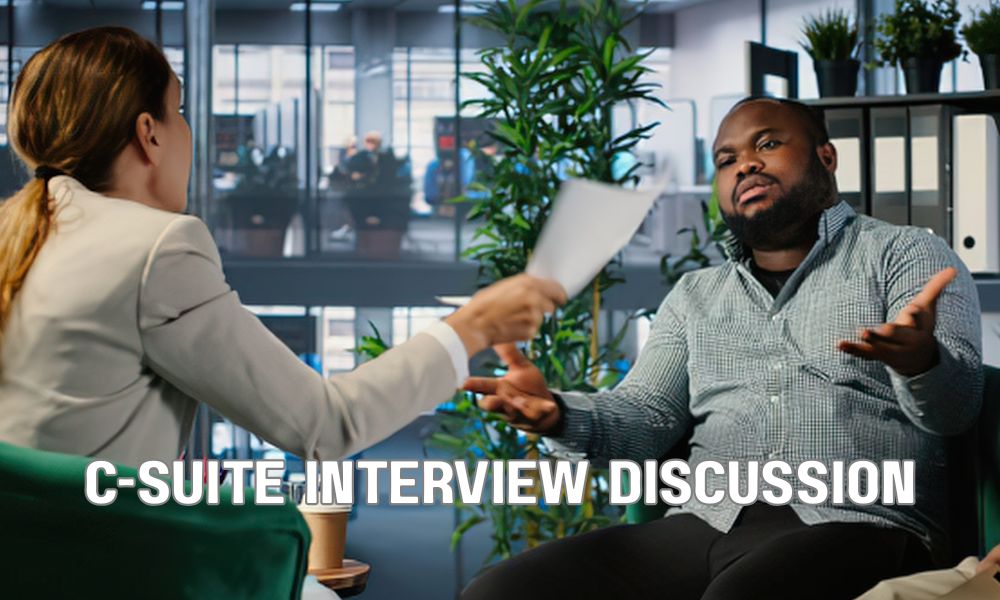
Drawing on our executive search work, we put this list together to give employers a practical, ranked view they can actually act on. The final round of a CEO interview is where boards move past résumé and rapport to test judgment, character, and fit for the specific challenge. These fifteen questions, drawn from what strong boards actually ask, are ordered from foundational to probing, and each is designed to reveal something a polished candidate cannot easily fake.
Key Takeaways
- Final-round CEO questions should test judgment, character, and situational fit.
- The best questions are hard to answer with rehearsed, generic responses.
- Probe how candidates think and decide, not just what they have done.
- Situational and behavioral questions reveal more than hypothetical ones.
- Use the answers, and how they are given, to assess the whole candidate.
What Makes a Great Final-Round Question
By the final round, the board knows the candidate’s track record; the job now is to test judgment, character, and fit for the specific CEO challenge ahead. The best final-round questions are hard to answer with rehearsed generalities, they probe how the candidate actually thinks and decides, surface real behavior and character, and test fit for the specific situation. Below are fifteen such questions, ordered from foundational to most probing, with what each is designed to reveal.
The 15 Questions
1. What do you believe this company needs from its next CEO, specifically?
This opens the final round by testing whether the candidate understands the specific challenge, not a generic CEO role. A strong answer shows they have diagnosed the real situation; a weak one offers platitudes. It reveals situational understanding and judgment about what the role actually requires.
2. Walk me through the hardest decision of your career and how you made it.
This probes judgment and decision-making under difficulty. Listen for how they reasoned, what they weighed, and whether they take responsibility, revealing the quality of their judgment far better than describing successes.
3. Tell me about a significant failure, your role in it, and what you learned.
This tests accountability and self-awareness. A candidate who owns a real failure and shows genuine learning reveals maturity; one who deflects or offers a non-failure reveals a concerning lack of accountability.
4. How would you approach your first 90 days here?
This tests whether the candidate would learn before acting, the mark of a strong new CEO, or rush to prove themselves. A strong answer emphasizes listening and understanding before major moves.
5. What would you need to see to conclude a strategy change is required?
This probes strategic judgment and how the candidate reasons about change, revealing whether they would act on evidence and analysis or on instinct and ego.
6. How do you build and lead a leadership team?
This tests people leadership, central to the CEO role. Listen for how they attract, develop, and lead talent, and whether they build strong teams or dominate them.
7. Describe your relationship with a board. What worked and what didn’t?
This probes the crucial CEO-board relationship. A candid, reflective answer reveals how they will work with your board; a defensive or dismissive one is a warning.
8. How do you make decisions when the data is ambiguous?
This tests judgment under uncertainty, a defining CEO skill. Listen for a sound approach to reasoning and deciding without complete information.
9. Tell me about a time your integrity was tested.
This probes character directly. How the candidate describes a real test of integrity, and how they responded, reveals their values under pressure.
10. How would you handle [a specific challenge this company faces]?
This tests situational fit by asking how they would approach a real challenge the company faces, revealing their thinking on the specific problem, not a generic one.
11. What have you changed your mind about, and why?
This probes intellectual honesty and the capacity to update, revealing whether the candidate can learn and reconsider or is rigid and certain.
12. How do you think about the balance of short-term results and long-term value?
This tests strategic and stewardship judgment, revealing whether they would sacrifice the long term for short-term optics or balance the two wisely.
13. What would your former colleagues say about you when you’re not in the room?
This probes self-awareness and character, and how they answer, candidly or defensively, reveals as much as the content.
14. Why do you want this role, specifically?
Late in the round, this tests genuine motivation and fit. A specific, authentic answer about this role and company differs from a generic desire for a CEO seat, and the difference matters.
15. What questions do you have for us?
The final question reveals what the candidate cares about and how they think. Sharp, substantive questions signal a serious candidate; superficial or no questions are a warning.
The Bottom Line
The best final-round CEO questions test judgment, character, and situational fit through questions that resist rehearsed answers, so use them to assess how the candidate actually thinks and decides, and weigh how they answer as much as what they say. Use this list to sharpen your thinking, then adapt it to the specifics of your company and your hire.
Related Reading
For employers going deeper, see Should the Board Interview Every CEO Finalist, CEO Search Committee Charter Template for Boards, How to Interview for Integrity.
Frequently Asked Questions
- Q: What should final-round CEO questions test?
- A: Judgment, character, and fit for the specific CEO challenge, through questions hard to answer with rehearsed generalities, revealing how the candidate actually thinks and decides.
- Q: Are behavioral questions better than hypothetical ones?
- A: Generally yes; behavioral and situational questions about real past decisions and the specific challenge reveal more than abstract hypotheticals a candidate can theorize about.
- Q: How many questions should a final round include?
- A: Enough to test judgment, character, and fit thoroughly, around a dozen or so probing questions, used conversationally rather than as a checklist.
- Q: What is the most revealing CEO question?
- A: Often asking about a significant failure and what they learned, which tests accountability and self-awareness that polished candidates struggle to fake.
- Q: Should the full board ask these questions?
- A: For a CEO hire, the full board should interview finalists, and these questions help the board assess judgment, character, and fit collectively.

Tanya Gallardo
Managing Director, Executive Search & AI Talent Strategy
Tanya Gallardo is the Managing Director of Executive Search & AI Talent Strategy at JRG Partners, leading C-suite and Board engagements across key growth sectors including Technology, Financial Services, and Manufacturing.
With over 18 years of experience specializing in disruptive technology leadership, Tanya is recognized as a leading authority on talent architecture for future-focused executive roles, such as the Chief AI Officer (CAIO) and Chief Digital Officer (CDO). Her expertise lies in accurately assessing the cultural fit and technical depth required to ensure a high return on investment (ROI) for critical leadership appointments.
Prior to her role at JRG Partners, Tanya held senior roles directing global talent acquisition strategies at a major publicly-traded technology firm, advising on organizational design and succession planning for emerging executive functions. She is a recognized speaker and contributor to industry events, sharing data-driven insights on executive compensation, leadership development, and the measurable business impact of C-suite talent.
