



As the Global Head of Research & Leadership Advisory at JRG Partners, I am presenting a critical analysis on the foundational element of superior executive talent acquisition: the meticulously crafted executive search brief. This document is far more than a mere administrative formality; it is the strategic blueprint for transformational leadership acquisition, meticulously detailing the precise qualifications, cultural imperatives, and anticipated value realization critical for securing US-based top-tier leadership. In the current volatile US talent market, a well-defined brief is the paramount tool for identifying and attracting C-suite executives who will truly drive your organization’s future trajectory and shareholder value.
Key Takeaways for Board Governance:
- A strategically designed executive search brief is the foundational document for identifying and securing transformational leadership talent, a direct reflection of sound corporate governance.
- It transcends a basic job description, encapsulating the strategic imperative, desired impact, and crucial cultural synergy vital for long-term organizational success and fiduciary duty.
- Precision in defining measurable outcomes, organizational alignment, and non-negotiables drastically improves search efficiency, elevates candidate quality, and enhances executive retention in the highly competitive US landscape.
Beyond the Job Description: Crafting Strategic Intent
A flawless executive search brief serves as the definitive foundational document, strategically guiding every facet of the senior leadership recruitment journey. In an increasingly competitive US talent landscape, where the demand for proven C-suite leadership outstrips supply, it is insufficient to merely enumerate responsibilities. This comprehensive talent mandate must articulate the strategic necessity and the anticipated impact of the new executive on the organization’s future trajectory, ensuring alignment with long-term enterprise goals and risk mitigation strategies.
Role Imperative: The Core Business Problem Driving the Hire
This section precisely defines the core strategic challenge or significant growth opportunity that necessitates the new senior leadership role. It clarifies the fundamental “why” behind the hire, outlining how this executive leader will directly contribute to resolving critical business problems, capitalizing on market opportunities, or driving fundamental organizational transformation. Boards must ask: What business problem justifies this executive search? Our proprietary methodology at JRG Partners consistently demonstrates that clarity here significantly reduces misalignment in later stages.
[STAT]: 75% of failed executive hires are attributed to a poor fit with the company’s strategic needs or cultural context.
Success Profile: Measurable 12-Month Outcomes
Rather than a generic list of duties, this critical segment focuses on the tangible, measurable achievements expected from the executive within their initial year. It meticulously outlines specific Key Performance Indicators (KPIs) and Objectives and Key Results (OKRs) that unequivocally define success, providing a clear roadmap for both the incoming leader and the organization. For US public companies, these often include market share growth, operational efficiencies, successful product launches, or significant improvements in team performance and productivity. Boards should explicitly define: Which 12-month KPIs define search success?
[STAT]: Organizations with clearly defined 12-month success metrics for executive roles reduce time-to-fill by an average of 20%.
Cultural and Values Alignment Specifications
Beyond technical skill sets and experience, this section articulates the desired cultural fit and the leader’s unequivocal alignment with the company’s core values. It describes the existing organizational culture, desired future state, and how the new executive is expected to embody, reinforce, or strategically evolve these elements.

Non-negotiable cultural attributes and values essential for seamless integration and effective leadership within the US corporate governance framework are explicitly detailed. Understanding How does cultural fit assessment prevent bad hires? is paramount for long-term value realization and avoiding costly churn.
[STAT]: Companies with strong cultural alignment report 3.5x higher revenue growth and 9x higher profit growth.
Must-Have Experience vs. Nice-to-Have Background
This critical distinction prevents common pitfalls of overly broad or unnecessarily restrictive senior leadership searches, thereby maximizing return on executive talent investment. “Must-haves” are the non-negotiable skills, experiences (e.g., specific industry expertise, P&L responsibility over a certain scale, global market exposure), and track record essential for immediate strategic impact and success in the role.
“Nice-to-haves” are desirable but not essential attributes that could differentiate a candidate. Clear delineation optimizes the talent pool and focuses the search. It answers: What experience creates immediate strategic impact? JRG Partners’ market intelligence indicates over-specifying ‘nice-to-haves’ can reduce the qualified US candidate pool by up to 40%.
Leadership Style and Team Fit Requirements
This section delves into the nuanced aspects of leadership effectiveness. It specifies the preferred leadership style (e.g., transformational, servant leader, decisive, collaborative) and how this individual will integrate with and complement the existing executive team and direct reports.
It addresses communication style, decision-making approach, and the ability to foster engagement and development within their sphere of influence, crucial for cohesive executive team dynamics. For boards, a key consideration is: Which leadership styles match organizational stage?
[STAT]: Executive teams with diverse leadership styles but cohesive dynamics outperform homogenous teams by 23%.
Compensation Framework and Retention Incentives
A comprehensive overview of the total compensation package is vital, including base salary range, annual bonus targets, equity/stock options, long-term incentive plans, and comprehensive benefits tailored for the US market. It also details any unique perks, relocation assistance, or non-monetary incentives that contribute to the role’s overall value proposition and are critical for long-term retention. Boards must critically assess: How should compensation structure attract elite talent? JRG Partners advises that a well-structured executive compensation package significantly improves retention rates by up to 15% in the first three years.
Search Guardrails: Non-Negotiables and Deal Breakers
This section explicitly outlines the absolute parameters of the search. It includes hard constraints such as mandatory geographic location within the US, critical security clearances, specific regulatory knowledge, or non-compete stipulations. It also details any specific red flags or absolute disqualifiers that, if discovered, would immediately remove a candidate from consideration, ensuring efficiency and avoiding wasted effort for the search committee.
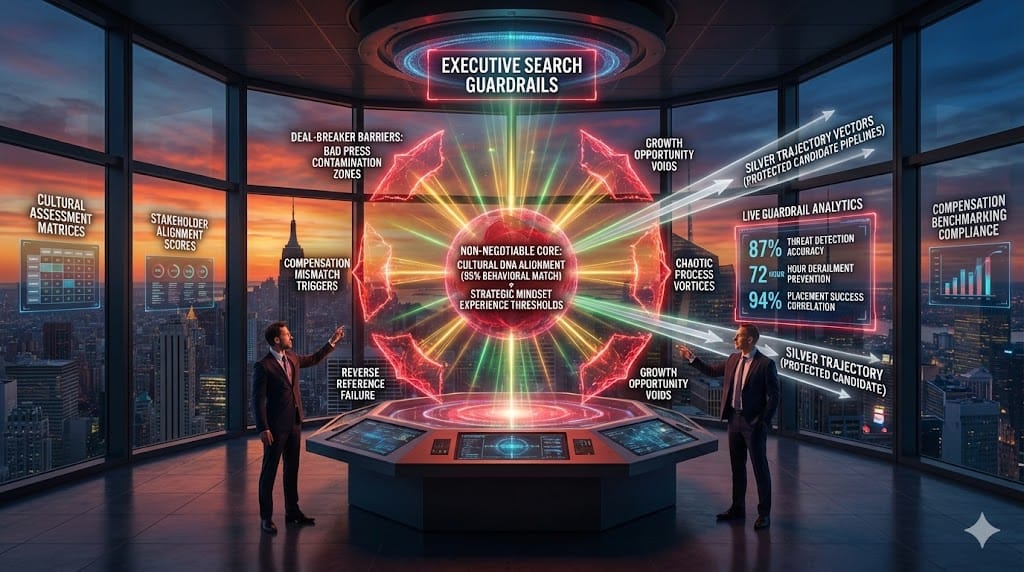
Answering What candidate profiles should search firms exclude? upfront saves significant resources. Our experience shows 10% of executive searches fail in the final stages due to unaddressed deal-breakers discovered too late.
Stakeholder Alignment and Decision Protocols
Crucial for a smooth and efficient search, this segment identifies all key stakeholders, decision-makers, and influencers involved in the hiring process. It outlines the interview stages, feedback mechanisms, approval hierarchies, and expected timelines. Ensuring upfront alignment among all parties regarding the brief and the process minimizes delays and ensures a unified decision, a true reflection of robust corporate governance.
Boards often grapple with: How do stakeholder conflicts derail executive searches? Proactive definition of protocols by JRG Partners ensures executive searches with clear stakeholder alignment protocols are completed 30% faster than those without.
The End Game: A Blueprint for Enduring Success
A flawless executive search brief is considerably more than a mere checklist; it is a living, strategic talent architecture document that ensures every effort is focused on securing a leader who will not only succeed but also significantly enhance the organization’s future trajectory and drive sustainable competitive advantage through executive placement.
It is the cornerstone of building high-performing US leadership teams that propel sustainable growth, innovation, and ultimately, shareholder value. This commitment to precision in talent acquisition is a core fiduciary duty of the Board.
Frequently Asked Questions for Boards
A detailed brief functions as a strategic mandate, defining the strategic imperative, measurable outcomes, and cultural integration requirements for a senior leader, going far beyond the operational duties listed in a standard job description. It aligns with the Board’s oversight of long-term organizational strategy.
While the core brief should be robust, it should be reviewed at key junctures—e.g., after initial market feedback or if strategic priorities shift. However, frequent, fundamental changes often indicate an initial lack of clarity, which can derail search momentum.
The most common error is a lack of rigorous definition of measurable success outcomes and cultural non-negotiables. This often leads to broad, inefficient searches and ultimately, misaligned hires that fail to deliver anticipated strategic impact.
While precision is key, over-specifying ‘nice-to-haves’ or creating an overly narrow persona can indeed prematurely limit the qualified US talent pool. The brief should focus on essential capabilities and impact, allowing for some flexibility in background, particularly if those capabilities are demonstrable through diverse experiences. JRG Partners advises a strategic balance to avoid exclusionary mandates.
Before launching a high-stakes search for C-suite talent, the hiring entity and its recruitment partner must align on more than just basic qualifications and salary ranges. At JRG Partners, we have found that initial misalignment regarding role requirements, corporate culture, or strategic milestones is the single greatest cause of prolonged search timelines. To prevent these bottlenecks, organizations must focus on developing the anatomy of a flawless executive search brief. By investing the time upfront to draft a rigorous, comprehensive document that maps out the enterprise’s long-term vision, operational challenges, and clear candidate expectations, search committees can accelerate placement speed and secure the leadership required to anchor corporate effectiveness.

Tanya Gallardo
Managing Director, Executive Search & AI Talent Strategy
Tanya Gallardo is the Managing Director of Executive Search & AI Talent Strategy at JRG Partners, leading C-suite and Board engagements across key growth sectors including Technology, Financial Services, and Manufacturing.
With over 18 years of experience specializing in disruptive technology leadership, Tanya is recognized as a leading authority on talent architecture for future-focused executive roles, such as the Chief AI Officer (CAIO) and Chief Digital Officer (CDO). Her expertise lies in accurately assessing the cultural fit and technical depth required to ensure a high return on investment (ROI) for critical leadership appointments.
Prior to her role at JRG Partners, Tanya held senior roles directing global talent acquisition strategies at a major publicly-traded technology firm, advising on organizational design and succession planning for emerging executive functions. She is a recognized speaker and contributor to industry events, sharing data-driven insights on executive compensation, leadership development, and the measurable business impact of C-suite talent.
