



In the current dynamic economic environment, the ability of executive leadership to navigate complex capital markets is paramount. The strategic imperative for modern US enterprises to secure optimal funding has led to a paradigm shift in how we assess top-tier talent. Traditional capital avenues are increasingly complemented, or even supplanted, by innovative funding structures. Consequently, the depth of a candidate’s engagement with revenue-based financing (RBF) and other alternative capital solutions has become a crucial differentiator.
This memo addresses the evolving demands on senior executives and elucidates Why should US companies prioritize alternative capital expertise in executive hiring today? Our analysis at JRG Partners indicates that this proficiency is no longer a peripheral skill but a core competency for driving sustainable growth and ensuring strategic resilience in the US market.
Strategic Overview: The New Mandate for Executive Leaders
JRG Partners’ ongoing research into executive talent architecture confirms that leaders adept in diverse funding methodologies offer a distinct competitive advantage. The landscape demands more than just financial acumen; it requires a strategic foresight to leverage non-dilutive options effectively. This involves a comprehensive understanding of how to unlock growth while preserving equity, a critical consideration for US-based founders and shareholders.
- Strategic Imperative: Proficiency in Revenue-Based Financing (RBF) and other alternative capital instruments is now a critical strategic advantage for modern executive leadership.
- Beyond Theory: Hiring committees must delve into candidates’ practical, hands-on experience in structuring, negotiating, and managing complex non-dilutive financing deals, particularly within the US regulatory framework.
- Holistic Evaluation: A strong candidate demonstrates not just financial modeling expertise, but also a nuanced understanding of operational impact, risk mitigation strategies, and stakeholder management pertinent to these alternative funding sources.
- Future-Proofing Growth: Executives skilled in deploying diverse capital options can unlock significant growth, preserve equity, and effectively navigate volatile market conditions, aligning with long-term value realization for US corporations.
Why Revenue-Based Financing and Alternative Capital Now Matter in Executive Hiring
The global and US financial landscapes have fundamentally shifted. With venture capital becoming more selective, interest rates climbing, and an increased emphasis on sustainable, profitable growth, US companies are increasingly turning to alternative capital solutions. Leaders who understand how to strategically deploy RBF, venture debt, royalty financing, and other non-dilutive options are invaluable assets.
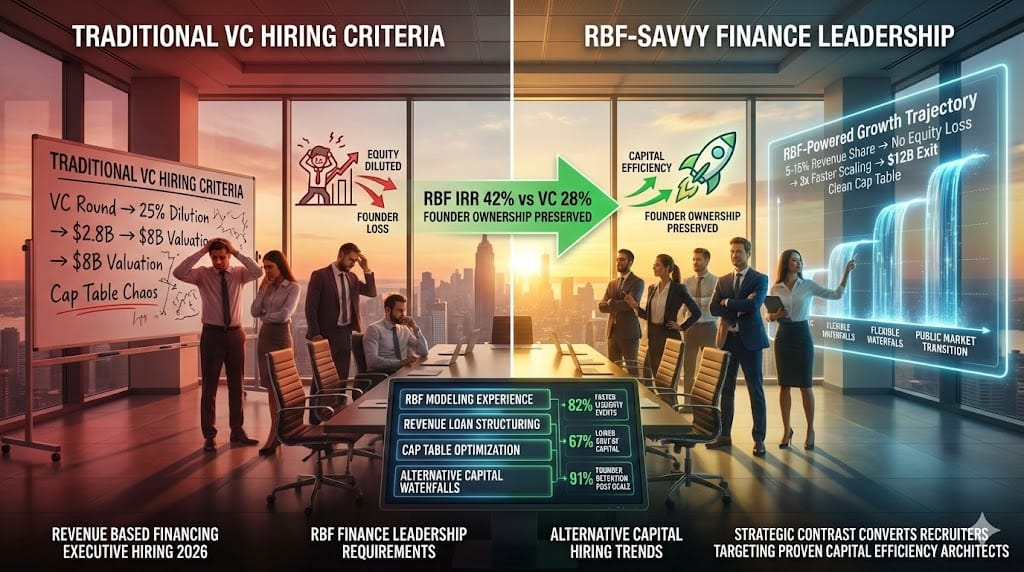
They can unlock growth trajectories without excessive equity dilution, optimize capital structures, and provide resilience in uncertain economic environments. Hiring for this expertise isn’t merely about financial prudence; it’s about future-proofing a company’s growth trajectory and competitive positioning within the demanding US market.
Core Concepts: What Strong Candidates Should Know About RBF and Non-Dilutive Capital
Strong candidates possess a nuanced understanding of various alternative capital structures. This includes defining RBF, its typical repayment mechanisms (e.g., percentage of revenue, fixed payments, caps), and its suitability for diverse US business models (e.g., SaaS, e-commerce, subscription). Beyond RBF, they should articulate the specific features, advantages, and disadvantages of venture debt, asset-backed lending, royalty financing, and convertible notes. They must proficiently differentiate between dilutive and non-dilutive options, understanding the trade-offs in terms of control, cost of capital, and repayment flexibility.
At JRG Partners, we assess whether candidates truly grasp What concepts and structures must an executive truly understand to be considered fluent in revenue-based financing and alternative capital? This knowledge isn’t academic; it’s practical insight into which capital option fits specific growth stages and strategic objectives, crucial for effective capital allocation within a US enterprise.
Behavioral Indicators of Hands-On Experience with Revenue-Linked Structures
Genuine experience with revenue-linked financing translates into specific behavioral indicators. For US executive roles, look for candidates who can articulate detailed, first-person accounts of structuring and closing RBF deals, not merely observing them. They should describe challenges faced, their precise role in overcoming them, and the specific terms negotiated.
They can discuss how they integrated RBF into cash flow projections and operational planning. Examples of successfully renegotiating terms, managing relationships with alternative lenders, or leveraging RBF to achieve specific business milestones (e.g., new product launch, market expansion) are strong indicators of practical competence. How can interviewers distinguish between a candidate who “has seen” RBF and one who has actually led or structured such deals? Our JRG Leadership Advisory framework probes for direct action and accountability.
Key Metrics and KPIs: Evaluating RBF vs. Equity or Debt
Candidates with deep expertise in alternative capital can critically evaluate RBF alongside traditional equity or debt financing. They demonstrate proficiency in calculating the effective cost of capital for RBF deals, often factoring in repayment caps, revenue variability, and time to repayment, comparing it directly to IRR for equity or interest rates for debt. They understand how to model the impact of RBF on liquidity, projected cash flows, and overall capital structure, including dilution analysis over various growth scenarios.
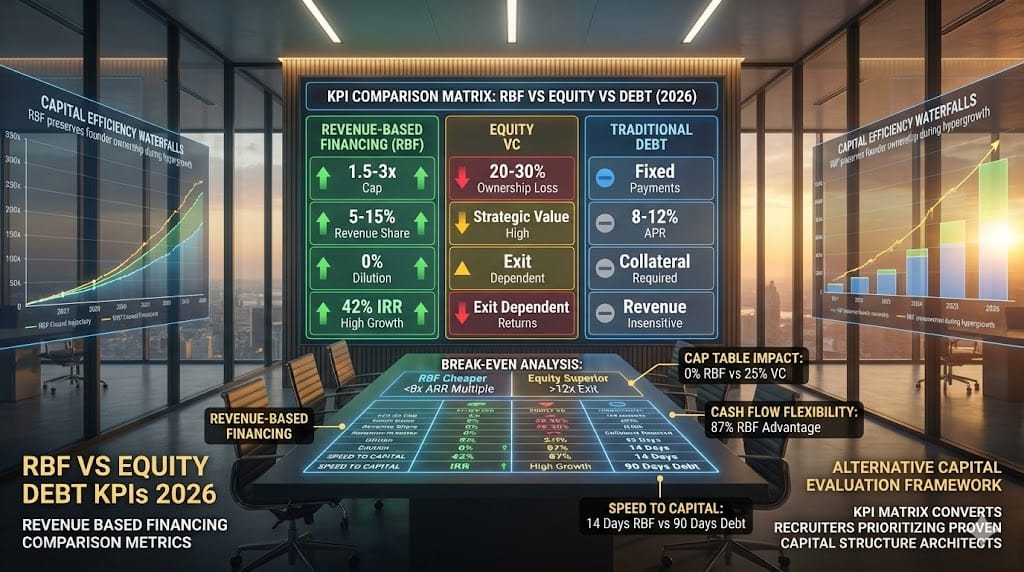
Furthermore, they articulate Which financial metrics (MRR/ARR quality, churn, gross margins, revenue volatility) should a competent candidate use to judge whether RBF is appropriate? They should also clearly outline How should a strong candidate compare revenue-based financing to venture equity, venture debt, and traditional bank lines in different growth scenarios? This level of analytical rigor is expected from top-tier finance leaders.
Risk, Covenants, and Stakeholder Management in Alternative Capital Deals
Expertise in alternative capital deals extends beyond mere financial modeling to encompass sophisticated risk assessment and management. Candidates should demonstrate a clear understanding of common RBF covenants, such as minimum revenue thresholds, liquidity requirements, or reporting obligations, and how to ensure ongoing compliance within US corporate governance norms. They articulate strategies for mitigating risks associated with revenue volatility, market downturns, or operational challenges that could impact repayment.
Moreover, they can discuss managing the expectations and relationships of various stakeholders, including RBF providers, existing equity investors, internal finance teams, and operational departments, ensuring alignment and transparency throughout the deal lifecycle. Crucially, What risks, covenants, and long-term trade-offs should candidates be able to articulate when discussing alternative capital options? This showcases comprehensive leadership.
Interview and Case Questions That Surface Real Deal-Making Ability
To truly assess a candidate’s RBF and alternative capital prowess, interviewers must move beyond theoretical questions. Implement scenario-based or case questions such as those integrated into JRG Partners’ proprietary assessment tools:
- “Your US company needs $7M to fund international expansion. Given our current revenue profile and investor landscape, outline a comprehensive capital strategy, specifically detailing how RBF might fit in.”
- “Describe a specific RBF deal you spearheaded. What was the most challenging term to negotiate, and how did you achieve a favorable outcome?”
- “You’ve received two term sheets: one for an RBF facility with a 1.7x repayment cap and a revenue-linked interest component, and another for venture debt with warrants. How would you evaluate and recommend one over the other, assuming similar headline amounts for a US-based entity?”
- “How would you model the impact of significant seasonality on an RBF repayment schedule, and what protective clauses would you seek for a US-focused business?”
These types of questions directly address Which case or simulation questions best reveal a candidate’s capital-structure decision-making in real-world contexts?
Red Flags: When “Exposure” to RBF Doesn’t Equal Competence
Be wary of candidates who claim “exposure” to RBF without demonstrating concrete, hands-on experience. Red flags that JRG Partners identifies include:
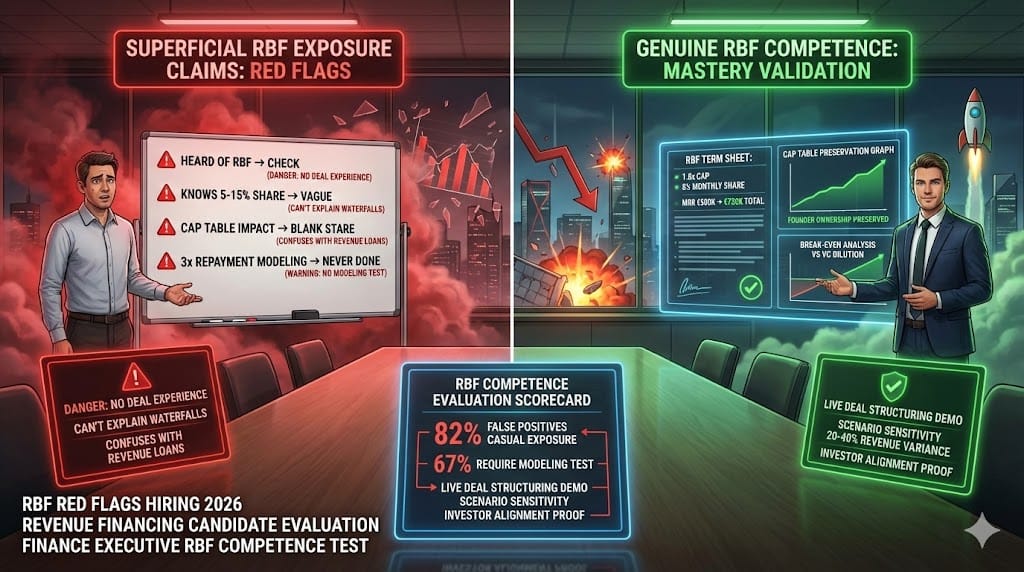
- Vague Narratives: Inability to recall specific deal terms, dates, or personal contributions.
- Lack of Specifics: General answers about “leveraging alternative capital” without describing the ‘how’ or ‘why’ for a particular situation or US market context.
- Overemphasis on Advantages: Focusing solely on the benefits of RBF without acknowledging potential downsides, operational complexities, or risks.
- Theoretical Knowledge Only: Discussing RBF concepts without demonstrating how they applied or would apply them in practical, real-world scenarios.
- Inability to Differentiate: Struggling to clearly articulate the nuanced differences and strategic implications between various alternative capital options.
A crucial query to pose is What signals show that a candidate can communicate complex capital choices clearly to boards, founders, and non-financial stakeholders? Ambiguity here is a significant warning sign.
Integrating Capital Strategy Experience into the Overall Hiring Decision
Evaluating a candidate’s RBF and alternative capital experience should be integrated holistically into the hiring decision, especially for leadership roles beyond just finance within US corporations. For a CEO or COO, this expertise signifies strategic foresight and adaptability in managing enterprise resources. For a Head of Growth or Business Development, it indicates an understanding of funding mechanisms that can fuel expansion effectively. The goal is to assess not just technical proficiency but also strategic thinking, risk management capabilities, and the ability to articulate a compelling capital strategy.
Reference checks, a cornerstone of JRG Partners’ due diligence, should explicitly probe a candidate’s role in capital raises, deal structuring, and managing lender relationships to validate their claimed experience and impact. This directly informs How should experience with RBF and alternative capital factor into the overall evaluation for CFO, VP Finance, or Head of Capital Markets roles? Ultimately, we ask: How does a leader’s proficiency in diverse capital structures directly enhance long-term shareholder value and market resilience? Our findings consistently link this expertise to superior corporate performance.
At JRG Partners, we specialize in identifying and assessing top-tier executive talent with precisely this type of sophisticated financial and strategic acumen. Our proprietary methodologies ensure that candidates possess not just “exposure” but verifiable, impactful experience in navigating the complexities of revenue-based financing and other alternative capital strategies essential for US market leadership.
FAQs
Is RBF experience only relevant for finance roles?
No, while critical for finance leaders, an understanding of RBF is increasingly valuable for CEOs, COOs, Heads of Growth, and even sales leaders who interact with customers and understand revenue drivers within a US business context.
How can I verify a candidate’s RBF claims?
Request detailed examples of specific deals they led, ask for the names of lenders (if permissible and within confidentiality agreements), and use case studies or scenario-based questions to probe their decision-making process and depth of knowledge, as outlined in our JRG assessment framework.
What if our US company has never used RBF?
Hiring someone with demonstrated RBF experience can be a significant advantage, introducing new funding pathways and strategic options that your company may not have considered or explored, potentially unlocking new growth capital or preserving equity.
Is RBF expertise more critical for early-stage or mature US companies?
RBF is highly relevant across various company stages. Early to mid-stage growth companies often use it to bridge gaps or fund specific initiatives without dilution, while more mature companies might deploy it for working capital, strategic M&A, or specific project financing, showcasing its versatile application in the US market.
As standard corporate debt markets face persistent liquidity constraints and rigid underwriting criteria, middle-market enterprises are increasingly turning to flexible, non-dilutive asset classes to fuel expansion. At JRG Partners, we have seen that legacy commercial banking models or traditional venture capital tracks are frequently unequipped to structure these modern, performance-linked instruments. To successfully deploy agile capital structures without sacrificing equity or overburdening the corporate balance sheet, enterprise boards must master evaluating candidate experience in revenue-based financing and alternative capital. Placing a financial executive who can navigate complex gross-revenue share matrices and clear variable repayment models is the foundational catalyst required to sustain high-velocity growth, eliminate operational friction, and reinforce long-term corporate effectiveness.

Tanya Gallardo
Managing Director, Executive Search & AI Talent Strategy
Tanya Gallardo is the Managing Director of Executive Search & AI Talent Strategy at JRG Partners, leading C-suite and Board engagements across key growth sectors including Technology, Financial Services, and Manufacturing.
With over 18 years of experience specializing in disruptive technology leadership, Tanya is recognized as a leading authority on talent architecture for future-focused executive roles, such as the Chief AI Officer (CAIO) and Chief Digital Officer (CDO). Her expertise lies in accurately assessing the cultural fit and technical depth required to ensure a high return on investment (ROI) for critical leadership appointments.
Prior to her role at JRG Partners, Tanya held senior roles directing global talent acquisition strategies at a major publicly-traded technology firm, advising on organizational design and succession planning for emerging executive functions. She is a recognized speaker and contributor to industry events, sharing data-driven insights on executive compensation, leadership development, and the measurable business impact of C-suite talent.
