


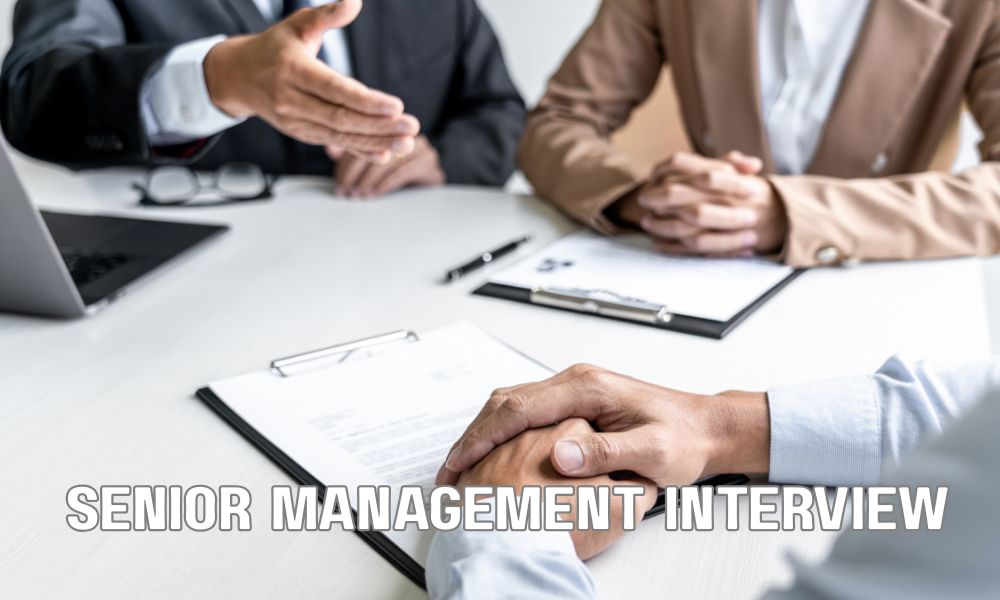
As Global Head of Research & Leadership Advisory at JRG Partners, I offer these 25 interview questions to ask when hiring a VP of Human Resources, drawn from real assessment work rather than theory. Each question comes with listening guidance: the shape of a great answer, and the tells that should worry you. Used consistently across candidates, they convert interviews from conversation into evidence.
Key Takeaways: Interviewing VP of Human Resources Candidates Effectively
- Structure the interview around competencies and ask the same core questions of every finalist; consistency is what makes comparison honest.
- Great answers are specific, quantified, and honest about failure; fluent answers with no numbers and no scars are the field’s oldest warning sign.
- Probe the candidate’s personal role in every claimed achievement, executive wins are team wins, and title inflation is routine.
- Match question emphasis to your mandate: the VP of Human Resources you need for the next three years determines which competencies below deserve double weight.
- Always verify through structured referencing afterward, interviews generate claims; references test them.
Before You Interview: Define the Mandate
Interviews test candidates; mandates test companies. Write down what the role must deliver in three years, growth, build-out, transformation, or repair, and let that document decide which question groups below get the most time. Price the role against the same mandate using our VP of Human Resources salary guide, so the offer conversation never waits on a committee cycle.
Talent Engine, Rewards, and HR Operations (Questions 1-7)
1. Walk me through a talent-acquisition turnaround: the funnel before and after. Machine mechanics: time-to-fill, quality-of-hire, and the sourcing changes behind them.
2. Tell me about the hardest employee-relations case you handled end to end. Process integrity: investigation discipline, fair outcome, and legal exposure managed.
3. Describe running a compensation cycle through budget constraint. Rewards craft: differentiation defended, communication handled, and retention through it.
4. How have you reduced regretted attrition, specifically? Diagnosis to intervention to measured result, not engagement-survey hand-waving.
5. Walk me through an HRIS or people-analytics implementation you owned. Systems delivery: adoption achieved and a decision the data changed.
6. Tell me about supporting a reorganization: your role in design and landing. Structure craft plus change execution, with the aftermath honestly assessed.
7. How do you coach a manager everyone complains about? Development mechanics with a real trajectory, improvement or exit, either handled well.
Employee Relations, Change, and Business Partnership (Questions 8-13)
8. Describe navigating a multi-state or global compliance challenge. Regulatory craft: the exposure found, the fix, and the audit outcome.
9. Tell me about a benefits redesign and its reception. Cost and care balanced, with utilization and feedback data after.
10. How have you built manager capability at scale? Enablement receipts: the program, the adoption, and the metric it moved.
11. What HR process did you kill, and what did the organization gain? Simplification courage against the function’s accumulation habit.
12. Walk me through partnering with a leader through their team’s crisis. Trusted-advisor craft in a real moment: candor, care, and the outcome.
13. What would you assess first about our organization’s health? Preparation test: attrition, engagement, or capability hypotheses tied to our likely stage.
Strategic Partnership Across the Executive Table (Questions 14-17)
14. Tell me about a time you disagreed with your CEO on a significant decision. What did you do? Spine and diplomacy in one story: a private, evidence-based challenge, and commitment once decided. A VP of Human Resources who never disagreed with a CEO has been decorative.
15. Describe a decision where your analysis or counsel changed the company’s direction. A specific before-and-after with consequences attached, this is where strategic executives separate from reporters of events.
16. Which executive-team dynamic have you most improved, and how? Team-of-leaders citizenship: the dysfunction named carefully and the contribution verifiable.
17. How do you earn credibility with a skeptical CEO or board in the first ninety days? A deliberate entry strategy: early listening, a fast meaningful win, and honesty about what they don’t yet know.
Leadership and Team Building (Questions 18-21)
18. Tell me about the best team you built. How did you find and develop the key people? Builders light up here, name individuals’ growth arcs, and point to alumni now in bigger seats.
19. What will your current team say is hardest about working for you? Specific self-awareness without rehearsed humility, and knowledge that referencing will verify it.
20. How do you decide what to delegate versus own personally? Reveals whether the leader scales with you or becomes the bottleneck at your next stage.
21. How have you built accountability without fear? Culture mechanics: standards enforced, psychological safety preserved, with an example proving both at once.
Judgment, Integrity, and Pressure (Questions 22-25)
22. Tell me about a time you were pressured to present information more favorably than you believed was right. Non-negotiable. Strong answers show a clear line held, gracefully but firmly. Treat any equivocation as disqualifying.
23. Why this company, and why now? The closer. Great candidates connect their specific experience to your specific mandate; a beautiful generic answer is a candidate interviewing everywhere.
24. What have you changed your mind about professionally in the last two years? Intellectual openness with specifics, executives who update beat executives who defend.
25. Why this company, and why now? The closer. Great candidates connect their specific experience to your specific mandate; a beautiful generic answer is a candidate interviewing everywhere.
Scoring, Structure, and What Comes After the Interview

The process is the instrument: consistent questions, competency-scaled scoring, independent ratings submitted before the debrief, and verification afterward through references matched to the candidate’s actual claims, sourced beyond the provided list. The table below maps question groups to the mandates they matter most for.
| Competency Area | Questions | Weight Heavily When Your Mandate Is |
|---|---|---|
| Talent Engine, Rewards, and HR Operations | 1-7 | Core functional delivery, first professional VP of Human Resources, post-turbulence repair |
| Employee Relations, Change, and Business Partnership | 8-13 | Transformation, scaling, or building the capability from partial foundations |
| Strategic partnership | 14-17 | Executive-team upgrade, CEO thought-partner gap, cross-functional repair |
| Leadership and team | 18-21 | Organization build-out, inherited-team situations, rapid growth |
| Judgment and integrity | 22-25 | Always; never traded off against any other competency |
The Bottom Line for Hiring Committees
Interviews reward preparation asymmetrically: prepared committees hire operators, unprepared ones hire narrators. The mandate document, the consistent question set, the personal-role follow-ups, the independent scores, and the verifying references above are the whole method, none of it is exotic, and all of it is regularly skipped. If the specification itself still needs work, our VP of Human Resources job description template is built to precede this guide.
Frequently Asked Questions
- Q: What is the single most important question to ask a VP of Human Resources candidate?
- A: The pressure-and-integrity question, and the personal-role follow-up behind every achievement claim. Together they surface the two failure modes that references later confirm too late.
- Q: How many interviews should a VP of Human Resources hiring process include?
- A: Three to four, ending in a working session, reviewing your actual numbers, plans, or product, because an hour of real work reveals more than three more hours of conversation.
- Q: Should VP of Human Resources candidates complete a case study or working exercise?
- A: A working exercise is the highest-signal hour in the process, done respectfully: real material, bounded preparation, and evaluation against the same rubric for every finalist.
- Q: How do we assess a first-time VP of Human Resources versus a proven one?
- A: Use the same questions but weight trajectory over polish: look for candidates who owned the role’s work under a previous title-holder, probe personal role even harder, and reference with the executive they worked for.
- Q: What are the biggest red flags in VP of Human Resources interviews?
- A: Fluent answers without numbers, achievements described entirely in ‘we’ with no personal role, no admissible failures, disparagement of previous employers, and any hedging on the integrity question. Each predicts problems that surface after hiring.
- Q: Who should lead the VP of Human Resources interview process?
- A: One accountable owner, normally the executive the role reports to, with structured peer and board input. Committees that share ownership equally usually discover they shared it with no one.

Tanya Gallardo
Managing Director, Executive Search & AI Talent Strategy
Tanya Gallardo is the Managing Director of Executive Search & AI Talent Strategy at JRG Partners, leading C-suite and Board engagements across key growth sectors including Technology, Financial Services, and Manufacturing.
With over 18 years of experience specializing in disruptive technology leadership, Tanya is recognized as a leading authority on talent architecture for future-focused executive roles, such as the Chief AI Officer (CAIO) and Chief Digital Officer (CDO). Her expertise lies in accurately assessing the cultural fit and technical depth required to ensure a high return on investment (ROI) for critical leadership appointments.
Prior to her role at JRG Partners, Tanya held senior roles directing global talent acquisition strategies at a major publicly-traded technology firm, advising on organizational design and succession planning for emerging executive functions. She is a recognized speaker and contributor to industry events, sharing data-driven insights on executive compensation, leadership development, and the measurable business impact of C-suite talent.
