


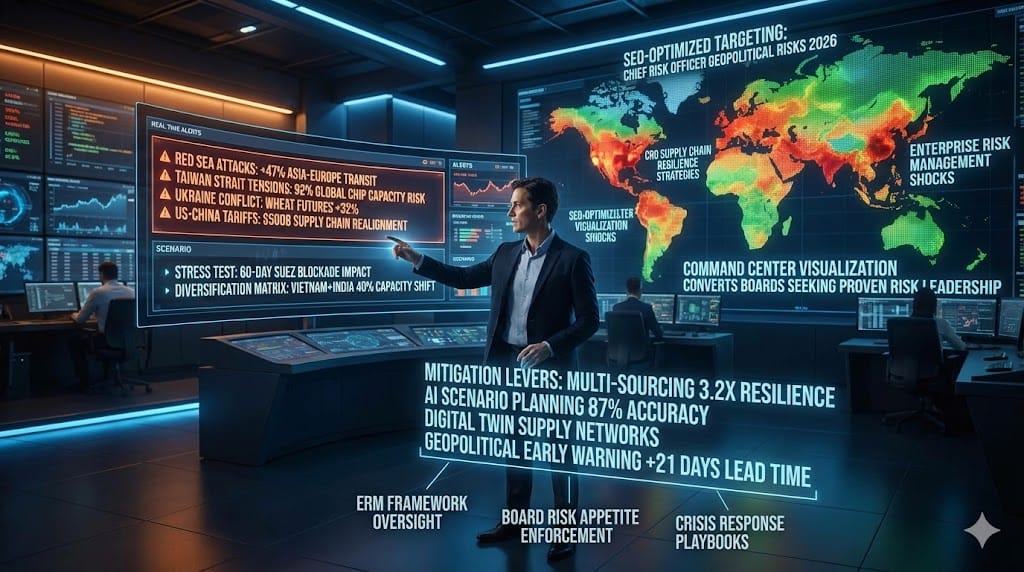
In an era defined by profound global interconnectedness and unprecedented volatility, the mandate of the modern Chief Risk Officer (CRO) has undergone a significant paradigm shift. No longer confined to traditional financial risk management, today’s CRO is a strategic architect, indispensable to safeguarding enterprise longevity amidst complex external pressures.
Our comprehensive analysis at JRG Partners underscores a critical imperative for US corporations: Proactive foresight against global shocks. A frequent query we encounter from leading executives is: “What geopolitical risks dominate 2026 CRO agendas?” The answer transcends mere compliance, demanding integrated strategic planning, sophisticated data analytics, and robust frameworks for resilience across an increasingly intricate operational landscape.
Key Imperatives for Advanced Risk Stewardship
- The modern CRO’s role has expanded significantly, moving beyond traditional financial vulnerabilities to encompass strategic geopolitical factors and complex logistics network susceptibilities.
- Proactive geopolitical scenario planning, integrated data analytics, and robust stress-testing are indispensable tools for navigating an increasingly volatile global environment.
- Effective hazard governance now demands comprehensive mapping of indirect vendor ecosystems and the implementation of real-time intelligence for early detection and agile response.
- Strategic crisis response playbooks, optimized risk transfer mechanisms, and quantifiable resilience metrics are critical for demonstrating the CRO’s value and safeguarding enterprise longevity.
Evolving CRO Mandate Beyond Financial Exposure
The transition from solely financial oversight to holistic enterprise risk management reflects a profound recognition of systemic interconnectedness. The contemporary CRO now integrates strategic, operational, reputational, and external perils—including geopolitical instability, climate change impacts, and potential pandemic disruptions—into C-suite strategic discussions and long-term corporate planning.
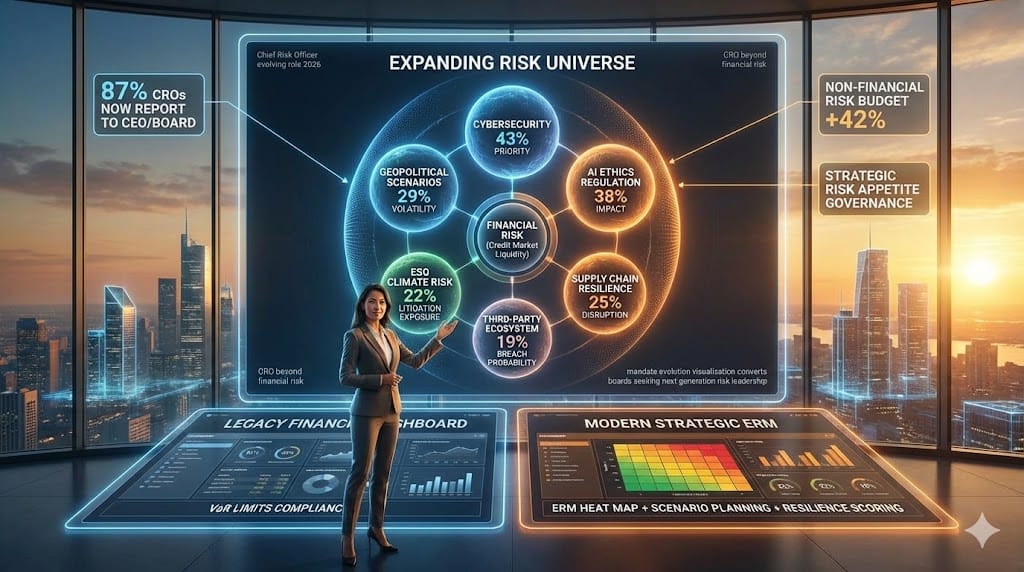
This evolution marks a pivotal shift from compliance-driven functions to value-adding leadership, a trend keenly observed in our executive search engagements. JRG Partners finds exceptional demand for CROs who possess not only deep financial acumen but also a sophisticated understanding of global dynamics and strategic foresight.
- Incorporation of strategic, operational, reputational, and external risks (geopolitical instability, climate change, pandemics).
- Role in C-suite strategic discussions and long-term planning.
- Shift from compliance-driven to value-adding risk leadership.
- 70% of CROs now report directly to the CEO or Board, reflecting their expanded strategic importance.
Geopolitical Scenario Planning Frameworks
Developing multi-horizon scenarios is crucial for anticipating disruptions from events such as trade disputes, regional conflicts, cyber warfare, or resource scarcity. This foresight identifies potential impacts on market access, regulatory compliance, operational continuity, and brand reputation. Utilizing expert panels, war-gaming, and intelligence analysis supports horizon scanning, integrating geopolitical insights into business strategy and investment decisions. Our research indicates that enterprises rigorously engaging in this form of predictive strategizing are significantly better positioned.
- Identifying potential impacts on market access, regulatory compliance, operational continuity, and brand reputation.
- Utilizing expert panels, war-gaming, and intelligence analysis for horizon scanning.
- Companies that regularly engage in geopolitical scenario planning are 2x more likely to outperform peers in volatile markets.
Supply Chain Stress Testing Protocols
How should CROs stress test global supply chains? Simulating disruptive events, from port closures and natural disasters to cyberattacks, labor shortages, or political instability affecting logistics, is paramount. This process identifies critical nodes, single points of failure, and bottleneck vulnerabilities across the entire procurement and distribution network.
Assessing the resilience, redundancy, and responsiveness of the global supply network, along with evaluating alternative sourcing, manufacturing, and distribution strategies, becomes a strategic imperative. The financial impact of such disruptions is substantial, emphasizing the need for robust protocols.
- Simulating disruptive events: port closures, natural disasters, cyberattacks, labor shortages, political instability affecting logistics.
- Identifying critical nodes, single points of failure, and bottleneck vulnerabilities across the supply network.
- Evaluating alternative sourcing, manufacturing, and distribution strategies.
- The average cost of a severe supply chain disruption can be up to 45% of one year’s EBIT for affected companies.
Third-Party Risk Ecosystem Mapping
Comprehensive mapping and continuous monitoring of direct and indirect suppliers, vendors, partners, and their sub-tiers is essential. This includes assessing financial stability, cybersecurity posture, ethical practices, and adherence to US regulatory compliance (e.g., sanctions, forced labor statutes).
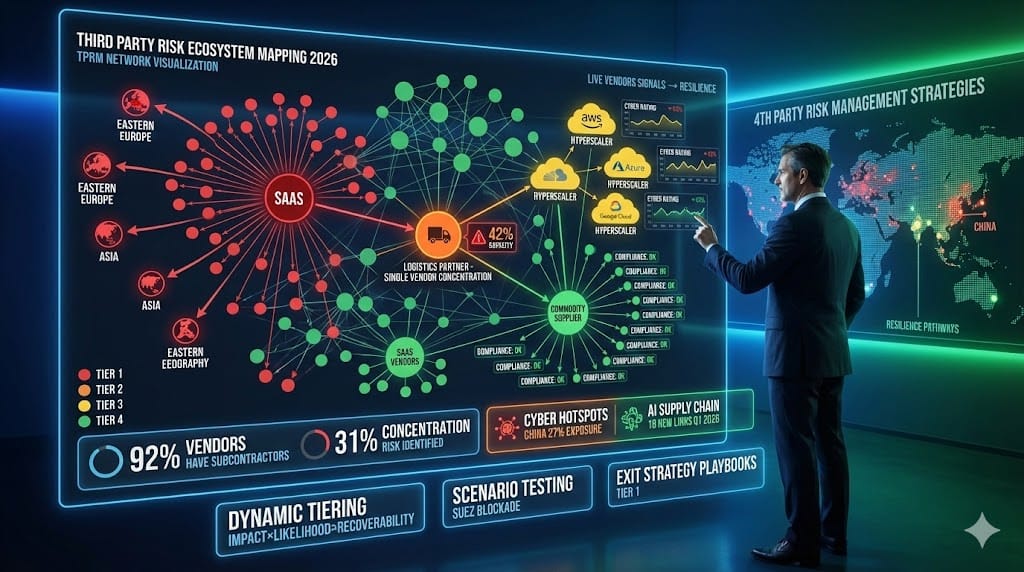
Leveraging AI and machine learning for automated due diligence and enhanced risk scoring is vital. A key concern for Boards is understanding: “Which third-party risks create enterprise contagion?” Failures within the extended vendor ecosystem can have severe cascading effects on primary enterprise operations, demanding meticulous oversight.
- Assessing financial stability, cybersecurity posture, ethical practices, and US regulatory compliance (e.g., sanctions, forced labor).
- Leveraging AI and machine learning for automated due diligence and risk scoring.
- Understanding the cascading effects of third-party failures on enterprise operations.
Real-Time Risk Dashboard Implementation
Aggregating data from diverse internal systems (ERP, CRM) and external sources (news feeds, geopolitical sensors, logistics trackers, weather data) provides a dynamic, holistic view of emerging hazards and their potential impact. What dashboard metrics signal emerging shocks? Developing key risk indicators (KRIs) and early warning systems for critical thresholds is crucial.
This enables rapid decision-making through intuitive visualization and customizable alerts, enhancing incident response capabilities. Our talent acquisition efforts at JRG Partners consistently highlight the demand for CROs adept at leveraging such sophisticated technological capabilities.
- Aggregating data from diverse internal systems (ERP, CRM) and external sources (news feeds, geopolitical sensors, logistics trackers, weather data).
- Developing key risk indicators (KRIs) and early warning systems for critical thresholds.
- Enabling rapid decision-making through intuitive visualization and customizable alerts.
Crisis Response Playbooks for Executive Alignment
Developing pre-defined, agile strategies and communication protocols for various geopolitical and supply network shock scenarios is imperative. How do CROs align executives during crisis escalation? Clearly outlining roles, responsibilities, and decision-making authority for executive leadership and incident response teams ensures a coordinated and swift reaction.
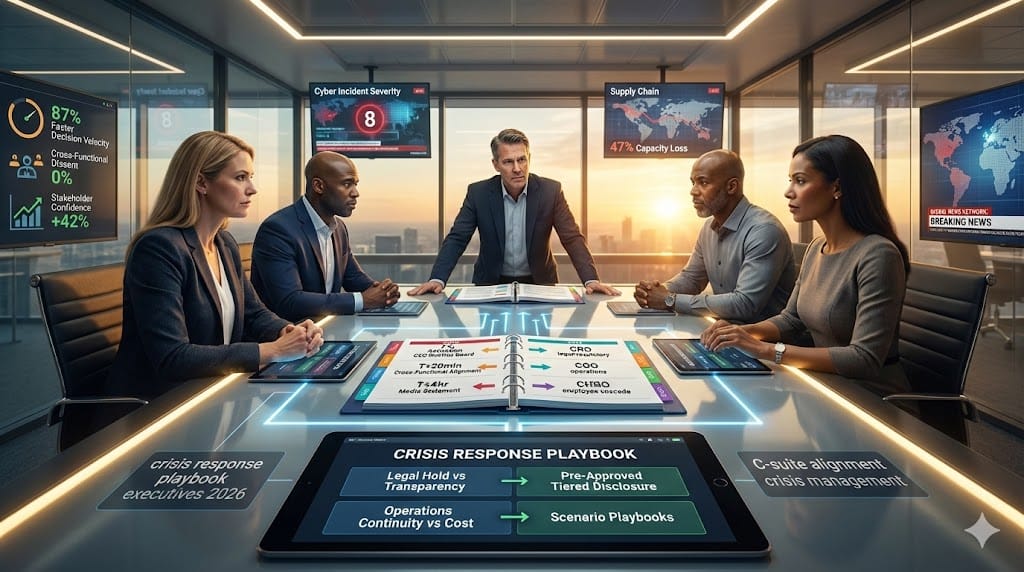
Establishing rapid communication channels with stakeholders—employees, customers, investors, and US regulators—and conducting regular simulation exercises and drills ensure readiness and identify any gaps in the organizational response structure.
- Clearly outlining roles, responsibilities, and decision-making authority for executive leadership and incident response teams.
- Establishing rapid communication channels with stakeholders (employees, customers, investors, US regulators).
- Conducting regular simulation exercises and drills to ensure readiness and identify gaps.
Insurance and Hedging Strategy Optimization
Reviewing and optimizing insurance portfolios to cover emerging exposures (e.g., political risk insurance, supply chain disruption insurance, cyber insurance, cargo insurance) is critical. Which hedging strategies mitigate tariff volatility? Utilizing financial instruments (e.g., currency hedging, commodity futures) mitigates exposure to market volatility driven by geopolitical events.
Balancing risk retention (self-insurance) with strategic risk transfer, along with assessing the adequacy of coverage limits and policy exclusions in a dynamic environment, forms a cornerstone of prudent financial stewardship.
- Reviewing and optimizing insurance portfolios to cover emerging risks (e.g., political risk insurance, supply chain disruption insurance, cyber insurance, cargo insurance).
- Utilizing financial instruments (e.g., currency hedging, commodity futures) to mitigate exposure to market volatility driven by geopolitical events.
- Balancing risk retention (self-insurance) with strategic risk transfer.
Measuring CRO Impact Through Resilience Metrics
What resilience KPIs validate CRO effectiveness? Developing quantifiable metrics to assess organizational fortitude, such as Recovery Time Objective (RTO), Recovery Point Objective (RPO), Maximum Tolerable Downtime (MTD), and Supply Chain Diversification Index, is vital. Tracking incident frequency, severity, duration, and the efficiency of hazard mitigation efforts demonstrates the Return on Investment (ROI) of proactive strategies through reduced losses and enhanced business continuity.
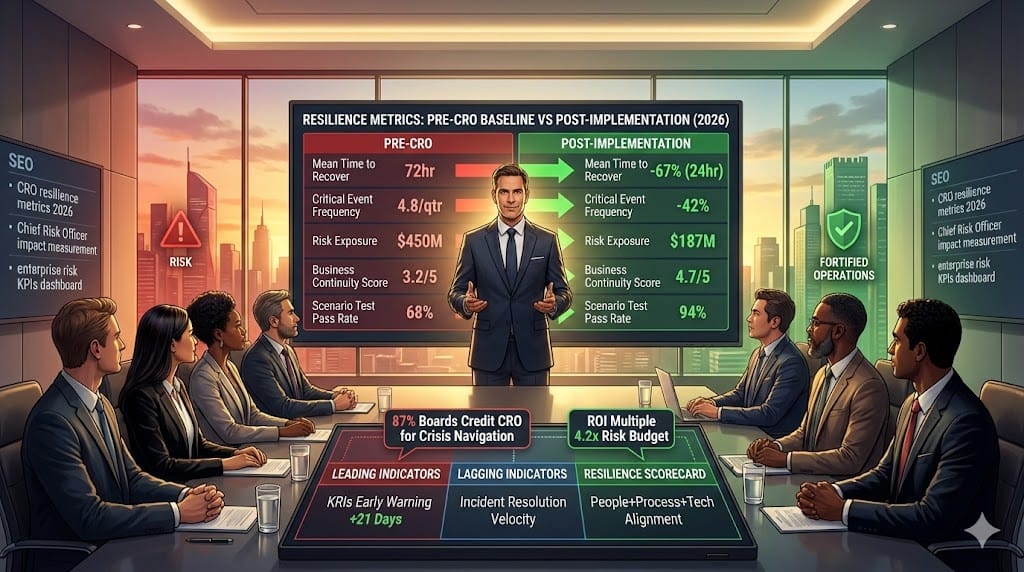
Benchmarking capabilities against industry peers and best practices reinforces a culture of continuous improvement. The question of whether AI risk prediction will redefine CRO roles by 2030 underscores the imperative for continuous skill development in this domain, a focus for JRG Partners in identifying next-generation leadership.
- Tracking incident frequency, severity, duration, and the efficiency of risk mitigation efforts.
- Demonstrating the Return on Investment (ROI) of risk management initiatives through reduced losses and enhanced business continuity.
- Benchmarking resilience capabilities against industry peers and best practices.
FAQs for Board Consideration
- What is the biggest challenge for CROs in navigating geopolitical and supply network risks?
- The interconnectedness and inherent unpredictability of global events, combined with the sheer volume of disparate data, make anticipating and quantifying impacts incredibly complex. The absence of historical analogs for certain novel disruptions further exacerbates this challenge.
- How does AI and machine learning enhance a CRO’s ability to mitigate these exposures?
- AI/ML can process vast amounts of unstructured data (news, social media, intelligence reports) to identify subtle patterns, predict potential disruptions, and provide early warnings far more effectively than human analysis alone. This empowers a more proactive and predictive posture.
- What skills are most essential for a modern CRO focusing on these critical areas?
- Strategic thinking, geopolitical acumen, advanced data analytics proficiency, strong communication and influencing capabilities, and a deep understanding of global logistics dynamics are paramount. JRG Partners specializes in identifying candidates who possess this unique blend of skills for top-tier leadership roles.
- Can smaller US businesses effectively address these complex vulnerabilities without a dedicated CRO?
- While challenging, smaller businesses can leverage external consultants, industry consortia, and specialized technology platforms to gain insights and develop basic hazard governance frameworks. The focus should be on critical vulnerabilities and building inherent redundancy into their core operations.
- Is it truly possible to predict geopolitical events to avoid their impact?
- While precise prediction is often impossible, rigorous scenario planning and continuous global monitoring allow organizations to anticipate potential directions, assess probable impacts, and build adaptive strategies to respond effectively, rather than merely react. This proactive adaptability is the hallmark of enterprise resilience.
As international trade corridors face unprecedented disruption and localized conflicts redefine global trade routes, the traditional boundaries of operational risk management have collapsed. At JRG Partners, we have seen that enterprise resilience can no longer be managed through siloed, backward-looking compliance frameworks. To insulate global supply chains from sudden macroeconomic and regulatory disruptions, forward-thinking corporate boards must redefine their risk architecture by evaluating the strategic role of the Chief Risk Officer (CRO) in mitigating geopolitical and supply chain shocks. By empowering an analytical, boardroom-aligned CRO who can translate macro-level vulnerabilities into agile operational safeguards, organizations can protect their margins, eliminate single-point-of-failure vulnerabilities, and ensure continuous corporate effectiveness.

Tanya Gallardo
Managing Director, Executive Search & AI Talent Strategy
Tanya Gallardo is the Managing Director of Executive Search & AI Talent Strategy at JRG Partners, leading C-suite and Board engagements across key growth sectors including Technology, Financial Services, and Manufacturing.
With over 18 years of experience specializing in disruptive technology leadership, Tanya is recognized as a leading authority on talent architecture for future-focused executive roles, such as the Chief AI Officer (CAIO) and Chief Digital Officer (CDO). Her expertise lies in accurately assessing the cultural fit and technical depth required to ensure a high return on investment (ROI) for critical leadership appointments.
Prior to her role at JRG Partners, Tanya held senior roles directing global talent acquisition strategies at a major publicly-traded technology firm, advising on organizational design and succession planning for emerging executive functions. She is a recognized speaker and contributor to industry events, sharing data-driven insights on executive compensation, leadership development, and the measurable business impact of C-suite talent.
