

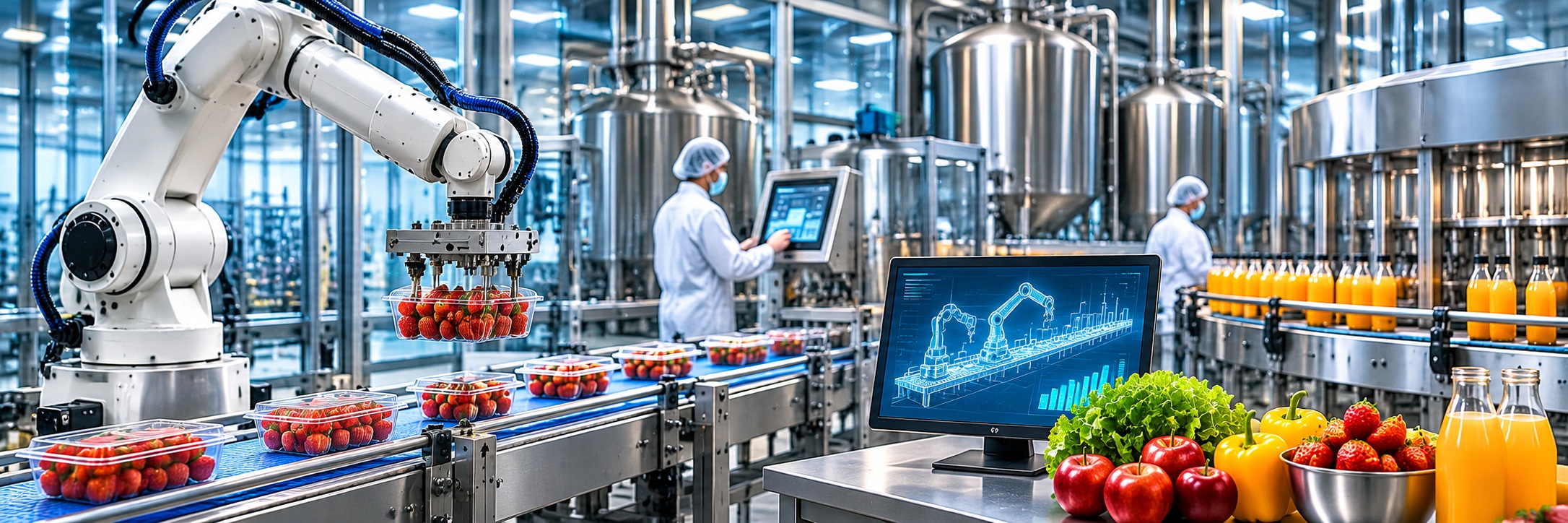
Food & Beverage Automation & Robotics Executive Search Firm
Identify exceptional executives who can advance food manufacturing automation, robotics integration, production efficiency

Identify exceptional executives who can advance food manufacturing automation, robotics integration, production efficiency
Executive Leadership for the Future of Food & Beverage Automation
The food and beverage industry is undergoing significant operational transformation as manufacturers invest in robotics, automated processing, intelligent packaging, and connected production technologies. Organizations need executives who can translate automation investments into measurable improvements in productivity, product consistency, food safety, and manufacturing performance.
At JRG Partners, we identify senior leadership talent for food and beverage automation and robotics organizations across food processing, packaging machinery, industrial robotics, material handling, and manufacturing technology. Our executive searches consider each organization’s technology portfolio, engineering capabilities, customer markets, operational requirements, and growth objectives.
Whether your organization is expanding its robotic automation capabilities, developing next-generation food processing equipment, integrating intelligent packaging systems, or modernizing production facilities, we help identify executives with the technical understanding and commercial leadership needed to move your business forward.
Stay in touch with us
Call us today to discuss your
search assignment parameters.
Food manufacturers are investing in automated production equipment, robotics, and intelligent manufacturing systems to improve throughput, product consistency, and operational efficiency. This creates demand for executives who can manage automation strategies while maintaining manufacturing performance.
Robotic picking, sorting, palletizing, filling, and packaging technologies are becoming increasingly important across food production environments. Companies require leaders who understand robotic applications, equipment integration, engineering development, and commercial deployment.
Automation leaders must understand the relationship between production technology, sanitation requirements, traceability, quality management, and food safety standards. Executives who can align manufacturing innovation with compliance requirements are increasingly valuable.
Connected equipment, machine vision, predictive maintenance, and AI-powered production monitoring are changing food manufacturing operations. Organizations need technology executives capable of integrating intelligent systems into existing production environments.
Finding executives who combine food industry knowledge, robotics expertise, engineering leadership, and commercial experience can be challenging. Companies increasingly require candidates who understand both the technical complexity of automation and the realities of food manufacturing.

We understand the operating environments of food and beverage manufacturers, including processing facilities, packaging operations, production equipment, and automated manufacturing systems. Our approach considers the technical requirements and commercial realities that shape leadership success in this sector.
Our executive search approach focuses on leaders with experience across industrial robotics, food processing automation, packaging machinery, controls engineering, and intelligent manufacturing technologies. We consider candidates who have managed complex engineering teams and delivered automation initiatives across industrial environments.

We evaluate candidates based on their experience with automation strategy, robotics integration, production systems, equipment development, engineering management, and manufacturing technology. This helps organizations identify executives whose capabilities align with their technical and operational priorities.

Successful executives must understand more than technology. We assess leadership experience in business development, customer relationships, manufacturing performance, product commercialization, operational improvement, and organizational growth.
Senior leadership talent across food processing automation, industrial robotics, intelligent packaging, and advanced manufacturing technology markets.
Chief Executive Officer (CEO) / President: Visionary executives responsible for corporate strategy, business expansion, operational performance, and organizational growth.
Chief Technology Officer (CTO): Technology leaders overseeing automation innovation, robotics development, engineering strategy, and industrial technology roadmaps.
Chief Operating Officer (COO): Operational executives managing manufacturing performance, production systems, supply chains, facility operations, and process improvement.
VP of Engineering: Leaders directing automation engineering, mechanical and electrical engineering, product development, and technical teams.
VP of Automation & Robotics: Executives responsible for robotics integration, automated production systems, equipment deployment, and industrial automation strategy.
VP of Manufacturing: Leaders overseeing production facilities, manufacturing efficiency, workforce performance, quality systems, and operational scalability.
Chief Commercial Officer (CCO): Commercial executives responsible for revenue growth, customer relationships, strategic accounts, and automation technology commercialization.
VP of Product Development: Leaders managing new equipment development, product innovation, engineering collaboration, and technology commercialization.
Our research-driven methodology combines industry-specific market mapping, technical leadership assessment, and targeted executive engagement to identify leaders capable of advancing automation and manufacturing technology businesses.
1. Understand the Business & Technology Environment
We begin by evaluating your organization’s business model, automation portfolio, manufacturing capabilities, customer markets, engineering structure, and strategic objectives.
2. Define the Executive Leadership Profile
We establish the technical, operational, commercial, and leadership competencies required for the position. This includes experience with robotics, processing equipment, packaging automation, manufacturing systems, and technology development where relevant.
3. Map the Executive Talent Market
Our research identifies relevant executives across food manufacturing, industrial robotics, packaging machinery, automation integration, and adjacent industrial technology markets.
4. Engage Qualified Executive Candidates
We approach relevant executives confidentially and evaluate their professional experience, technical knowledge, leadership capabilities, business accomplishments, and potential alignment with your organization.
5. Assess Leadership & Industry Fit
Candidates are evaluated against the agreed leadership requirements, including engineering management, automation implementation, manufacturing performance, commercial development, and organizational leadership.
6. Support Executive Selection
We coordinate candidate evaluation and support the selection process through structured feedback, interview coordination, and relevant candidate insights.
7. Facilitate the Hiring & Transition Process
We assist throughout the final stages of the executive search, supporting communication and coordination as your organization moves toward its hiring decision.
Connecting food manufacturers, robotics companies, and industrial automation businesses with specialized executive leadership talent across major U.S. markets.
Food and beverage automation companies operate across diverse manufacturing and technology hubs. JRG Partners conducts targeted executive searches based on geographic requirements, industry specialization, organizational structure, and leadership objectives.
Our search approach can support organizations seeking executives for: Food processing and manufacturing operations, Packaging machinery and automation businesses, Robotics engineering and integration companies, Industrial technology and equipment manufacturers, Smart manufacturing and automation solution providers, Multi-site food and beverage production organizations.
Supporting organizations in identifying leaders for complex automation, engineering, manufacturing, and industrial technology roles.
A poultry and further-processed protein manufacturer generating $5.2B in annual revenue across 18 plants faced chronic labor shortages, processing-role turnover above 70%, rising workplace injuries, and yield losses from inconsistent manual deboning. The board approved a $400M automation program to deploy robotic deboning, vision-guided trimming, automated packaging, and palletizing, but the company lacked the engineering, controls, and reliability leadership to execute the transformation at scale. JRG Partners was engaged to recruit a COO, VP of Automation & Robotics Engineering, VP of Plant Engineering & Capital Projects, VP of Controls & Industrial Software, and VP of Maintenance & Reliability.
JRG Partners assessed 440+ food processing, automation, and engineering executives across North America, prioritizing leaders with proven experience in protein processing robotics, large-scale capital programs, vision-guided controls, and automated equipment reliability. The COO was placed within 50 days, and the complete five-role leadership team was seated within seven months. The new team sequenced the $400M program across the plant network, deployed robotic processing and packaging systems, built in-house controls and vision capabilities, and trained 300 robotics technicians to support automated operations in demanding washdown environments.
Robotic deboning, vision-guided trimming, and automated packaging were deployed across 14 plants within three years, improving deboning yield by 2.8 percentage points. Automated line uptime exceeded 96%, while commissioning time fell by 35%. The transformation reduced labor hours per pound by 30%, cut recordable injuries on automated lines by 60%, and increased throughput by 18% without additional headcount. The program delivered a scalable automation platform that strengthened productivity, safety, and operational reliability.
A dairy cooperative generating $2.9B in annual revenue across nine manufacturing plants faced rising labor shortages, overtime and temporary labor costs up 40%, and retailer penalties caused by missed deliveries. Its $260M modernization program aimed to automate high-care packaging, robotic palletizing, cold storage, and material handling, but the company lacked integrated automation leadership and the digital systems needed to connect production, warehousing, and planning. JRG Partners was engaged to recruit a VP of Automation & Advanced Manufacturing, VP of Packaging Engineering, VP of Warehouse & Material Handling Automation, VP of Digital Manufacturing & MES, and VP of Manufacturing Operations.
JRG Partners assessed 400+ dairy, food manufacturing, packaging, and automation executives across North America, prioritizing leaders with experience in high-care packaging automation, robotic palletizing, cold-chain warehousing, AGV systems, and manufacturing execution platforms. The VP of Automation & Advanced Manufacturing was placed within 45 days, and the complete five-role leadership team was seated within seven months. The new team deployed automated packaging and robotic case packing, commissioned automated cold storage and AGV systems, connected production and warehouse operations through an MES platform, and reorganized plants around automated workflows.
Automated packaging across all nine plants cut changeover time by 50% and enabled 40% more SKUs. Automated cold storage and AGVs at six plants eliminated 280 manual forklift positions and reduced warehouse injuries by 65%. Overtime and temporary labor costs fell by 55%, while on-time retailer delivery improved from 91% to 98.7%, eliminating penalties. The modernization program delivered $70M in annualized savings and established a more efficient, reliable multi-plant operating model.
A private-equity-backed fresh-cut produce and prepared foods manufacturer generating $1.1B in annual revenue across seven plants relied on manual assembly and inspection, with labor costs reaching 28% of revenue. Hundreds of short-run SKUs, frequent changeovers, inconsistent portioning, and missed foreign material created quality risks and retailer complaints. The sponsor’s value-creation plan depended on automation savings, but the company lacked the robotics, machine vision, and engineering leadership to automate variable fresh products without disrupting short shelf-life operations. JRG Partners was engaged to recruit a Chief Manufacturing Technology Officer, VP of Automation Engineering, VP of Robotics Integration, VP of AI Vision & Quality Systems, and VP of Automation Program Management.
JRG Partners assessed 380+ food manufacturing, robotics, and machine vision executives across North America, prioritizing leaders with experience in flexible food robotics, AI vision inspection, foreign material detection, and multi-plant automation programs. The Chief Manufacturing Technology Officer was placed within 55 days, and the complete five-role leadership team was seated within seven months. The new team deployed AI-guided robotic picking, portioning, and kit assembly, implemented automated inspection across every line, established in-house automation engineering capabilities, and delivered 90 automation cells on schedule without shelf-life losses during commissioning.
Robotic assembly was deployed across five plants, handling hundreds of SKUs with changeovers under ten minutes. AI vision inspection reduced retailer complaints by 75% and eliminated product withdrawals. In-house engineering cut deployment cost per cell by 50%, while labor costs declined from 28% to 19% of revenue. The transformation generated $85M in annualized savings, exceeding the sponsor’s value-creation plan and establishing a scalable automation platform for fresh and prepared foods production.
The right executive leadership can accelerate automation adoption, strengthen engineering capabilities, improve manufacturing performance, and support the next stage of business growth.
Whether you need a CEO to lead an automation business, a CTO to advance robotics technology, a VP of Engineering to oversee equipment development, or a COO to improve manufacturing operations, JRG Partners can help identify experienced executives aligned with your objectives.
Partner with JRG Partners to develop an executive search strategy tailored to your technology portfolio, customer markets, organizational structure, and long-term business goals.
Hiring a CEO for a food automation equipment company requires evaluating experience across industrial manufacturing, food processing technology, robotics, and business strategy. Organizations should prioritize candidates who understand automated production systems, equipment commercialization, customer relationships, and manufacturing economics. A strong CEO should also demonstrate the ability to expand market presence, lead engineering and commercial teams, manage financial performance, and develop long-term growth strategies. Experience working with food processing equipment manufacturers, packaging machinery businesses, and industrial automation providers can be particularly valuable.
A VP of Robotics and Automation should combine strong engineering leadership with practical experience implementing industrial automation solutions. Relevant expertise may include robotic picking, palletizing, sorting, machine vision, motion control, automated packaging, and production line integration. Organizations should evaluate candidates on their ability to oversee robotics engineering teams, manage complex automation projects, improve equipment performance, and align technology investments with customer requirements. Experience delivering automation solutions within food manufacturing environments is especially relevant because production systems must account for sanitation, product handling, and operational reliability.
Evaluating a CTO requires understanding the organization’s technology portfolio, product development strategy, engineering capabilities, and innovation objectives. Candidates should demonstrate experience overseeing industrial software, automated processing equipment, robotics, control systems, and connected manufacturing technologies. Organizations should also assess their ability to lead research and development, manage multidisciplinary engineering teams, evaluate emerging technologies, and translate technical innovation into commercially viable products. Experience with food processing applications, production automation, and equipment integration can provide an important advantage.
A VP of Engineering in packaging machinery manufacturing must be capable of leading mechanical, electrical, controls, and automation engineering functions. Important experience includes packaging equipment design, automated filling systems, labeling technologies, sealing machinery, robotic integration, and production line development. Companies should evaluate candidates on their ability to manage product engineering from concept through commercialization, improve equipment performance, oversee technical teams, and coordinate engineering activities with manufacturing and customer-facing functions. Experience developing packaging solutions for food and beverage applications can be particularly valuable.
A COO should understand manufacturing operations, automation implementation, production planning, equipment performance, and operational improvement. Organizations should prioritize candidates who have managed complex production environments, overseen manufacturing facilities, improved operational efficiency, and coordinated engineering, maintenance, quality, and supply chain functions. Experience implementing automated production systems and managing capital investment projects is also important. Strong candidates should be able to connect manufacturing strategy with financial performance, workforce development, and long-term operational scalability.
Industrial robotics integrators require executives who can manage engineering teams, oversee automation projects, develop customer relationships, and deliver technically complex integration solutions. Important capabilities include robotics engineering, systems integration, machine vision, industrial controls, project management, and technical problem-solving. Leaders should also understand project budgeting, equipment commissioning, customer requirements, and commercial execution. Experience integrating robotics into food processing, packaging, and material handling operations can help executives understand the specialized requirements of this market.
Recruiting commercial leaders for food processing equipment companies requires evaluating experience in industrial B2B sales, technical business development, strategic account management, and equipment commercialization. Candidates should understand food manufacturing operations, processing technologies, packaging systems, and the purchasing requirements of industrial customers. Organizations should assess their ability to develop distributor relationships, manage complex sales cycles, negotiate equipment contracts, and identify new market opportunities. A strong commercial executive should also work effectively with engineering and product development teams to align equipment capabilities with customer requirements and revenue objectives.
Q1: What does a food and beverage automation executive search firm do?
A food and beverage automation executive search firm helps food manufacturers, robotics companies, packaging equipment providers, and industrial automation businesses identify experienced senior leaders. Searches may cover CEOs, CTOs, COOs, VPs of Engineering, VPs of Automation, and commercial executives. The recruitment process considers the organization’s technology portfolio, manufacturing environment, customer requirements, and long-term business objectives.
Q2: What leadership positions are important for food automation companies?
Important leadership positions include CEOs, Presidents, COOs, CTOs, VPs of Engineering, VPs of Manufacturing, and VPs of Automation and Robotics. Depending on the organization’s products and operating model, companies may also require Chief Commercial Officers, product development executives, engineering directors, and senior operations leaders.
Q3: Why is specialized executive recruitment important for robotics companies serving the food industry?
Robotics companies serving food manufacturers operate in environments that require an understanding of automation engineering, production workflows, food safety, sanitation, packaging requirements, and equipment integration. Specialized executive recruitment helps organizations identify leaders who can manage these technical requirements while supporting product innovation, customer relationships, and commercial growth.
Q4: What experience should a CEO of a food processing automation company have?
A CEO should ideally have experience leading industrial equipment, food processing technology, automation, or manufacturing businesses. Relevant capabilities include corporate strategy, financial management, business development, product commercialization, and operational leadership. Experience working with food manufacturers, processing equipment, or industrial automation customers can be particularly valuable.
Q5: What qualifications should a VP of Robotics & Automation have?
A VP of Robotics and Automation should have experience leading robotics engineering, automation integration, automated production systems, and industrial technology implementation. Familiarity with robotic handling, palletizing, machine vision, motion control, and packaging automation can be valuable. Strong engineering management and project execution capabilities are also important.