

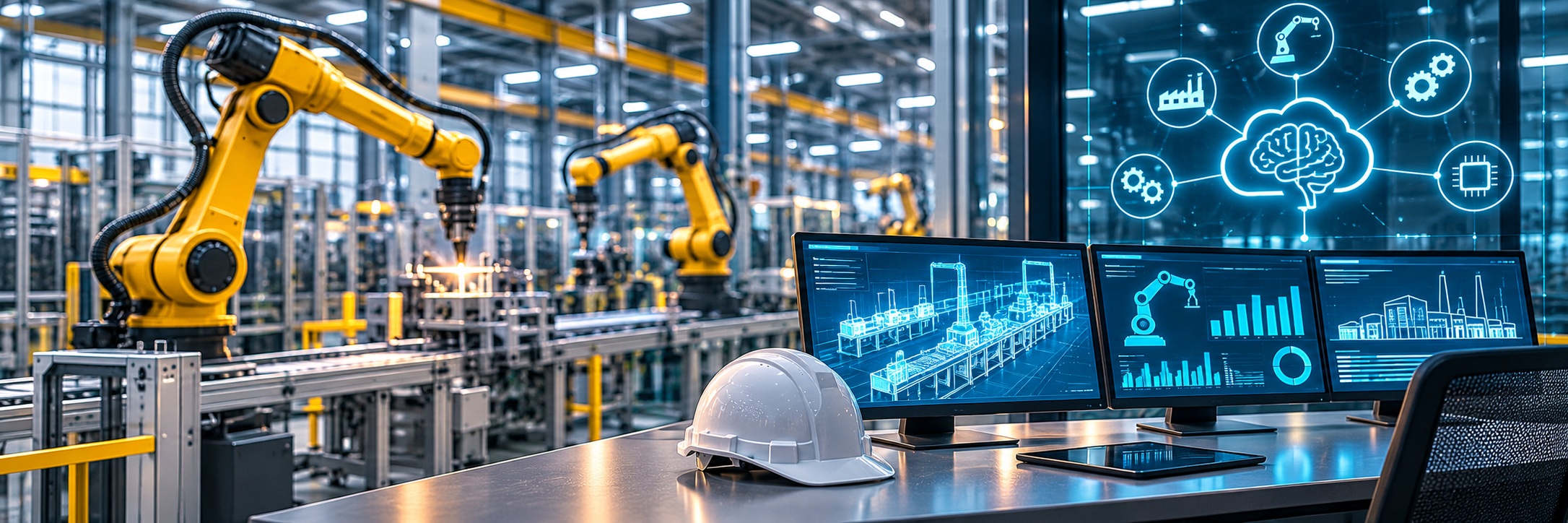
Smart Factory & Industrial AI Executive Search Firm
Identifying exceptional executive talent to lead intelligent manufacturing, industrial automation, and AI-driven factory transformation.

Identifying exceptional executive talent to lead intelligent manufacturing, industrial automation, and AI-driven factory transformation.
Strategic Leadership for Smart Factory & Industrial AI Organizations
Manufacturing is undergoing a fundamental transformation as artificial intelligence, robotics, industrial automation, and connected technologies reshape traditional production environments. Smart factories increasingly rely on integrated digital systems, real-time operational intelligence, predictive analytics, and automated processes to improve productivity, quality, and manufacturing performance.
At JRG Partners, we help smart manufacturing companies, industrial AI providers, robotics businesses, and advanced manufacturing organizations identify senior executives with the technical understanding and strategic leadership required to navigate this transformation.
Our executive search approach considers your organization’s automation strategy, manufacturing environment, technology portfolio, digital infrastructure, and long-term operational objectives.
Whether your organization is implementing AI-powered production systems, expanding robotics capabilities, deploying digital twins, or modernizing existing manufacturing facilities, we help identify executives who can translate technological innovation into measurable business outcomes.
Stay in touch with us
Call us today to discuss your
search assignment parameters.
Manufacturers are increasingly exploring artificial intelligence for production optimization, quality inspection, process monitoring, and operational decision-making. Organizations need executives who understand how to integrate AI capabilities into manufacturing environments while maintaining operational reliability.
Industrial robotics, autonomous systems, collaborative robots, and automated production lines are changing factory operations. Companies require leaders who can develop automation strategies, manage technology implementation, and improve manufacturing productivity.
Digital twins and connected manufacturing platforms allow organizations to monitor production processes, simulate operating conditions, and improve equipment performance. Demand is growing for executives who understand industrial software, data integration, and digital manufacturing architecture.
Manufacturers are increasingly using machine learning, sensor data, and industrial analytics to anticipate equipment failures and reduce unplanned downtime. Leadership candidates must understand how predictive technologies support reliability, maintenance planning, and manufacturing efficiency.
Smart factories depend on the integration of operational technology (OT), information technology (IT), industrial networks, and enterprise systems. Organizations need leaders who can oversee connected infrastructure while addressing cybersecurity, interoperability, and data governance.
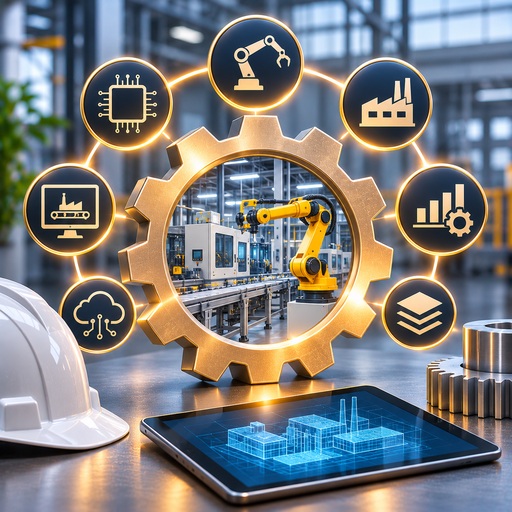
We recognize the complexity of modern manufacturing environments and the technologies driving industrial transformation. Our search approach considers industrial AI, automation, robotics, digital manufacturing, connected production systems, and advanced manufacturing operations.

Our executive search approach focuses on identifying senior professionals with experience across industrial technology, manufacturing automation, artificial intelligence, robotics, engineering, and digital transformation. We consider both technical expertise and the ability to lead complex organizations.

We develop focused candidate searches based on your organization’s technology strategy, manufacturing capabilities, operational environment, and leadership requirements. This allows us to concentrate on executives with experience relevant to your specific business objectives.
Successful smart factory leadership requires the ability to connect technological capabilities with manufacturing outcomes. Our search approach considers strategic thinking, engineering leadership, operational performance, innovation management, and commercial development.
Senior leadership talent across intelligent manufacturing, industrial AI, automation, robotics, and advanced factory technologies.
Industrial Artificial Intelligence: Executives experienced in AI-powered manufacturing, machine learning applications, intelligent production systems, computer vision, and industrial analytics.
Smart Manufacturing & Industry 4.0: Leaders experienced in connected factories, digital manufacturing strategies, industrial IoT, manufacturing execution systems, and intelligent production environments.
Industrial Robotics & Automation: Executives with backgrounds in robotic systems, collaborative robots, autonomous manufacturing, automated production lines, and industrial control technologies.
Digital Twins & Industrial Software: Leaders experienced in digital twin platforms, industrial simulation, manufacturing software, real-time production monitoring, and connected industrial ecosystems.
Predictive Maintenance & Industrial Analytics: Executives familiar with condition monitoring, machine learning-based maintenance, industrial sensors, equipment reliability, and operational intelligence.
Advanced Manufacturing Technologies: Leaders experienced in additive manufacturing, precision production, intelligent machinery, process automation, and next-generation manufacturing systems.
Chief Executive Officer (CEO) / President: Strategic leaders responsible for corporate direction, technology commercialization, business expansion, and organizational growth.
Chief Technology Officer (CTO): Executives overseeing industrial technology strategy, AI development, robotics innovation, software architecture, and engineering capabilities.
Chief Digital Officer (CDO): Leaders responsible for digital transformation, connected factory initiatives, enterprise technology integration, and digital operating models.
Chief Artificial Intelligence Officer (CAIO) / VP of AI: Executives driving industrial AI strategy, machine learning adoption, AI governance, and intelligent automation initiatives.
Chief Operating Officer (COO) / VP of Operations: Leaders managing manufacturing performance, production efficiency, operational scalability, and factory transformation.
VP of Engineering & Automation: Executives overseeing industrial engineering, automation systems, robotics integration, and technical development.
VP of Smart Manufacturing / Digital Manufacturing: Leaders responsible for Industry 4.0 implementation, manufacturing digitization, connected production systems, and intelligent factory operations.
Our research-driven methodology combines targeted executive mapping, industrial technology intelligence, and structured leadership assessment to identify executives capable of leading intelligent manufacturing and digital transformation initiatives.
1. Understand Your Organization
We begin by understanding your business model, manufacturing environment, technology portfolio, automation infrastructure, competitive position, and strategic objectives.
2. Define the Leadership Requirements
We establish the technical, operational, commercial, and strategic capabilities required for the position. This includes evaluating the leadership experience needed across industrial AI, robotics, engineering, digital manufacturing, and factory operations.
3. Map the Executive Market
Our research identifies relevant executives across smart manufacturing, industrial software, robotics, automation, AI technology, advanced engineering, and connected industrial environments.
4. Engage Qualified Executives
We approach relevant executives confidentially and evaluate their professional experience, technology leadership, organizational capabilities, and potential alignment with your requirements.
5. Evaluate Leadership Capabilities
Candidates are assessed against the agreed leadership profile, including technology strategy, innovation management, manufacturing performance, financial accountability, and organizational transformation.
6. Present Qualified Candidates
We present candidates whose professional backgrounds and leadership capabilities align with your requirements, providing relevant experience and assessment insights to support informed decisions.
7. Support the Selection Process
We coordinate with your organization throughout the interview and selection stages, helping maintain alignment between the executive’s capabilities and your long-term business objectives.
Connecting smart manufacturing organizations, industrial AI companies, and automation technology providers with specialized executive talent across major U.S. technology and manufacturing markets.
The smart factory industry spans advanced manufacturing hubs, industrial technology centers, robotics businesses, and digital innovation markets. JRG Partners conducts targeted executive searches based on the geographic scope, technology requirements, organizational structure, and leadership objectives of each assignment.
Whether your organization is expanding industrial AI capabilities, modernizing manufacturing facilities, developing robotics platforms, or implementing connected factory systems, we help identify executives with relevant experience and strategic leadership capabilities.
Supporting organizations in identifying leaders for complex manufacturing technology, automation, and industrial transformation roles.
A publicly traded industrial equipment manufacturer generating $6.5B in annual revenue across 30 global plants had invested more than $80M in smart factory pilots without achieving scalable results. Fragmented data architecture, disconnected OT and IT teams, inconsistent automation standards, and limited integration with operational excellence prevented the company from realizing measurable productivity gains. JRG Partners was engaged to recruit a Chief Digital Manufacturing Officer, VP of Industrial AI & Data Science, VP of Manufacturing Systems & OT-IT Integration, VP of Automation & Robotics Engineering, and VP of Operational Excellence to transform isolated initiatives into a coordinated enterprise-wide program.
JRG Partners assessed 460+ digital manufacturing, industrial AI, and automation executives across North America, prioritizing leaders with proven experience scaling connected plant programs, industrial data platforms, predictive analytics, robotics, and operational improvement across multi-site manufacturing networks. The Chief Digital Manufacturing Officer was placed within 55 days, and the complete five-role leadership team was seated within seven months. The new team established a common industrial data platform and OT security architecture, scaled AI applications across production facilities, standardized automation engineering, and integrated digital initiatives into the operating system.
The manufacturer unified its industrial data platform and OT security architecture across all 30 plants within 15 months. Industrial AI deployments across 24 plants reduced unplanned downtime by 32%, while network OEE improved by 9 points. Standardized automation enabled the deployment of 180 robotic cells in two years and cut project delivery time by 40%. Within two years, the program delivered $140M in annualized productivity savings, turning the company’s smart factory investment into measurable operational and financial results.
A private-equity-backed precision metal components manufacturer generating $720M in annual revenue approved a $210M greenfield smart factory to double production capacity while operating with one-third the labor of its legacy plants. However, the company lacked leaders experienced in highly automated factory design, robotics, industrial AI, OT cybersecurity, and technician-based workforce development. With critical architecture decisions approaching and productivity targets tied to the sponsor’s investment plan, JRG Partners was engaged to recruit a Smart Factory VP & General Manager, VP of Automation & Robotics, VP of Industrial Data & AI, Director of OT Cybersecurity & Industrial Networks, and VP of Workforce Transformation.
JRG Partners assessed 400+ advanced manufacturing, automation, and industrial technology executives across North America, prioritizing candidates with proven greenfield start-up, robotics commissioning, industrial AI deployment, network security, and workforce transformation experience. The Smart Factory VP & General Manager was placed within 50 days, and the complete five-role leadership team was seated within seven months—14 months before production start. The team established the factory design and ramp plan, commissioned automation systems, deployed AI-driven scheduling and quality analytics, secured industrial networks, and partnered with regional colleges to develop a skilled technician workforce.
The new facility commissioned 64 robotic cells and automated material handling on schedule, achieved 98% first-pass yield within six months, and passed aerospace and medical customer security audits before production. The company recruited and certified 220 technicians, enabling the factory to operate at one-third the labor per unit of legacy plants. The facility doubled platform capacity and achieved sponsor productivity targets within 14 months of start-up, ahead of the 18-month investment plan.
A specialty materials manufacturer generating $3.4B in annual revenue across 12 continuous-process plants faced rising energy costs, inconsistent production yields, and costly furnace and kiln outages. Despite extensive process data, advanced process control was limited to two plants, maintenance remained calendar-based, and a previous IT-led digital initiative had stalled. With critical process knowledge at risk from upcoming retirements, JRG Partners was engaged to recruit a Chief Digital & Technology Officer, VP of Process AI & Advanced Process Control, VP of Asset Reliability & Predictive Maintenance, VP of Industrial IoT & Plant Connectivity, and VP of Digital Change & Workforce Enablement.
JRG Partners assessed 420+ process manufacturing, industrial AI, and reliability executives across North America, prioritizing leaders with experience in continuous-process optimization, predictive maintenance, industrial IoT, and workforce transformation. The Chief Digital & Technology Officer was placed within 60 days, and the complete five-role leadership team was seated within eight months. The new team expanded advanced process control and machine learning across all 12 plants, implemented predictive monitoring for critical assets, established a secure common industrial data platform, and introduced operator knowledge-capture and digital guidance programs.
Advanced process control reduced energy intensity by 11% and improved yield by 3.5 percentage points across all 12 plants. Predictive maintenance eliminated unplanned major outages for two consecutive years, while a common secure data platform connected every plant within 14 months. Workforce programs preserved expertise ahead of 200 planned retirements and achieved adoption above 90%. Within two years, the transformation delivered $95M in annualized energy, yield, and reliability savings.
The right leadership team can accelerate industrial innovation, improve manufacturing performance, advance automation capabilities, and help your organization realize the full potential of intelligent factory technologies.
Whether you need a CTO to lead industrial technology innovation, a Chief AI Officer to advance artificial intelligence initiatives, a COO to strengthen manufacturing operations, or a VP of Automation to expand robotics capabilities, JRG Partners can help identify experienced executives aligned with your objectives.
Partner with JRG Partners to discuss your executive hiring requirements and develop a focused search strategy tailored to your technology, manufacturing environment, and long-term business goals.
Build a leadership team ready to shape the future of intelligent manufacturing.
Hiring a CTO for a smart manufacturing organization requires evaluating experience in industrial technology, software development, automation, AI integration, and digital manufacturing systems. Organizations should prioritize candidates who can establish technology roadmaps, oversee engineering teams, evaluate emerging technologies, and connect technical innovation with manufacturing objectives. Experience with Industry 4.0, industrial IoT, robotics, and connected production environments can be particularly valuable.
Industrial AI executives should understand artificial intelligence, machine learning, industrial data analytics, and manufacturing processes. Important qualifications include experience implementing AI-powered production systems, developing predictive models, overseeing industrial data platforms, and translating analytical insights into operational improvements. Strong leadership and technology commercialization capabilities are also important.
Organizations should evaluate CDO candidates on their ability to develop digital manufacturing strategies, integrate enterprise and operational technologies, and lead organizational transformation. Relevant experience may include industrial IoT, manufacturing execution systems, digital twins, cloud infrastructure, and factory automation. Candidates should demonstrate the ability to coordinate technology investments with operational priorities.
A VP of Robotics and Industrial Automation should have experience managing automation engineering, robotics integration, production systems, and industrial technology implementation. Organizations should assess candidates on their ability to deploy automated production lines, manage robotics programs, improve manufacturing workflows, and coordinate multidisciplinary engineering teams.
A strong Chief AI Officer should understand machine learning, computer vision, predictive analytics, industrial data infrastructure, and AI governance. Beyond technical expertise, organizations should evaluate the candidate’s ability to establish AI strategies, manage implementation teams, identify commercially valuable use cases, and scale AI applications across manufacturing operations.
Smart factory transformation requires operational leaders who understand traditional manufacturing as well as modern digital technologies. Recruitment should prioritize experience in production optimization, manufacturing automation, connected factory systems, workforce development, and continuous improvement. Executives must be capable of coordinating technology adoption while maintaining production quality and operational reliability.
Executives leading digital twin and predictive maintenance businesses should understand industrial software, sensor technologies, machine learning, equipment monitoring, and manufacturing analytics. Organizations should evaluate their ability to manage product development, technology integration, engineering teams, and customer adoption across industrial environments.
Q1: What does a smart factory executive search firm do?
A smart factory executive search firm helps manufacturing companies, industrial technology providers, and automation businesses identify experienced senior leaders for specialized executive positions. These searches may cover industrial AI, robotics, automation, digital manufacturing, engineering, technology strategy, and manufacturing operations. The recruitment process considers the organization’s technology environment, business objectives, and leadership requirements.
Q2: What leadership positions are most important for smart manufacturing companies?
Important leadership positions include CEOs, CTOs, Chief Digital Officers, Chief AI Officers, COOs, VPs of Engineering, VPs of Manufacturing, and VPs of Automation. Depending on the organization’s technology portfolio and operating model, leadership requirements may also include digital manufacturing directors, robotics executives, and industrial software leaders.
Q3: Why is specialized executive recruitment important for industrial AI companies?
Industrial AI companies operate at the intersection of artificial intelligence, manufacturing operations, engineering, and industrial technology. Their executives must understand both technical innovation and real-world industrial applications. Specialized executive recruitment helps organizations identify leaders who can oversee AI development, guide technology implementation, manage engineering teams, and support commercial growth.
Q4: What experience should a CTO of a smart manufacturing company have?
A CTO should ideally have experience leading technology strategy, engineering development, industrial software, automation systems, and digital manufacturing initiatives. Familiarity with industrial IoT, robotics, machine learning, cloud platforms, and connected production systems can also be valuable. Strong leadership and the ability to align technology investments with business objectives are equally important.
Q5: What qualifications should a Chief AI Officer have in industrial manufacturing?
A Chief AI Officer should have experience developing AI strategies, overseeing machine learning initiatives, managing data science teams, and implementing AI applications within operational environments. Knowledge of predictive maintenance, computer vision, quality inspection, industrial analytics, and AI governance can be particularly relevant.