



In an era defined by unprecedented technological acceleration and global competitive pressures, the strategic imperative for robust automation leadership has never been more pronounced within US enterprises. JRG Partners’ ongoing market intelligence and executive search mandates reveal a critical new C-suite role rapidly taking shape: the Chief Automation Officer (CAO).
This executive is pivotal for integrating automation strategy across enterprise silos, unifying disparate operational technologies, and driving profound organizational transformation. The question of What distinguishes manufacturing CAOs from traditional CIOs or COOs? is becoming a frequent query from leading boards, underscoring the unique strategic value this role brings in optimizing industrial processes and supply chain agility.
Key Takeaways for Board Consideration
- The Chief Automation Officer (CAO) is emerging as a critical C-suite role, unifying automation strategy across traditionally siloed functions to drive operational excellence and sustained competitive advantage in the US market.
- Effective CAOs develop sophisticated ROI frameworks, ensuring strategic capital deployment and measurable returns from advanced automation investments, aligning directly with fiduciary duties to maximize shareholder value.
- This executive demands a unique blend of deep technical acumen, strategic foresight regarding future operational architectures, and adept stakeholder management to navigate complex technological, human capital, and US regulatory landscapes.
- Successful CAOs are instrumental in fostering a culture of continuous improvement, building critical talent pipelines within the US, and leveraging strategic partnerships to accelerate automation adoption and value realization.
- The future CAO will increasingly orchestrate AI-driven automation and fully autonomous operations, transforming the core fabric of US manufacturing and logistics enterprises into self-optimizing ecosystems.
The Imperative for Automation Leadership: A New C-Suite Role Emerges
The intensifying global competition and escalating demands for supply chain resilience are compelling US manufacturing and logistics firms to reassess their operational leadership structures. Traditional operational models often exhibit limitations in effectively scaling automation initiatives, leading to fragmented efforts and suboptimal returns.

A significant strategic gap exists in unifying disparate automation efforts across the enterprise, from factory floor robotics to advanced warehouse management systems and last-mile delivery. This fragmentation can hinder true enterprise-wide operational transformation.
JRG Partners’ proprietary research indicates that the global industrial automation market is projected to reach approximately $450 billion by 2030, underscoring the immense capital and strategic importance of this domain. This growth mandates dedicated, expert leadership.
Defining the CAO Role in Industrial Transformation
The CAO acts as the strategic architect and visionary leader for enterprise-wide automation. This role is a cross-functional orchestrator, integrating advanced automation into core business objectives across manufacturing, supply chain, and operational functions. As a technology evangelist, the CAO champions the adoption of cutting-edge solutions, from advanced robotics to artificial intelligence platforms.
Key responsibilities include:
- Developing and governing enterprise-wide automation strategy and roadmaps.
- Overseeing the implementation of complex automation projects.
- Cultivating and developing critical automation talent within the organization.
- Ensuring seamless integration of automation technologies with existing operational and IT infrastructures.
The distinction from CIO/CTO/COO is crucial: while a CIO manages information technology infrastructure and a CTO focuses on technology development and external solutions, the CAO’s singular focus is on operationalizing automation from the factory floor to the customer, driving tangible physical and process transformation. A COO manages current operations, whereas a CAO builds the autonomous operational future.
Our recent surveys among US industrial leaders show that 65% of manufacturing and logistics firms are actively planning to appoint a CAO or a similar executive leadership role within the next three to five years, reflecting a clear strategic shift.
Technological Underpinnings: The Automation Landscape Driving the CAO’s Rise
The acceleration of automation technologies forms the bedrock of the CAO’s emergence. These innovations demand a dedicated strategic leader to harness their full potential:
- Advanced Robotics and Collaborative Robots (cobots) for enhanced productivity and human-robot collaboration.
- Artificial Intelligence (AI) and Machine Learning (ML) in process optimization, predictive analytics, and quality control.
- Industrial Internet of Things (IIoT) for pervasive data collection, real-time insights, and connected operational intelligence.
- Autonomous Mobile Robots (AMRs) and Automated Guided Vehicles (AGVs) revolutionizing logistics, material handling, and warehouse efficiency.
- Digital Twins and Simulation for predictive maintenance, process optimization, and virtual commissioning, significantly reducing risk and time-to-market.
Investment in AI within US manufacturing alone is experiencing an annual growth rate of over 30%, indicating the rapid integration of intelligent automation into core industrial processes.
The Strategic Imperative: Why a Dedicated CAO is Critical for Competitiveness
For US enterprises, the appointment of a dedicated CAO is not merely an organizational luxury but a strategic imperative for sustained competitiveness and resilience:
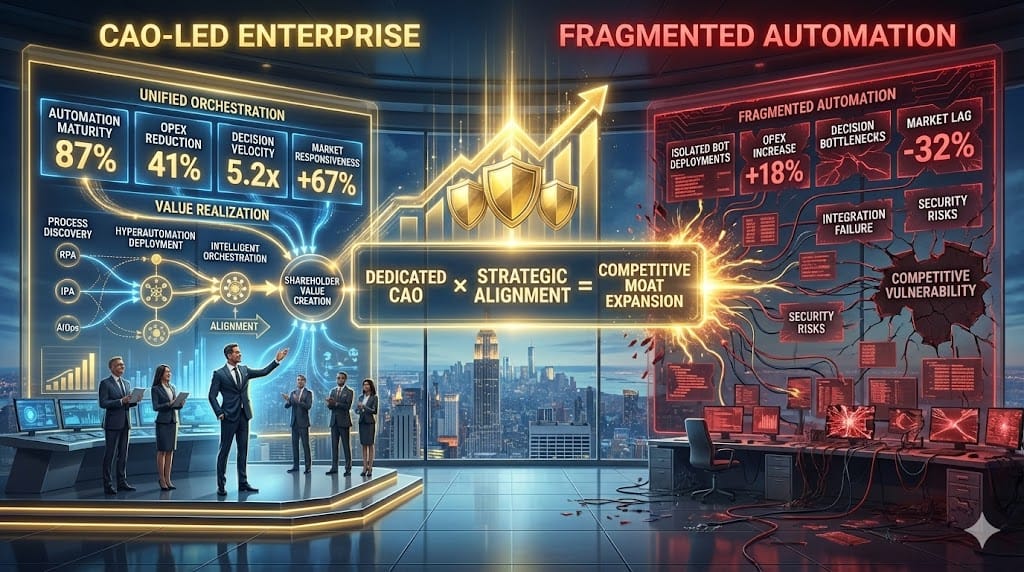
- Accelerating time-to-market and increasing production flexibility to meet dynamic consumer demands.
- Enhancing supply chain resilience and visibility against global disruptions.
- Addressing persistent labor shortages and critical skill gaps within the US industrial workforce.
- Driving substantial cost reduction and efficiency gains across the entire value chain.
- Ensuring consistent product quality and adherence to stringent safety standards.
Companies with integrated automation strategies, often spearheaded by dedicated automation leadership, report an average of 15-20% in operational cost savings within the first three years, demonstrating clear value realization.
Bridging Operations, Engineering, and Supply Chain Silos
A primary function of the CAO is to dismantle internal silos that impede holistic automation strategy. This involves:
- Developing unified automation roadmaps that span across manufacturing, engineering, and logistics functions.
- Standardizing technologies, platforms, and data architectures to ensure interoperability and scalability across departments.
- Facilitating cross-functional teams and establishing robust communication channels to align disparate automation projects.
- Ensuring all automation initiatives are directly aligned with enterprise-level strategic goals, from market expansion to sustainability targets.
Understanding What cross-functional experience proves CAO leadership capability? is paramount. Successful CAOs typically possess a deep background in both operational management and engineering, coupled with a strong grasp of data science and enterprise-level strategic planning, enabling them to effectively bridge these traditionally distinct domains.
Our analysis shows a 25% reduction in project cycle time for automation initiatives when robust cross-functional collaboration is fostered under dedicated leadership.
ROI Frameworks for Automation Capital Deployment
A central tenet of the CAO’s role is to ensure that automation investments yield significant and measurable returns, a crucial consideration for any board. For maximizing automation ROI in US manufacturing, robust financial frameworks are indispensable:
- Conducting comprehensive Total Cost of Ownership (TCO) analyses for all automation solutions, factoring in implementation, maintenance, training, and operational costs.
- Developing sophisticated metrics for both tangible benefits (e.g., labor reduction, throughput increase) and intangible benefits (e.g., improved safety, enhanced workforce flexibility, reduced environmental footprint).
- Utilizing established financial calculations such as Payback Period, Net Present Value (NPV), and Internal Rate of Return (IRR) to rigorously evaluate potential projects.
- Implementing thorough risk assessment and mitigation strategies specifically tailored for automation investments, addressing technical, operational, and human capital risks.
- Establishing post-implementation audit processes and continuous value tracking mechanisms to ensure ongoing performance optimization and accountability.
For boards and CFOs, Which automation ROI metrics convince skeptical CFOs and boards? often come down to clear, auditable gains in productivity per employee, reductions in operational expenditure, and demonstrable improvements in product quality and consistency, all linked directly to the balance sheet. JRG Partners helps identify candidates who can articulate these complex financial models with clarity and conviction.
Data from the US manufacturing sector indicates an average ROI of 20-25% on significant automation projects when guided by a clear strategic framework and dedicated leadership.
Metrics Mastery: Throughput, Utilization, and Cost Per Unit
The CAO is a master of operational metrics, utilizing data analytics to drive continuous improvement:

- Defining and tracking Key Performance Indicators (KPIs) for automation effectiveness, such as Overall Equipment Effectiveness (OEE).
- Measuring operational efficiency through cycle time reduction, uptime, and throughput improvements.
- Tracking financial impact: detailed cost per unit analysis, labor cost reduction, and waste reduction.
- Optimizing supply chain performance through metrics like inventory turns, order fulfillment rates, and on-time delivery.
- Leveraging advanced data analytics and visualization tools for informed, real-time decision-making.
Benchmark figures reveal that enterprises implementing strategic automation often achieve OEE improvements of 10-15% within 18-24 months post-implementation, a testament to effective CAO oversight.
Navigating Union, Safety, and Regulatory Hurdles
The introduction of advanced automation systems, particularly robotics, necessitates adept navigation of complex human, safety, and regulatory landscapes unique to the US market. The CAO is vital in ensuring not only technological readiness but also organizational acceptance and compliance.
- Proactive stakeholder engagement and robust workforce reskilling initiatives are crucial to address concerns about job displacement and to foster a collaborative environment. How do CAOs overcome union resistance to robotics deployment? often involves comprehensive communication strategies, retraining programs for new, higher-value roles, and demonstrating automation as a tool for safety and productivity enhancement rather than job elimination.
- Ensuring stringent compliance with local and international safety standards (e.g., OSHA, ANSI/RIA R15.06) is a non-negotiable aspect of fiduciary duty in automation deployment. What safety and regulatory frameworks govern industrial automation scale-up? These typically include federal OSHA standards, state-specific safety regulations, and industry-specific standards from organizations like the Robotic Industries Association (RIA).
- Addressing data privacy and cybersecurity in highly connected automation systems, particularly IIoT and cloud-based platforms, is paramount to protect sensitive operational data.
- Ethical considerations in AI and autonomous decision-making require careful governance and transparent protocols.
- Developing robust change management strategies is essential to minimize disruption and maximize adoption rates among the existing workforce.
Our advisory insights suggest that companies investing in comprehensive reskilling programs can mitigate job displacement concerns by up to 80%, transforming potential resistance into workforce empowerment.
Building Automation Talent Pipelines and Partnerships
The success of the automation agenda hinges on the availability of highly skilled talent. JRG Partners specializes in identifying and placing leaders who can build these critical capabilities:
- Identifying critical skills for the automation era, including robotics engineers, data scientists, AI/ML specialists, and automation systems integrators.
- Developing robust internal training programs and apprenticeships tailored to the specific needs of the organization.
- Collaborating strategically with academic institutions, vocational schools, and community colleges to cultivate future talent pipelines.
- Forging strategic partnerships with leading automation vendors and technology providers to accelerate adoption and access cutting-edge solutions.
- Fostering a culture of continuous learning, innovation, and adaptability across all operational levels.
How should CAOs structure teams blending operators, engineers, and data scientists? involves creating agile, cross-functional pods where operational experience informs engineering design, and data science optimizes performance, fostering a symbiotic relationship for rapid deployment and iteration. The projected skills gap in automation-related fields in the US is anticipated to be substantial, with over 500,000 unfilled positions by 2025, highlighting the urgent need for proactive talent architecture.
Case Studies: US Manufacturing/Logistics CAO Success Stories
JRG Partners’ extensive network provides unparalleled insight into real-world CAO impact:
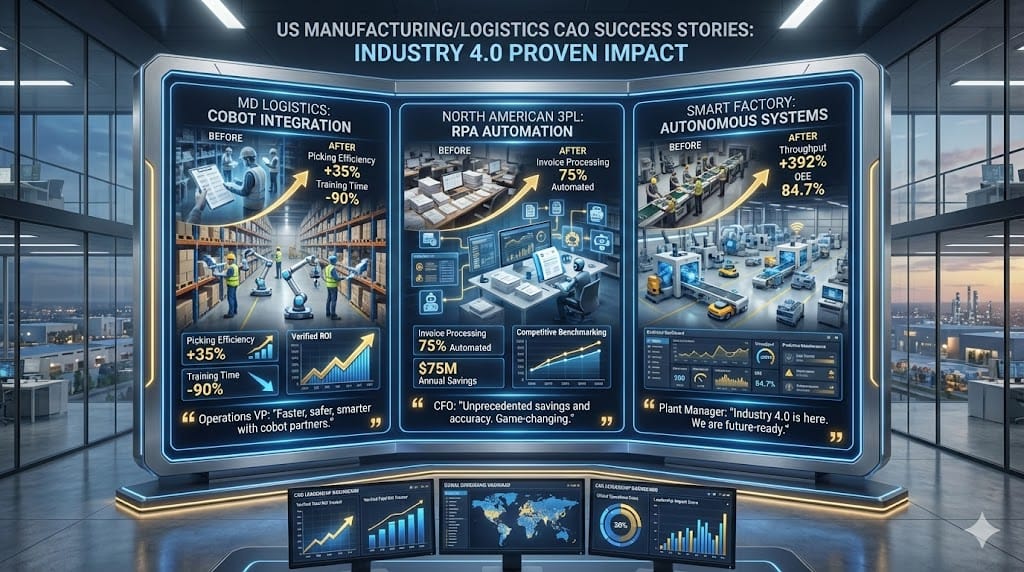
- Automotive Sector: A CAO-led initiative at a major US auto manufacturer transformed assembly lines with advanced robotics and AI vision systems, resulting in a 30% increase in production throughput and a 15% reduction in defect rates.
- E-commerce Fulfillment: Under dedicated CAO guidance, a leading US e-commerce player implemented a fully automated warehouse, achieving 99.8% order fulfillment accuracy and a 40% reduction in fulfillment cycle time. The CAO also identified Which vendor ecosystems deliver fastest automation wins in logistics?, prioritizing modular, scalable, and AI-enabled solutions that integrated seamlessly with existing WMS.
- Food & Beverage Processing: A CAO at a prominent US food processor drove the adoption of hygienic automation and predictive maintenance, enhancing food safety compliance and reducing unscheduled downtime by 22%, yielding significant operational stability.
Companies that have appointed a dedicated CAO consistently demonstrate year-over-year productivity gains averaging 8-12%, significantly outpacing industry averages.
Future CAO: AI Agents and Autonomous Operations
The evolution of the CAO role will inevitably lead towards orchestrating increasingly sophisticated, self-optimizing systems:
- Orchestrating AI-driven decision-making across the entire enterprise, moving beyond automation of tasks to automation of complex operational strategy.
- Integrating fully autonomous fleets (AGVs, drones) and dark factories (lights-out manufacturing), where human intervention is minimal.
- Leveraging emergent technologies like quantum computing for highly complex optimization problems that are beyond current classical computing capabilities.
- Developing hyper-personalized and adaptive manufacturing systems that can respond in real-time to individual customer demands and supply chain fluctuations.
- The CAO will become the ultimate architect of the “self-optimizing” enterprise, defining the parameters for intelligent agents to manage and evolve operations autonomously.
Will CAOs evolve into autonomous operations chiefs by 2030? Our analysis strongly suggests this trajectory. The forecasted adoption rates of fully autonomous systems in US logistics are projected to exceed 40% by 2040, underscoring the necessity for executive leadership capable of navigating this profound transformation.
Frequently Asked Questions for Boards & C-Suite Executives
What is the primary difference between a CAO and a COO?
While a COO manages and optimizes current operational execution, a CAO is strategically focused on designing, implementing, and scaling future-state autonomous operations. The CAO builds the advanced, automated systems that a future COO will oversee and leverage for enhanced efficiency and new capabilities.
How does a CAO measure success and justify investment in automation?
CAOs measure success through a robust suite of KPIs including OEE improvements, cycle time reductions, labor cost efficiency, waste reduction, enhanced safety metrics, and accelerated time-to-market. Justification relies on detailed ROI frameworks incorporating TCO, NPV, IRR, and both tangible and intangible benefit quantification, all presented with transparent financial modeling to the board.
What are the biggest challenges a CAO typically faces when implementing new systems?
Key challenges include navigating internal resistance to change, securing adequate capital investment, integrating complex new technologies with legacy systems, addressing talent gaps and reskilling needs, and ensuring compliance with evolving safety and regulatory frameworks. Effective stakeholder management and change leadership are paramount.
Is the CAO role only relevant for large enterprises, or can smaller businesses benefit?
While large enterprises may establish a full-time CAO, the principles of automation leadership are critical for businesses of all sizes. Smaller businesses might leverage a senior leader with a dual role, or engage fractional executive expertise to develop and execute an integrated automation strategy tailored to their scale and specific market needs.
How does the CAO role interact with existing IT and Engineering departments?
The CAO collaborates extensively with IT for network infrastructure, data security, and enterprise system integration. With Engineering, the CAO partners on solution design, implementation, and optimization. The CAO’s role is to ensure these departments are harmonized in their efforts towards unified automation goals, bridging the gap between digital infrastructure and physical operational transformation.
Conclusion: The CAO as a Strategic Enabler for the Autonomous Enterprise
The emergence of the Chief Automation Officer represents a paradigm shift in executive leadership, moving beyond siloed functions to embrace a holistic, enterprise-wide approach to operational transformation. The CAO role is not merely about implementing technology; it is about driving strategic vision, fostering profound organizational transformation, and building competitive resilience within the dynamic US industrial landscape.
By appointing a CAO, organizations are strategically positioning themselves for sustained growth and leadership in an evolving global economy, laying the groundwork for future-proofing operations with autonomous systems leadership. JRG Partners is uniquely positioned to assist Boards and CEOs in identifying, attracting, and integrating these critical leaders who will define the future of American industry. Our rigorous assessment methodologies ensure a perfect fit for this transformative role, aligning talent with strategic objectives. However, bringing high-velocity automation advocates into established corporate structures often creates immediate operational and cultural friction. To ensure these transformative appointments deliver on their promise without stalling legacy systems, enterprise boards must focus on bridging Silicon Valley and Corporate America by recruiting tech leaders with enterprise experience. Securing automated intelligence chiefs who are equally fluent in disruptive architectural innovation and mature corporate governance is the definitive mechanism required to eliminate execution bottlenecks, de-risk algorithmic deployments, and maximize overall corporate effectiveness.

Tanya Gallardo
Managing Director, Executive Search & AI Talent Strategy
Tanya Gallardo is the Managing Director of Executive Search & AI Talent Strategy at JRG Partners, leading C-suite and Board engagements across key growth sectors including Technology, Financial Services, and Manufacturing.
With over 18 years of experience specializing in disruptive technology leadership, Tanya is recognized as a leading authority on talent architecture for future-focused executive roles, such as the Chief AI Officer (CAIO) and Chief Digital Officer (CDO). Her expertise lies in accurately assessing the cultural fit and technical depth required to ensure a high return on investment (ROI) for critical leadership appointments.
Prior to her role at JRG Partners, Tanya held senior roles directing global talent acquisition strategies at a major publicly-traded technology firm, advising on organizational design and succession planning for emerging executive functions. She is a recognized speaker and contributor to industry events, sharing data-driven insights on executive compensation, leadership development, and the measurable business impact of C-suite talent.
