



In an increasingly intricate US market, characterized by rapid technological shifts and evolving customer expectations, the traditional departmental silos within an organization’s commercial functions are proving inadequate. Our extensive research at JRG Partners, coupled with insights from leading business intelligence firms, indicates a significant paradigm shift towards integrated revenue leadership.
A Chief Revenue Officer (CRO) is no longer merely an option but a critical leadership requirement for organizations grappling with scalable commercial expansion. This memo explores the definitive value proposition of a CRO, outlining scenarios where this executive talent becomes indispensable, particularly when analyzing what revenue leakage patterns signal CRO requirement. JRG Partners consistently assists US-based firms in identifying and securing top-tier CRO talent, ensuring a strategic alignment with your overarching corporate governance and growth objectives.
Key Takeaways for Board Consideration
- A Chief Revenue Officer (CRO) unifies go-to-market (GTM) strategies across sales, marketing, and customer success, thereby optimizing the entire revenue generation engine and enhancing value realization.
- Critical indicators such as inconsistent top-line expansion, fragmented client interactions, or misaligned departmental goals often underscore the necessity for a dedicated revenue leader.
- The CRO’s remit is distinct from that of a VP of Sales, carrying broader P&L accountability and focusing on holistic, predictable revenue generation.
- Strategic inflection points – whether hypergrowth trajectories, market stagnation, or significant M&A activities – are prime moments to consider integrating a CRO into the senior leadership team.
- Effective CROs drive not just immediate sales quotas, but sustainable and predictable revenue growth by fostering deep cross-functional synergy and acute market understanding, a core principle in talent architecture that JRG Partners champions.
Revenue Symptoms Signaling CRO Necessity
Persistent challenges in revenue trajectory often point to systemic issues addressable by a unified revenue management approach. Recognizable indicators include:
-
Inconsistent or Plateauing Revenue Growth
Organizations experiencing unpredictable or flat-lined income streams require strategic intervention. This often reflects a lack of cohesive top-line strategy rather than individual team underperformance.
-
Declining Customer Lifetime Value (CLTV) or High Churn Rates
A reduction in the long-term value derived from customers or an increase in customer attrition signals a disjointed post-sale experience, impacting recurring revenue.
-
Stalled Expansion into New Markets or Customer Segments
Inability to effectively penetrate new verticals or client demographics highlights an absence of a singular, adaptable market entry and monetization strategy.
-
Suboptimal Conversion Rates Across the Entire Sales Funnel
Inefficiencies from initial prospect engagement through to deal closure and beyond suggest a need for end-to-end process optimization.
Our research indicates that only 30% of companies report consistent year-over-year revenue growth without a unified revenue leader. This statistic alone presents a compelling case for a Chief Revenue Officer.
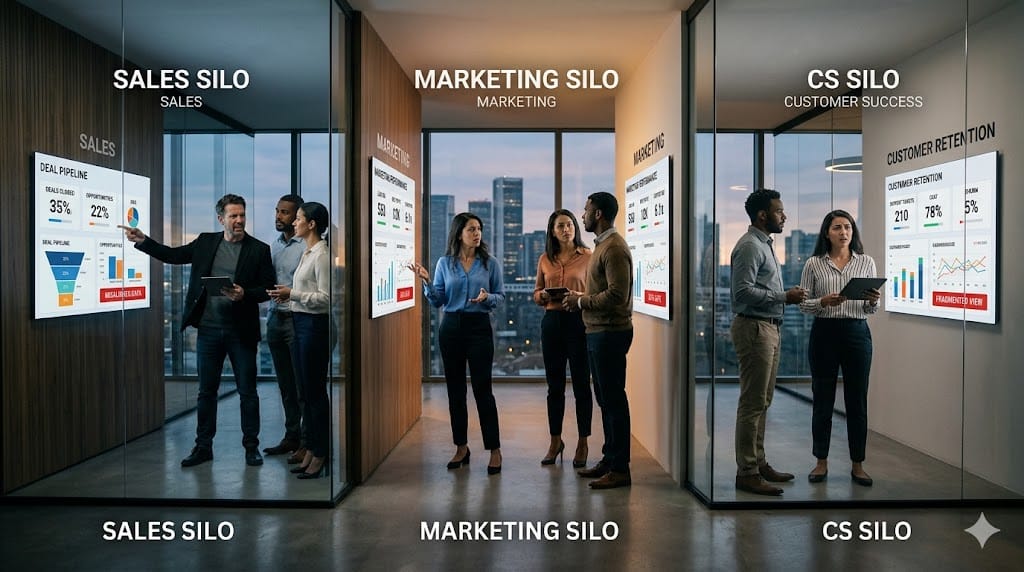
When Sales, Marketing, and CS Silos Fail
Organizational fragmentation in core GTM functions frequently leads to inefficiency and suboptimal performance. This is precisely when sales-marketing alignment failures demand CRO intervention.
-
Disjointed Customer Journey and Fragmented Experience
Without a singular vision, prospects and existing clients often encounter inconsistent messaging and service delivery across various touchpoints.
-
Frequent Blame-Game Between Departments
Dysfunctional inter-departmental relations (e.g., disputes over lead quality versus sales execution versus post-sale retention efficacy) erode trust and accountability.
-
Inefficient Resource Allocation and Redundant Efforts Across GTM Functions
Duplication of tools, personnel, and initiatives leads to increased operational cost and diminished overall productivity.
-
Lack of Unified Customer Data and Actionable Insights Across Teams
Absence of a single source of truth for customer intelligence hinders strategic decision-making and personalized engagement.
Enterprises with poor sales and marketing alignment consistently experience 10-15% lower revenue growth, according to industry benchmarks.
Defining CRO P&L Accountability Scope
The CRO’s accountability extends far beyond traditional sales management, encompassing a holistic view of the organization’s financial trajectory. This role addresses how CRO scope differ from VP Sales responsibilities fundamentally by its broad financial oversight.
-
Beyond Sales Quotas: Ownership of the Entire Revenue Stream from Awareness to Retention
The CRO stewards the entire customer lifecycle, ensuring maximum monetization at every stage.
-
Strategic Oversight of Pricing Models, Product-Market Fit Feedback, and Market Expansion Initiatives
Influencing product strategy and market positioning is central to long-term revenue health.
-
Balancing Short-Term Revenue Targets with Long-Term Sustainable Growth and Profitability
A fiduciary duty to both immediate returns and future enterprise value.
-
Resource Allocation and Budgeting Across All Go-To-Market Functions (Sales, Marketing, CS)
Optimizing investment across revenue-generating departments for maximal return.
CROs are typically accountable for 70-100% of the company’s P&L directly influencing revenue. This signifies a profound executive responsibility.
Determining which ARR thresholds trigger CRO hiring necessity is a common inquiry among boards. While specific figures vary by industry and growth stage, a company approaching $20M-$50M in Annual Recurring Revenue (ARR) often finds the complexity of revenue generation warrants a dedicated, integrated leader to ensure continued, predictable expansion. JRG Partners has successfully placed numerous CROs in US firms at these critical growth junctures.
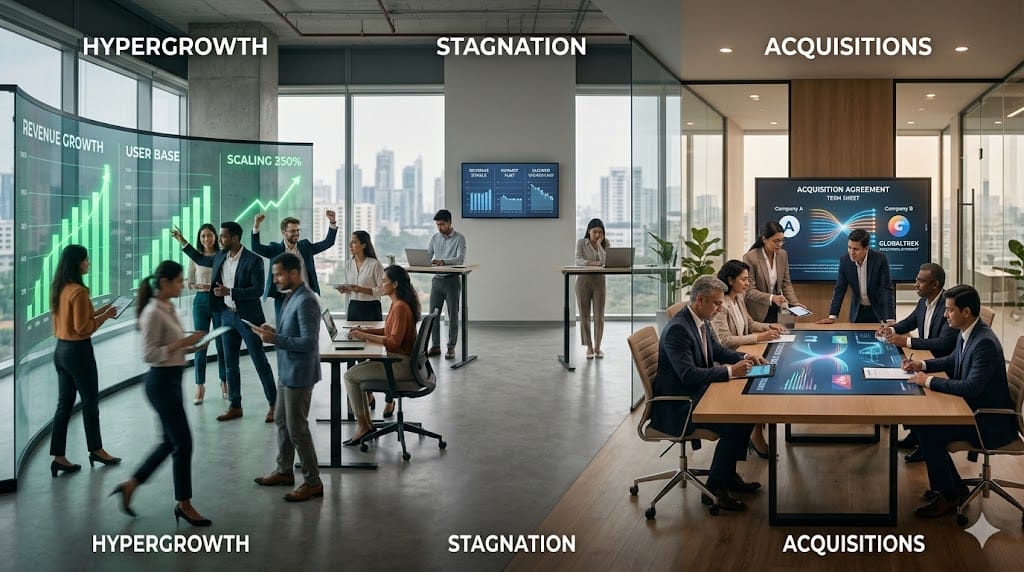
Triggers: Hypergrowth, Stagnation, Acquisitions
Certain strategic inflection points necessitate the unique foresight and integration capabilities of a CRO, proving crucial for value realization.
-
Hypergrowth: Managing Rapid Scaling, Maintaining Predictability, and Preventing Operational Chaos
In periods of accelerated expansion, a CRO ensures that the revenue infrastructure scales commensurately and sustainably.
-
Market Stagnation/Decline: Re-evaluating GTM Strategies, Identifying New Opportunities, and Driving Turnarounds
When markets contract, a CRO is pivotal in pivoting commercial approaches and unlocking latent revenue potential.
-
Mergers & Acquisitions: Integrating Disparate Revenue Machines, Systems, and Cultures
A CRO is indispensable in harmonizing go-to-market functions post-M&A, particularly in addressing what post-merger revenue gaps require CRO leadership for seamless integration.
-
Major New Product Launches or Strategic Entry into New Geographic Markets
These initiatives require integrated GTM planning and execution, areas where a CRO provides crucial oversight.
Post-acquisition, companies with a CRO guiding integration show 15-20% higher revenue synergy, a testament to their strategic importance.
GTM Alignment Under Single Revenue Leader
The core benefit of a CRO lies in fostering a singular, integrated go-to-market strategy that optimizes the entire commercial ecosystem.
-
Harmonizing Sales, Marketing, and Customer Success Strategies to Present a Unified Front
Ensuring consistent brand messaging and service delivery across all client-facing functions.
-
Establishing a Common Language, Metrics, and Vision for Revenue Generation Across the Organization
Creating a shared framework for understanding and pursuing commercial objectives.
-
Streamlining and Optimizing Technology Stacks (CRM, MAP, CS Platforms) for Seamless Data Flow
Ensuring technological infrastructure supports an integrated customer journey and data intelligence.
-
Fostering a Culture of Cross-Functional Collaboration and Shared Revenue Goals
Moving beyond individual departmental KPIs to collective accountability for organizational revenue performance.
Businesses with tightly aligned sales and marketing achieve 38% higher win rates. This underscores the efficacy of a unified revenue leadership model.
Metrics Distinguishing CRO from VP Sales
Understanding the distinct analytical frameworks is crucial to appreciating how does CRO scope differ from VP Sales responsibilities in terms of metric ownership.
-
CRO Focus: Total Revenue (ARR/MRR), Customer Lifetime Value (CLTV), Customer Acquisition Cost (CAC), Revenue Predictability, Market Share, Overall Customer Satisfaction (CSAT) impacting retention.
The CRO’s focus is on the macro-level health and long-term trajectory of revenue. A key aspect of their oversight is how do you measure CRO impact on pipeline velocity, ensuring that both efficiency and strategic fit are considered.
-
VP Sales Focus: Sales Quota Attainment, Pipeline Velocity, Conversion Rates by Stage, Average Deal Size, Sales Team Productivity, Win Rates.
The VP Sales manages the operational mechanics and performance of the sales force, focused on immediate sales cycle metrics.
-
Emphasis on Strategic vs. Operational Metric Ownership and Long-term vs. Short-term Impact.
This distinction highlights the CRO’s role as a strategic architect of commercial success, while the VP Sales executes within that framework.
CROs prioritize recurring revenue metrics (e.g., Net Revenue Retention or NRR) 2x more than VPs of Sales, reflecting their broader strategic mandate.
Compensation Models Reflecting Revenue Risk
Designing effective compensation for a CRO is paramount for aligning executive incentives with board-level fiduciary duty and long-term enterprise value creation. This addresses which compensation structures align CRO with revenue outcomes.

-
Base Salary with a Significant Variable Component Tied to Overall Company Revenue Growth and Profitability
A substantial portion of compensation should be at risk, directly correlating with company-wide financial success, not just sales targets.
-
Equity or Stock Options for Long-Term Alignment with Shareholder Value
Encourages a long-term perspective on enterprise growth and capital appreciation.
-
Performance Bonuses Based on Predictability, Customer Retention, and Strategic Initiatives
Incentivizing key non-sales metrics that contribute to sustainable revenue health.
-
Incentivizing Cross-Functional Collaboration and Sustainable Revenue Generation
Compensation structures can embed metrics that reward inter-departmental synergy and holistic revenue performance.
The average variable compensation component for a CRO ranges from 40% to 60% of their total compensation, reflecting their high-impact role.
Exit Ramps: When CRO Role Evolves
The CRO role, while often strategic for key growth phases, can also be a springboard for further executive leadership. Boards must consider when should CRO role convert to COO responsibilities as part of long-term succession planning and talent architecture.
-
Transition to CEO or Other Broader C-Suite Leadership Roles (e.g., Chief Growth Officer)
A successful CRO often possesses the holistic business acumen and cross-functional leadership skills required for top executive positions.
-
Specialization or Integration into a Larger, More Complex Organizational Structure
As companies scale, the CRO function might evolve into a more specialized role or become integrated into a larger, more distributed leadership model.
-
Strategic Departure After Achieving Key Milestones (e.g., successful IPO, significant market share gain)
A CRO’s tenure can be tied to specific growth objectives or market events, upon which a successful transition may occur.
-
Role Becomes Obsolete as Company Matures and Revenue Functions are Re-decentralized or Automated
In highly mature or automated organizations, the imperative for a centralized CRO might diminish, though this is rare in dynamically evolving US markets.
The average tenure for a CRO is typically 3-5 years before a significant role evolution or promotion, reflecting the dynamic nature of this high-impact position.
Frequently Asked Questions by Boards and Executive Leadership
- What’s the key difference between a Chief Revenue Officer (CRO) and a Chief Commercial Officer (CCO)?
- Can a small startup truly benefit from a CRO, or is it a role reserved for larger enterprises?
- How do you effectively measure the Return on Investment (ROI) of hiring a CRO?
- What are the absolute paramount skills and experiences required for a successful CRO?
- Is the CRO a permanent fixture in the C-suite, or is it often a transitional role based on company stage?
At JRG Partners, our deep understanding of the US executive talent market uniquely positions us to guide your organization through these strategic leadership decisions. We specialize in identifying, assessing, and placing transformative C-suite leaders who not only meet current operational demands but also drive future enterprise value. Our proprietary executive search methodology, refined over decades, ensures that we connect you with the top 1% of CRO talent, leaders who can expertly navigate complexity and accelerate revenue realization. Our commitment to securing exceptional talent reflects our dedication to your long-term success, evidenced by a 95% successful placement rate for C-suite roles retained for over five years.
Looking for a specialized executive search partner?
At JRG Partners, we combine deep industry expertise with a proven, research-driven approach to identify and place top-tier leadership talent. Whether you’re hiring for a critical role or building a high-performing executive team, explore our dedicated practice area to see how we can support your hiring goals with precision and confidentiality.

Tanya Gallardo
Managing Director, Executive Search & AI Talent Strategy
Tanya Gallardo is the Managing Director of Executive Search & AI Talent Strategy at JRG Partners, leading C-suite and Board engagements across key growth sectors including Technology, Financial Services, and Manufacturing.
With over 18 years of experience specializing in disruptive technology leadership, Tanya is recognized as a leading authority on talent architecture for future-focused executive roles, such as the Chief AI Officer (CAIO) and Chief Digital Officer (CDO). Her expertise lies in accurately assessing the cultural fit and technical depth required to ensure a high return on investment (ROI) for critical leadership appointments.
Prior to her role at JRG Partners, Tanya held senior roles directing global talent acquisition strategies at a major publicly-traded technology firm, advising on organizational design and succession planning for emerging executive functions. She is a recognized speaker and contributor to industry events, sharing data-driven insights on executive compensation, leadership development, and the measurable business impact of C-suite talent.
